
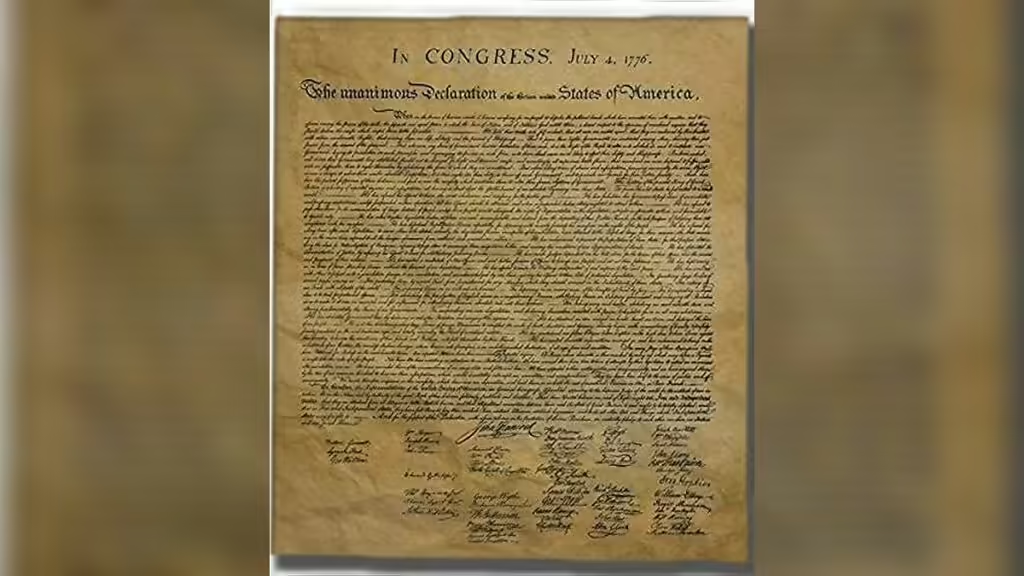
A volunteer working at Britain’s National Archives has uncovered a rare original printing of the United States Declaration of Independence while cataloguing 18th-century naval correspondence, a discovery historians are describing as an extraordinary addition to the historical record of the American Revolution.
The document, found among papers seized from an American vessel during the Revolutionary War, is believed to be the only known example of its kind held outside the United States.
Routine Cataloguing Leads to Unexpected Find
Michael Scurr, a retired insurance executive who has volunteered at the National Archives for more than a decade, made the discovery while reviewing correspondence belonging to an officer of the Royal Navy.
The document was enclosed with a report detailing the capture of the American privateer Dalton on Christmas Eve in 1776. Initially identified only as “another paper,” the folded document immediately caught Scurr’s attention when he noticed the word “Declaration” printed across its heading.
What first appeared to be another routine archival document quickly proved to be a significant historical artifact.
One of Only 11 Known Exeter Printings
Researchers at the National Archives later confirmed that the document is an original copy of the rare Exeter printing of the Declaration of Independence.
Printed in Exeter, New Hampshire, between July 16 and July 19, 1776—just days after the Declaration was formally adopted—the copies were produced to rapidly distribute news that the 13 American colonies had declared independence from Britain.
Only 11 surviving examples of the Exeter printing are currently known, making the newly identified document the first confirmed copy located outside the United States.
The discovery was announced ahead of celebrations marking the 250th anniversary of American independence.
Discovery Highlights America’s Naval War Effort
Historians say the document’s significance extends beyond its rarity because of where it was found.
Amanda Bevan, who oversees the National Archives’ project cataloguing Royal Navy correspondence from the American Revolutionary period, noted that the Declaration was recovered aboard the Dalton, a privately owned armed vessel operating under authorization from the Continental Congress.




The ship carried orders signed by Continental Congress President John Hancock, linking the document directly to the revolutionary government‘s wartime operations.
According to Bevan, the discovery sheds light on the often-overlooked role of American privateers, who supplemented the fledgling Continental Navy by disrupting British commerce and engaging Royal Navy ships.
Declaration May Have Inspired Sailors at Sea
Researchers believe the Declaration likely served a practical purpose during the voyage.
Naval commanders traditionally read official orders aloud to their crews, and historians suggest the captain of the Dalton may also have publicly read the Declaration to explain the broader purpose of their mission.
Rather than fighting solely over political grievances, the crew would have understood they were defending the newly declared ideals of liberty and independence.
Finding the document aboard a wartime vessel offers a rare glimpse into how the Declaration may have motivated American sailors engaged in combat far from home.
Capture of the Dalton Preserved the Historic Document
The Dalton, an 18-gun privateer, was captured by the British warship HMS Raisonnable after a lengthy pursuit off the Portuguese coast on Christmas Eve in 1776.
Commanded by Captain Thomas Fitzherbert, the larger British vessel eventually overtook the American ship, leading to the capture of its approximately 120 crew members.
The prisoners were transported to Plymouth, England, where they endured harsh conditions while awaiting exchange.
Among them was Charles Hebert, then 19 years old, whose journals later documented hunger, disease and punishment during more than two years in captivity before he was eventually released.
The seized Declaration remained preserved within British naval records for nearly 250 years before its recent rediscovery.
American Historians Welcome the Discovery
Experts in the United States have welcomed the finding as an important addition to Revolutionary War scholarship.
Matthew Skic, director of collections and exhibitions at the Museum of the American Revolution in Philadelphia, described the document as more than a rare printed text.
He said it represents a tangible connection to the individuals who carried the Declaration across the Atlantic during the earliest days of American independence and provides fresh insight into how news of the Revolution spread during wartime.
New Discovery Shows History Still Holds Surprises
The discovery also serves as a reminder that significant historical artifacts continue to emerge despite centuries of research into the American Revolution.
As institutions continue digitising and cataloguing vast archival collections, historians believe additional documents capable of reshaping understanding of the nation’s founding period may still be waiting to be uncovered.
For Britain’s National Archives, a volunteer’s careful attention to detail has revealed one of the most remarkable Revolutionary War discoveries made in recent years, offering scholars on both sides of the Atlantic a rare glimpse into the earliest days of American independence.

