
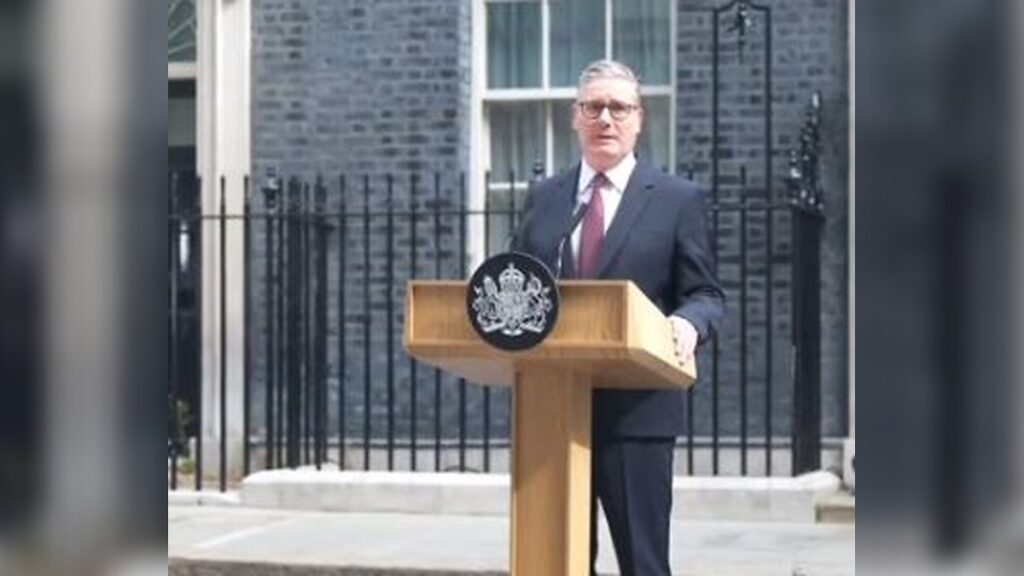
Sir Keir Starmer has revealed that he will step down as Prime Minister after concluding that he no longer has sufficient support among Labour MPs to lead the party into the next general election.
Speaking outside Downing Street, Starmer said a new Labour leader would be selected before Parliament reconvenes in September. He confirmed that he would remain in office during the transition period to ensure an orderly transfer of power.
Emotional Farewell Outside No. 10
In a speech marked by emotion, the outgoing Prime Minister reflected on his years in government and thanked his family for their support throughout his political career.
Starmer paid tribute to his wife, Victoria, and their children, acknowledging the personal sacrifices that come with holding the country’s highest political office. Observers noted visible emotion from family members as the announcement unfolded outside Downing Street.
Outgoing Leader Defends His Legacy
Despite announcing his resignation, Starmer used his speech to defend his record in office.
He argued that he had rebuilt Labour from a difficult period and restored credibility on key issues including economic management, national security, and defence. He maintained that his leadership had helped transform the party and return it to government after years in opposition.
Labour Figures Praise Starmer’s Leadership
Several senior Labour politicians quickly paid tribute to the departing Prime Minister.
Former Deputy Prime Minister Angela Rayner described Starmer’s resignation speech as one delivered with dignity and praised his public service. She also acknowledged the pressures political leadership places on both officeholders and their families.
Home Secretary Shabana Mahmood echoed those sentiments, highlighting Labour’s return to power under Starmer’s leadership and describing his election victory as a significant achievement in the party’s history.
Chancellor Rachel Reeves also expressed gratitude for Starmer’s leadership, crediting him with guiding Labour from a major electoral defeat to a commanding election victory. She pointed to economic achievements and efforts to strengthen the country’s financial stability during his tenure.




Critics Call for Change
Not everyone responded positively to the announcement.
Reform UK leader Nigel Farage argued that the political developments justified an immediate general election, claiming voters should be given a direct say in who governs the country.
Meanwhile, Scotland’s First Minister John Swinney said Starmer had made the correct decision to step aside but insisted that changing the leader alone would not address what he described as broader policy failures during Labour’s time in office.
Andy Burnham Emerges as Leading Contender
Attention has rapidly shifted to the contest to replace Starmer, with Andy Burnham emerging as a prominent candidate.
Fresh from his by-election victory in Makerfield, Burnham confirmed that he intends to enter the Labour leadership race. He described Starmer’s service to the country as significant and called for a stable and responsible transition process.
Burnham said the focus should remain on addressing major national concerns, including economic growth, the cost of living, public services, housing, and opportunities for younger generations.
Leadership Contest Begins to Take Shape
Burnham’s candidacy received an early boost after reports that Health Secretary Wes Streeting had thrown his support behind him.
The former Greater Manchester Mayor is widely regarded as one of Labour’s most recognizable figures and is expected to play a central role in the leadership battle expected over the coming months.
His supporters believe he can reconnect the party with voters across the country while maintaining Labour’s focus on economic growth and public service reform.
Burnham Signals Economic Priorities
As speculation over Labour’s future direction intensifies, Burnham has outlined several broad policy priorities.
He has indicated support for maintaining existing fiscal rules and reducing national debt while avoiding tax increases for working people. At the same time, he has advocated measures aimed at lowering household costs, including energy, water, and rail expenses.
Burnham has also spoken about expanding public ownership in certain sectors and encouraging industrial development, particularly in northern England.
Labour Faces Defining Transition
With the leadership race now underway, Labour enters a crucial period that will shape its future direction.
Party members and MPs will soon begin weighing their options as candidates seek support ahead of the leadership contest. The outcome will determine who takes charge of the governing party and leads it into the next phase of British politics.
For now, Starmer remains Prime Minister, but attention has already turned to the battle over who will inherit one of the most powerful positions in the country.
