
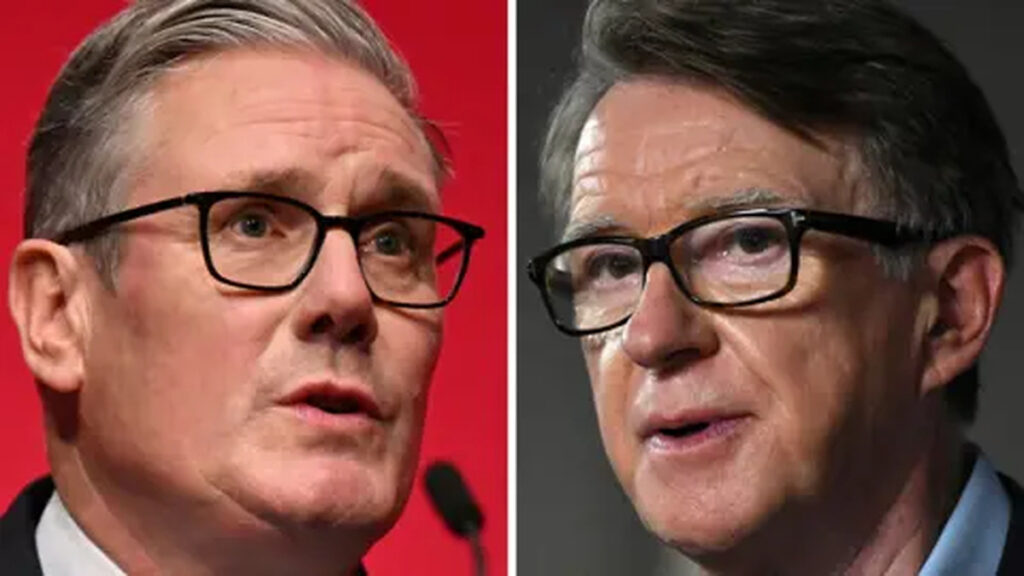
As Sir Keir Starmer reflects on his leadership at No. 10—whether that chapter proves lengthy or brief—one appointment is already emerging as a potential focal point for scrutiny.
His decision to dispatch Lord Mandelson to Washington is being framed by some observers as one of the most consequential judgments of his premiership.
Mandelson’s Washington Role Draws Early Political Attention
The move to position Lord Mandelson in the United States has not gone unnoticed in political circles, where it is already being weighed as a symbolic and strategic choice.
Supporters of the decision view it as an attempt to strengthen transatlantic ties at a time of shifting global alliances.
However, critics argue that the appointment could come to represent a more controversial aspect of Starmer’s foreign policy approach, particularly if outcomes fall short of expectations.
Strategic Intent Meets Political Risk
The decision reflects a broader effort to project experience and diplomatic weight into key international relationships.




Mandelson, a seasoned political operator with extensive foreign policy exposure, was seen by some within Labour circles as a figure capable of navigating complex U.S.–U.K. dynamics.
Yet the gamble lies in how such high-profile appointments are ultimately judged—less by intent and more by measurable diplomatic or political success.
A Decision Likely to Be Revisited Over Time
Political analysts suggest that Starmer’s choice may be repeatedly reassessed depending on how his government performs on the international stage.
In particular, the effectiveness of Labour’s engagement with Washington is expected to become a benchmark for evaluating the administration’s foreign policy competence.
For some, the appointment could age into a celebrated example of strategic foresight.
For others, it may be cited as a misstep in a broader pattern of high-stakes decision-making.
Legacy Politics Already Taking Shape Around No. 10
Even at this early stage, discussions around Starmer’s legacy are beginning to form, with individual decisions being isolated for future judgment.
The Mandelson appointment has therefore become more than a personnel choice—it is increasingly viewed as a test case for how the Prime Minister balances political loyalty, diplomatic ambition, and long-term national interest.
As with many decisions made at the highest levels of government, its significance may only fully emerge in hindsight, when the broader arc of Starmer’s time in office can be properly assessed.

