
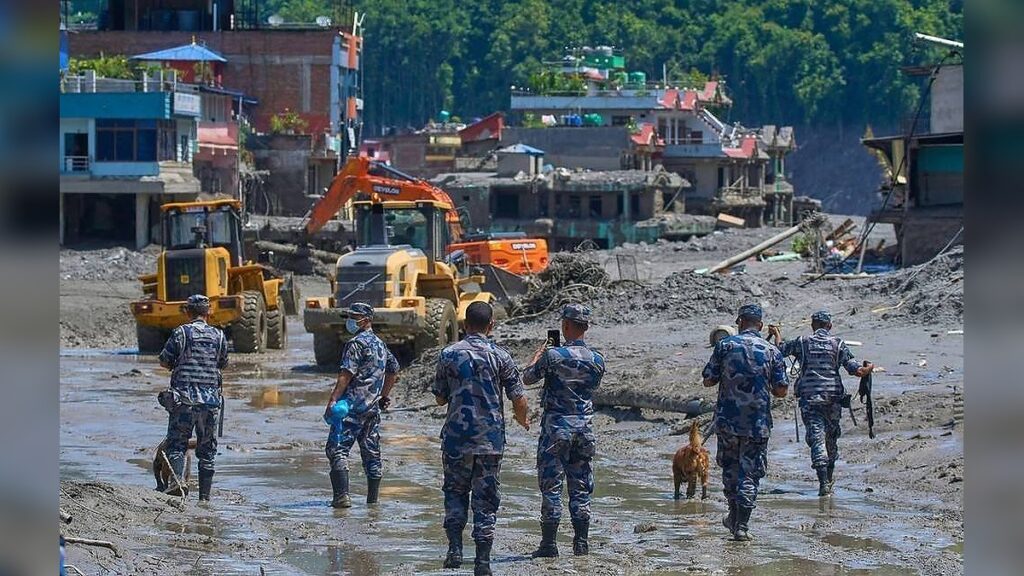
Nepal is facing a growing humanitarian crisis after devastating flash floods left at least 794 people dead and more than 2,400 others missing, with authorities acknowledging that only 20 of the victims have so far been formally identified.
The scale of the disaster has overwhelmed hospitals and emergency facilities across Kathmandu and surrounding areas. Bodies recovered from devastated communities are arriving faster than officials can process them, leaving authorities with few options for storing and identifying the dead.
Mass Burials Planned as Morgues Reach Capacity
The Nepalese government has ordered unidentified and unclaimed bodies to be buried in mass graves after DNA samples and photographs are taken. Officials say the measure is necessary because the country lacks sufficient facilities to preserve hundreds of bodies while families search for missing relatives.
One official said the decision was intended to prevent a public health crisis while ensuring that victims receive dignified burials. Authorities hope the DNA records and photographs will eventually allow families to identify relatives whose remains have been buried.
The decision is particularly painful in Nepal, where Hindu and Buddhist traditions place considerable importance on cremation and funeral rites.
Bodies Recovered Miles From Disaster Zone
Many of the recovered victims have been badly decomposed after spending days in floodwater and thick mud, making visual identification extremely difficult.
Some bodies have reportedly been discovered almost 100 miles from the epicentre of the flooding, while others have been found in rivers that carried them into neighbouring India.
The destruction has been concentrated in areas along the Nepal-Tibet border, where communities were devastated by torrents of water and debris that swept away homes, infrastructure and livestock.
Hospitals Overwhelmed by Dead and Injured
Medical facilities in Kathmandu are struggling to accommodate the influx of victims. Many hospitals in Nepal do not have dedicated morgues, further complicating the emergency response.
At Tribhuvan University Teaching Hospital, around 60 bodies recovered from the flood zone were being kept in the morgue, despite the facility having space for only about 50 people. Around 30 survivors were also receiving treatment at the hospital.
Hospital spokesman Dr Gopal Sedain said staff had identified only one of the bodies there and handed the remains to the victim’s family.
He said the morgue could no longer accommodate additional victims and that bodies recovered in the coming days would instead be transported to an area outside Kathmandu for burial.

Five-Year-Old Girl Found Alive Under Rubble
Amid the devastation, rescuers have also recorded extraordinary survival stories.
A five-year-old girl named Manisha was rescued after being trapped beneath rubble for almost four days. Rescuers initially believed they could hear a cat before realizing that the sound was coming from the child.
After approximately two hours of digging, rescuers managed to free her and she was flown to Kathmandu for treatment. Doctors said she was recovering despite the extraordinary length of time she had spent beneath the debris.
Hospital officials described her survival as remarkable in a disaster where thousands remain missing.
Families Search Hospitals for Missing Relatives
Desperate relatives have been gathering outside hospitals across Kathmandu, hoping to find information about loved ones who disappeared in the floods.
Walls at medical facilities have become makeshift noticeboards covered with photographs of missing people. Families have posted pictures, contact information, ages, occupations, passport copies and maps showing the last known locations of those who disappeared.
Officials have also directed relatives toward a Nepal Police website containing photographs of recovered bodies. However, the condition of many remains has made identification extremely difficult.
One man, Prem, said he had visited hospitals repeatedly while searching for a cousin who had been working near the Nepal-Tibet border. He described the images of recovered victims as deeply disturbing and said he had received no information despite searching hospitals across Kathmandu and surrounding areas.
British and Chinese Nationals Among Missing
The disaster has also affected foreign nationals. Nepalese officials have reported that 48 British nationals remain among those missing, while China has separately reported 15 people missing in Tibet.
It remains unclear whether the Chinese figure overlaps with Nepal’s missing-person count.
The continuing uncertainty has added to the international dimension of the disaster, with families waiting for information while authorities attempt to identify victims whose remains may have been transported far from where they disappeared.
Families Fear They May Never Recover Their Loved Ones
For relatives, the decision to bury unidentified victims has created another source of anguish.
Shaligram, who arrived carrying a photograph of his brother in military uniform and a copy of his military identification card, said his family had no idea what had happened to him.
He expressed a desire simply to recover his brother’s remains so the family could give him a traditional funeral. He said that, if his brother were buried unidentified, the family’s hope would be that future DNA identification would allow them to recover the body and carry out the cremation they believe is necessary for his spiritual peace.
Emergency Services Face an Unprecedented Challenge
Other hospitals are facing similar conditions. At Kathmandu Trauma Centre, relatives have continued registering missing people and posting photographs while ambulances transport victims from the disaster zone.
The facility is treating roughly 50 survivors while about 20 bodies are being held in a morgue designed for approximately half that number.
Hospital spokesman Ritu Raj Aral said medical workers were doing everything possible to save and treat survivors, but acknowledged that authorities were being forced to deal with the dead under circumstances that conflict with traditional Nepalese funeral practices.
With hundreds of victims still unidentified and thousands of people unaccounted for, Nepal’s emergency services remain under enormous pressure as rescue, recovery and identification efforts continue.
