
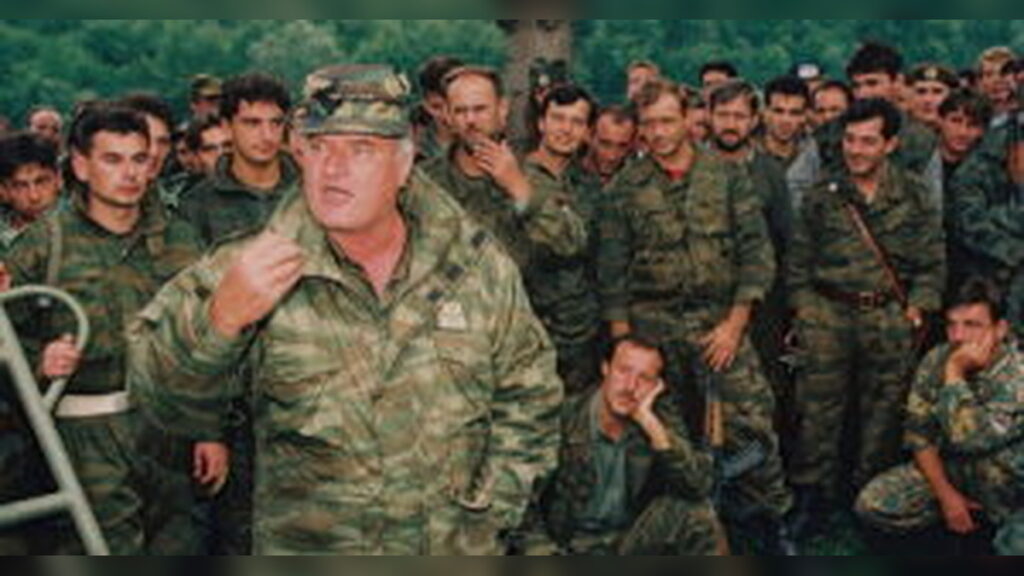
Ratko Mladic, the former Bosnian Serb military commander convicted over some of the worst atrocities committed during the Bosnian War, has died at the age of 84 while serving a life sentence, UN officials said.
Mladic died in a hospital in The Hague, Netherlands.
A family member also confirmed the death to the Associated Press, saying his son, Darko Mladic, was travelling to The Hague.
His death closes the life of one of the most infamous figures of the wars that accompanied the breakup of Yugoslavia, though the legacy of his crimes remains deeply contested and painful across the region.
Life Sentence Followed Decades of War Crimes Proceedings
Mladic was sentenced to life imprisonment in 2017 by the UN tribunal responsible for prosecuting crimes committed during the conflicts in the former Yugoslavia.
He had been taken into custody in 2011 after spending years as a fugitive.
His capture ended one of Europe’s most prominent international manhunts and paved the way for a trial that became a major moment for survivors and relatives of victims.
His conviction was widely regarded as an important step in attempts to establish accountability for atrocities committed during the Bosnian conflict.
Commander of Bosnian Serb Forces During the War
Mladic became commander of the Bosnian Serb army after Bosnia and Herzegovina descended into ethnic conflict in 1992.
His forces seized extensive territory while pursuing the creation of a Serb-controlled state.
Under his command, troops surrounded Sarajevo and carried out prolonged attacks against civilians.
Non-Serb civilians and captured fighters were also detained in camps, while systematic killings and other abuses were carried out across areas controlled by Bosnian Serb forces.
The siege of Sarajevo became one of the defining episodes of the conflict, with civilians exposed to sniper fire and artillery attacks while the city remained isolated.
Srebrenica Became the Defining Crime of His Legacy
Mladic’s name became inseparable from the 1995 massacre at Srebrenica.
More than 8,000 Bosniak Muslim men and boys were killed after Bosnian Serb forces overran the UN-designated safe area.
The victims were separated from women and children, transported to different locations and murdered, with their bodies subsequently concealed in mass graves.
International courts have recognised the Srebrenica massacre as genocide, making it the only confirmed genocide in Europe since the Second World War.
The killings remain one of the darkest chapters in modern European history and continue to shape relations between communities in Bosnia and Herzegovina.
Mladic Remained Defiant Until His Trial
Despite the severity of the allegations and eventual convictions, Mladic never publicly accepted responsibility for the crimes attributed to him.
During his trial, he frequently challenged the proceedings and maintained the image of himself as a defender of the Serbian people.




His nationalist worldview was deeply influenced by the history of the Balkans and his family’s experience during the Second World War.
Born on March 12, 1942, in the Bosnian village of Bozinovici, he entered the communist Yugoslav military before siding with the Serbs as Yugoslavia broke apart.
Rise From Communist Officer to Bosnian Serb Military Chief
Mladic initially became involved in the Serb insurgency in Croatia before taking command of the Bosnian Serb army.
The force received backing from Serbia and the government of then-president Slobodan Milosevic, who himself later faced prosecution at the Hague tribunal and died in custody in 2006 before his trial concluded.
Mladic viewed the conflict through a strongly historical and nationalist lens, frequently describing Bosnia’s Muslim population using language associated with the Ottoman era.
That outlook contributed to the rhetoric of revenge that accompanied some of his military operations.
A Long Fugitive Period Followed the War
After being indicted by the international tribunal, Mladic disappeared into hiding rather than face justice.
For years, he remained protected by networks connected to former military and political allies.
He spent part of his fugitive period at a military facility in eastern Bosnia before later moving with his family to a suburban property in Belgrade.
Reports about his whereabouts repeatedly surfaced, while claims about his health and movements generated further speculation.
Mladic occasionally appeared publicly before eventually disappearing almost completely from view in 2008.
Arrest Finally Came in 2011
Mladic was arrested in May 2011 in a village near Belgrade, where he had been hiding in a relative’s modest home.
His capture was a major development in international efforts to prosecute senior figures from the Bosnian War.
After years of evading authorities, he was transferred to The Hague to face the tribunal.
By the time he appeared in court, the once-powerful military commander had become a frail older man, a stark contrast to the figure who had dominated the battlefield during the 1990s.
His confrontational attitude, however, remained.
Conviction Brought a Landmark Moment for Survivors
In 2017, judges convicted Mladic and imposed a life sentence for crimes including genocide, persecution, extermination, murder, deportation and other offences committed during the conflict.
When the verdict was delivered, Mladic reacted angrily and shouted at the judges, continuing to reject the accusations against him.
For survivors and families of those killed, the conviction represented a significant moment of accountability after decades of waiting.
His Death Leaves a Complicated Legacy
Mladic’s death does not erase the divisions surrounding his legacy.
To survivors and victims’ families, he remains responsible for atrocities that devastated communities and killed thousands of civilians.
Among some Serb nationalists, however, he has continued to be portrayed as a military hero who fought for Serbian interests.
That conflicting perception has endured long after the end of the Bosnian War and remains an obstacle to reconciliation in parts of the former Yugoslavia.
What’s Next?
Mladic’s death is likely to renew attention on the Srebrenica genocide, the siege of Sarajevo and the broader question of accountability for crimes committed during the breakup of Yugoslavia.
His conviction remains an important part of the international legal record concerning the Bosnian War, while victims’ families continue to preserve the memory of those who were killed.
The debate over Mladic’s historical legacy is therefore unlikely to end with his death.
Summary
Ratko Mladic has died aged 84 in a hospital in The Hague while serving a life sentence for war crimes committed during the Bosnian conflict.
As commander of the Bosnian Serb forces, he was closely associated with the siege of Sarajevo and the 1995 Srebrenica massacre, in which more than 8,000 Bosniak Muslim men and boys were killed.
After years as a fugitive, Mladic was arrested in Serbia in 2011 and convicted by the UN tribunal in 2017.
He remained defiant throughout the legal process and never expressed remorse for the crimes for which he was convicted.

