
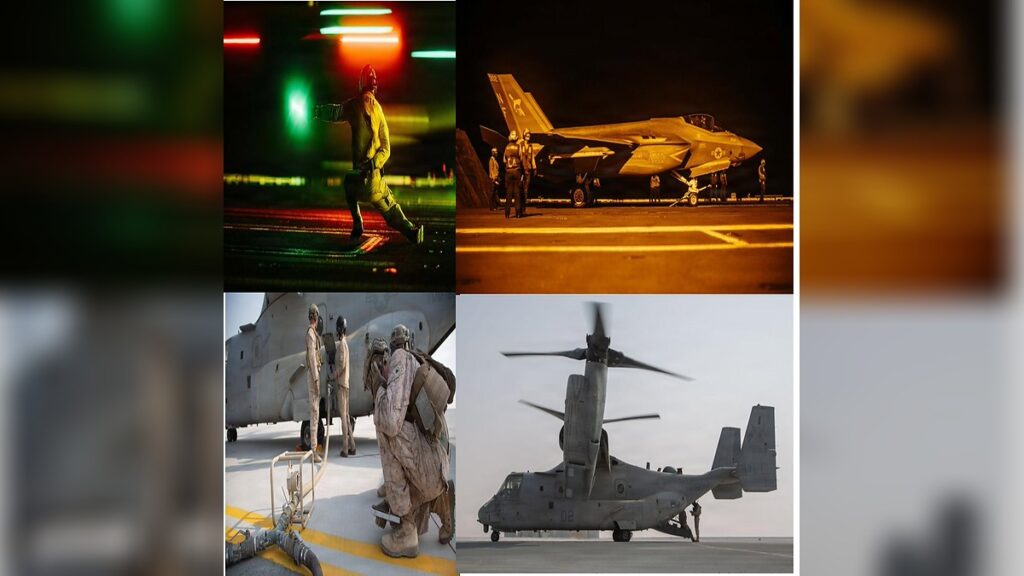
The United States has carried out its first publicly acknowledged strikes against Iranian targets in more than a month, hitting two rocket launchers on Larak Island near the Strait of Hormuz in an operation Washington said was intended to prevent Iran from deploying sea mines into the critical shipping route.
The strikes marked a renewed escalation in the six-month conflict between Washington and Tehran, coming after a period of reduced direct US-Iranian military activity.
Washington Cites Threat to Global Shipping
US Central Command spokesman Captain Tim Hawkins said Iranian Revolutionary Guard Corps forces had been observed preparing to launch rockets carrying sea mines into the Strait of Hormuz.
Hawkins said US forces were closely monitoring the area and remained prepared to protect commercial navigation through the strategically important waterway. The US military had also completed an operation the previous week to clear sea mines from international shipping routes in the strait.
Explosions Reported Near Larak Island
Iranian media reported explosions in the vicinity of Larak Island following the American operation. Iran’s Revolutionary Guards subsequently said that several Iranian fighters and civilians had been killed or wounded in the attack and warned that the United States would face retaliation.
The IRGC did not immediately provide a detailed breakdown of the casualties or the extent of damage caused by the strikes.
Iran Responds With Attacks on US Forces in Jordan
Iran subsequently launched ballistic missiles toward US military positions in Jordan, according to Iranian and US-linked reports. The attack was presented by Tehran as retaliation for the American strikes on Larak Island.

US officials said nearly all of the incoming missiles were intercepted and that there were no significant impacts. Jordanian authorities separately reported intercepting missiles that entered the country’s airspace.
The IRGC said the American attack would result in what it described as punishment for the aggressor, raising concerns that the exchange could trigger another cycle of direct US-Iranian attacks.
Hormuz Remains at the Center of the Conflict
The latest confrontation highlights the strategic importance of the Strait of Hormuz, through which roughly one-fifth of the world’s oil consumption normally passes.
Commercial traffic has remained far below prewar levels as the conflict has disrupted maritime operations. US officials have repeatedly insisted that the waterway must remain open, while Iran has demonstrated its ability to threaten shipping through missiles, drones and potential mine-laying operations.
The renewed fighting also comes after an unknown projectile struck a tanker transiting the strait north of Khasab, Oman. The United Kingdom Maritime Trade Operations agency said there were no reported casualties or environmental damage and that there had been no immediate claim of responsibility.
Washington Had Been Shifting Toward Economic Pressure
The military exchange comes only days after the Trump administration signaled a greater emphasis on economic pressure against Iran rather than expanding military operations.
The shift has included efforts to intensify sanctions against countries and entities continuing to conduct business with Tehran. The prolonged conflict has also raised concerns in Washington over US munitions stocks and the potential effect of sustained operations on broader military readiness.
Six-Month War Shows Few Signs of Ending
The latest strikes underscore how quickly the conflict can return to direct military confrontation despite periods of reduced fighting and diplomatic efforts.
President Donald Trump has continued to argue that Iran’s military capabilities have suffered severe damage, while Tehran has maintained that it remains capable of striking American interests and disrupting the strategically vital waterway.
With US forces now striking Iranian launchers and Iran responding against American positions in Jordan, the latest exchange threatens to widen a conflict that has already severely disrupted shipping through one of the world’s most important energy corridors.
