
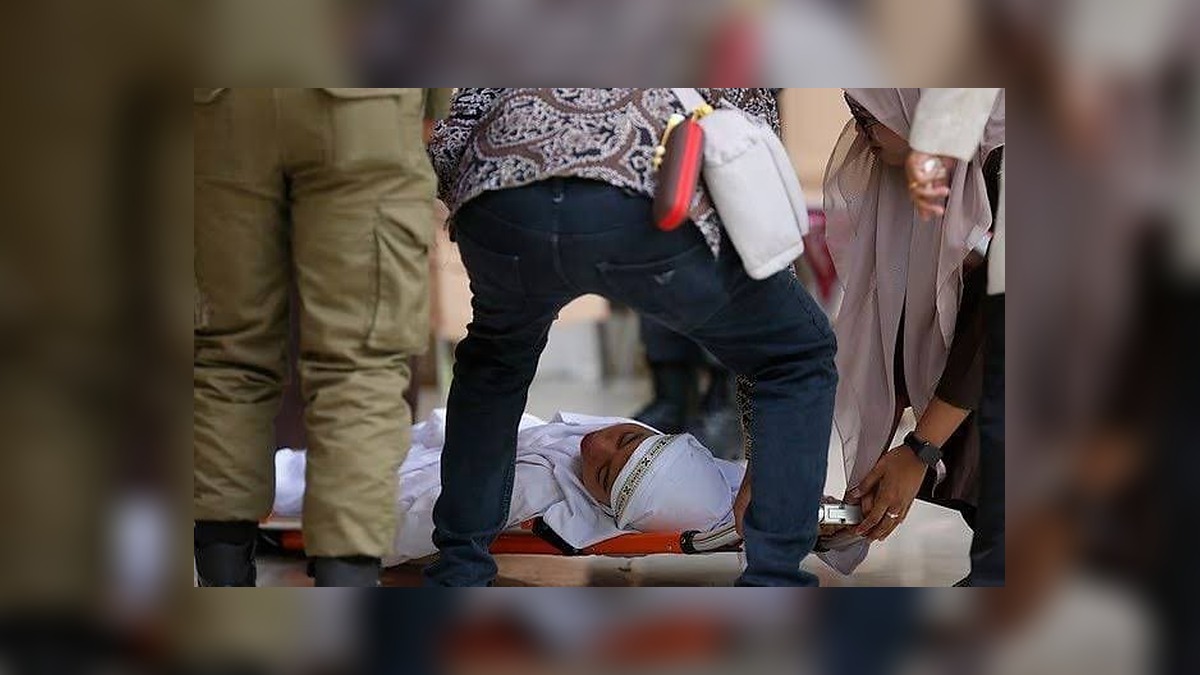
A woman collapsed during a public caning session in Indonesia after being punished for having sex outside marriage, in an incident that has renewed attention on the controversial enforcement of Islamic law in the country’s Aceh province.
Images taken in Banda Aceh, the provincial capital, on October 15, 2026, showed medical personnel and Sharia officers rushing to assist the woman after she became overwhelmed during the punishment. A man sentenced alongside her was also seen kneeling in visible pain following his caning.
The pair were among eight people sentenced by the Banda Aceh Syar’iyah Court for offences under the province’s Islamic legal code. Some of the punishments involved up to 100 lashes, depending on the offence.
Woman Receives Medical Attention After Caning
The woman had been convicted of having sexual relations outside marriage, an offence punishable under Aceh’s interpretation of Sharia law. Photographs from the scene showed officials gathering around her as she lay weakened on the public stage.
The man punished during the same session had been convicted of adultery, which is also prohibited under the province’s Islamic legal system.
The proceedings attracted a small crowd of onlookers who watched as the sentences were carried out in public. Medical personnel were present to provide assistance to convicts who struggled with the physical effects of the punishment.
Fainting and other visible signs of distress have been documented during previous caning sessions in the province, with some convicts requiring assistance to leave the punishment area.
How Public Caning Is Carried Out in Aceh
Caning is administered by officials commonly known as algojos, who use rattan sticks to strike convicted individuals in front of court representatives and members of the public.
The officers typically wear dark clothing that covers their bodies, with their faces concealed to protect their identities. The punishments are often conducted on public stages, outside mosques or in community squares.
The practice is intended not only to punish offenders physically but also to expose them to public shame. Spectators sometimes record the proceedings on their mobile phones, while photographs and videos of convicts experiencing severe pain have circulated widely.
Under Aceh’s legal framework, caning can be imposed for several offences, including gambling, alcohol consumption, homosexual acts and sexual relations outside marriage.
Human Rights Groups Condemn the Punishments
The practice has repeatedly attracted criticism from international human rights organisations, which argue that public caning amounts to cruel, degrading treatment and violates Indonesia’s human rights obligations.




Amnesty International and Human Rights Watch have both criticised the punishment, raising concerns about its physical and psychological consequences for those subjected to it.
Usman Hamid, executive director of Amnesty International Indonesia, has previously questioned whether conduct considered socially inappropriate should warrant criminal punishment of such severity.
He also raised concerns about the public circulation of footage showing people being punished, noting that social media content can be viewed by people of different ages, including children.
Amnesty International has argued that caning conflicts with Indonesia’s constitution and international human rights standards. The organisation has also said the practice may constitute torture or other cruel, inhuman or degrading treatment under international conventions to which Indonesia is a party.
Critics warn that the public humiliation involved can have consequences extending beyond the physical punishment, potentially causing lasting psychological distress and social stigma.
Aceh Remains Indonesia’s Only Province Applying Sharia Law
Indonesia is the world’s largest Muslim-majority country and officially recognises six religions, alongside indigenous belief systems. Although more than 90 per cent of its population is Muslim, religious practices and interpretations vary across the country.
Aceh occupies a distinct position within Indonesia because it is the only province authorised to implement Sharia law as a regional legal system.
The province received special autonomy in 2001, following a long-running separatist insurgency. The arrangement was part of efforts by the central government to address the conflict while allowing Aceh greater authority over its own affairs.
Sharia regulations were introduced in 2002, with additional provisions added in 2003. These included restrictions on sexual conduct, adultery and certain forms of interaction between unmarried men and women.
One provision prohibits a person from being alone with someone of the opposite sex who is neither their spouse nor a relative. Other rules address sexual offences, displays of affection involving unmarried people and underage sexual activity.
Religious Police Enforce Rules on Conduct and Dress
Aceh’s religious enforcement authorities have also been reported to target people accused of violating rules on dress and public behaviour.
Women who do not wear headscarves or are considered to be wearing tight-fitting clothing have faced scrutiny, while people suspected of drinking alcohol or participating in gambling have also been subject to enforcement.
The rules have drawn criticism over how broadly they can be applied, particularly when people are accused of conduct such as standing too close to a partner in public or being alone with someone to whom they are not married.
Supporters of the system regard the regulations as an important expression of Aceh’s religious identity and a means of discouraging behaviour prohibited under their interpretation of Islamic law. The practice also has substantial support among the province’s predominantly Muslim population.
Opponents, however, argue that the severity and public nature of the punishments raise serious questions about personal dignity, individual rights and the treatment of vulnerable people.
Proposal for Beheading Previously Sparked Controversy
Debate over the limits of Aceh’s criminal punishments has previously extended beyond caning.
In 2018, the province began consulting the public on whether beheading should be introduced as a punishment. Indonesia’s central government warned that such a proposal would not be permitted under national law.
The controversy highlighted the tension between Aceh’s special autonomy and the wider legal framework governing Indonesia.
As public caning continues in the province, the collapse of the woman during the October 15 session has once again drawn attention to the physical impact of the practice and the continuing disagreement between those who defend it as a deterrent and those who consider it a violation of fundamental human rights.
