
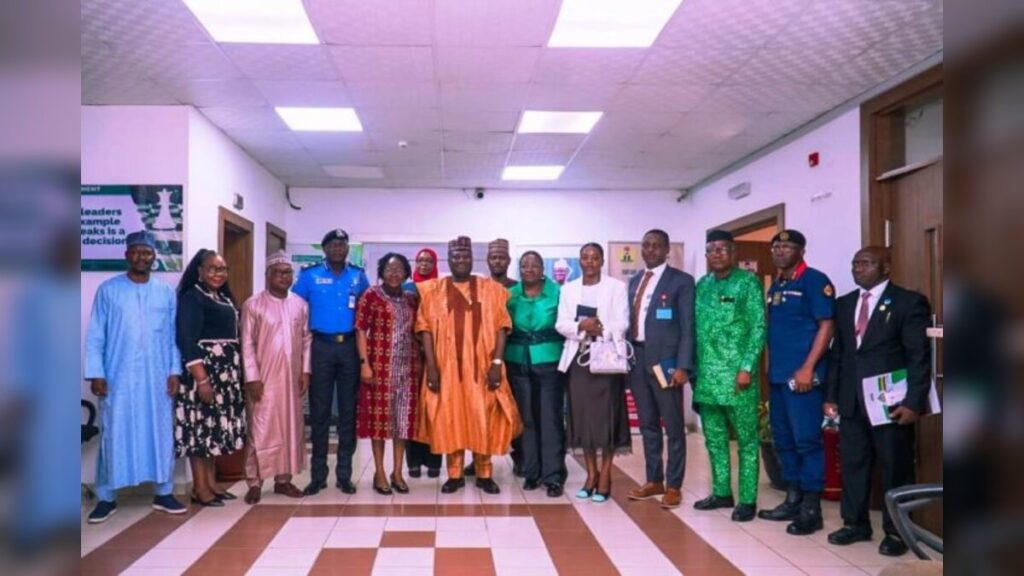
Nigeria’s security structure is set for a major review as the Federal Government has officially set up an Inter-Ministerial Committee to examine the growing number of security, para-military, and quasi-security outfits operating across the country.
The move is aimed at addressing rising concerns over duplication of duties, overlapping mandates, and the increasing presence of unregulated security groups.
Akume Flags Off Reform Drive in Abuja
The Secretary to the Government of the Federation (SGF), Senator George Akume, CON, inaugurated the committee on Wednesday, April 22, 2026, in Abuja.
Speaking through the Permanent Secretary, General Services Office (GSO), Dr. Ibrahim Abubakar Kana, mni, he explained that the decision reflects government’s push to strengthen efficiency, coordination, and accountability across all security-related institutions tasked with protecting lives and property.
He noted that the current structure has become increasingly complex, with multiple agencies performing similar roles, often leading to confusion and operational friction.
Why the Committee Was Created
According to the SGF, the proliferation of security outfits at federal, state, and quasi-government levels has created serious challenges.
These include:
- Overlapping jurisdictions
- Duplication of responsibilities
- Weak coordination between agencies
- Operational inefficiencies
The new committee is expected to provide clarity and direction on how these issues can be addressed in a sustainable way.
What the Committee Will Do
The Inter-Ministerial Committee has been given a wide-ranging mandate.
Its responsibilities include compiling a full inventory of all security and para-military bodies across Nigeria.
It will also:




- Examine legal and operational mandates of each agency
- Identify areas of overlap or conflict
- Assess the relevance and effectiveness of emerging security outfits
- Review coordination systems among agencies
- Recommend reforms to improve accountability and reduce duplication
Beyond this, the committee will evaluate existing frameworks and highlight gaps that weaken national security coordination.
Possible Reforms on the Table
The committee is also expected to propose far-reaching reforms that could reshape how security institutions operate in Nigeria.
These may include:
- Mergers of similar agencies
- Harmonisation of roles and responsibilities
- Reclassification of certain outfits
- Dissolution of redundant structures where necessary
The overall goal is to build a more coherent and efficient security system aligned with national priorities and global best practices.
Who Is on the Committee
The committee is chaired by the SGF and includes key stakeholders from major security and governance institutions such as:
- Nigeria Police Force (NPF)
- Department of State Services (DSS)
- Ministry of Defence
- Ministry of Police Affairs
- Ministry of Interior
- Nigeria Security and Civil Defence Corps (NSCDC)
- Office of the National Security Adviser (ONSA)
Their combined expertise is expected to guide a comprehensive review of the country’s security framework.
Deadline and Expectations
The committee has been given a specific timeframe within which it is expected to deliver its findings.
A final report with actionable recommendations will be submitted to the Federal Government to support policy decisions on restructuring and improving Nigeria’s security architecture.
Impact and Consequences
If fully implemented, the committee’s recommendations could significantly reshape Nigeria’s security landscape.
A reduction in overlapping agencies may lead to better coordination, faster response times, and clearer command structures.
However, the process could also spark institutional resistance, especially if mergers or dissolutions affect established agencies or personnel structures.
There may also be political and administrative debates around jurisdiction and control.
What’s Next?
Attention now shifts to the committee’s fieldwork and consultations across agencies.
The findings will determine whether Nigeria moves toward consolidation of security outfits or maintains its current multi-agency structure with reforms.
The government is expected to review the final report once submitted and decide on the next phase of implementation.
Summary
The Federal Government has launched a major review of Nigeria’s security and para-military institutions through a newly inaugurated Inter-Ministerial Committee.
The initiative aims to address duplication, inefficiency, and overlapping roles while proposing reforms that could reshape the country’s security framework.
Bulleted Takeaways
- FG has set up an Inter-Ministerial Committee on security agency reform
- The move targets duplication and inefficiency in security structures
- Agencies at federal, state, and quasi-government levels will be reviewed
- Committee will assess mandates, overlaps, and operational effectiveness
- Possible outcomes include mergers, restructuring, or dissolution of agencies
- Key security bodies like NPF, DSS, NSCDC, and ONSA are involved
- Final report will guide government decisions on security reforms
- Reform could significantly reshape Nigeria’s security architecture
