
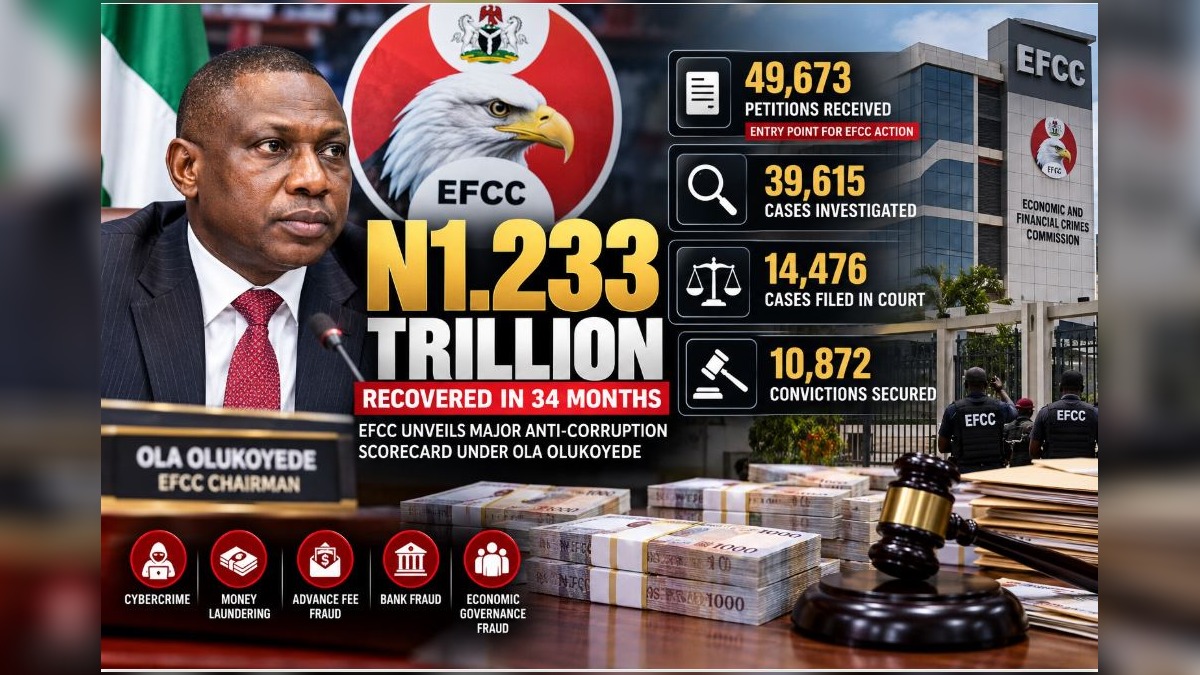
Nigeria’s Economic and Financial Crimes Commission has reported recovering N1.233 trillion during the first 34 months of Ola Olukoyede’s leadership, alongside more than 10,000 convictions for economic and financial crimes.
The anti-graft agency released the figures on Thursday while reviewing its activities between October 1, 2023, and July 31, 2026.
According to the EFCC, tens of thousands of petitions were received and investigated during the period, resulting in thousands of cases being taken before Nigerian courts.
EFCC Says N1.233 Trillion Recovered in 34 Months
The commission identified asset and fund recovery as one of the major results recorded under Olukoyede’s chairmanship.
“₦1.233 trillion in recoveries in just 34 months. This is the legacy of EFCC Chairman Ola Olukoyede,” the agency said in a video published through its official social media account.
The figure covers the period from October 2023 through the end of July 2026.
The commission presented the recoveries as part of its broader campaign against corruption, fraud, money laundering and other financial offences.
Nearly 50,000 Petitions Submitted to Anti-Graft Agency
The EFCC said it received 49,673 petitions during the period being reviewed.
Petitions frequently provide the starting point for investigations into suspected economic and financial crimes, and the commission described them as the “entry point for EFCC action.”
Not every petition ultimately resulted in an investigation or prosecution.
However, the agency said a substantial proportion progressed to the investigative stage.
More Than 39,000 Cases Investigated
Of the petitions and matters handled during the 34-month period, the EFCC reported investigating 39,615 cases.
Investigations can involve tracing financial transactions, examining documents, questioning suspects and witnesses and attempting to establish how allegedly illicit funds were transferred or concealed.
The commission said the work ultimately resulted in thousands of cases being prepared for prosecution.
EFCC Files 14,476 Cases in Court
The agency reported that 14,476 cases were filed before courts during the period.
That means considerably fewer cases reached court than were investigated, reflecting the different stages through which complaints and investigations progress before prosecution.




The EFCC presented the number of court filings as another indicator of the scale of its enforcement activities under Olukoyede.
Commission Records 10,872 Convictions
The EFCC said investigations and prosecutions during the period resulted in 10,872 convictions.
The commission did not present the figure simply as a numerical achievement but said it reflected enforcement efforts against numerous categories of financial crime.
Those offences ranged from cybercrime and advance-fee fraud to more complex allegations involving banks, money laundering and public resources.
Cybercrime and Money Laundering Among Major Targets
The commission said its enforcement operations covered a broad spectrum of economic offences.
It specifically identified advance-fee fraud, cybercrime, money laundering, bank fraud and economic governance fraud among the areas targeted by investigators.
“But what do these numbers represent?” the agency asked while presenting its performance figures.
According to the EFCC, they represent the continuing battle against financial crimes affecting individuals, businesses and government institutions.
EFCC Highlights Work Behind Headline Statistics
The commission said each conviction or recovery involved considerably more work than the headline figures reveal.
Investigators must follow financial trails, establish connections between transactions and suspected offences, gather evidence and, where appropriate, build cases capable of being presented in court.
“And behind every number is a case investigated, a financial trail uncovered, and public resources recovered,” the EFCC said.
The agency argued that these individual investigations collectively contribute to Nigeria’s wider effort to combat economic and financial crime.
Olukoyede’s Leadership Put Under Spotlight
Olukoyede’s tenure has placed him at the centre of some of Nigeria’s most closely watched anti-corruption investigations and prosecutions.
The latest figures represent the EFCC’s own assessment of its enforcement performance during the 34 months under review.
By highlighting recoveries, investigations, prosecutions and convictions together, the commission sought to demonstrate activity across different stages of the criminal enforcement process rather than relying on a single performance measure.
Recoveries Form Major Part of EFCC Anti-Corruption Campaign
Recovering proceeds linked to financial crimes remains an important component of the commission’s mandate.
Such operations can involve cash as well as other assets identified during investigations and legal proceedings.
In its latest assessment, however, the EFCC placed particular emphasis on the N1.233 trillion it says was recovered between October 2023 and July 2026.
The agency described those recoveries as resources reclaimed through its continuing enforcement efforts.
EFCC Says Anti-Financial Crime Campaign Will Continue
The commission’s statistics provide a snapshot of the volume of work it says was undertaken during Olukoyede’s first 34 months in charge.
Across the period, the EFCC reported 49,673 petitions, 39,615 investigations, 14,476 court cases and 10,872 convictions, alongside N1.233 trillion in recoveries.
For the anti-graft agency, however, those numbers are being presented as milestones rather than the conclusion of its campaign.
“The work continues,” the EFCC said.
