
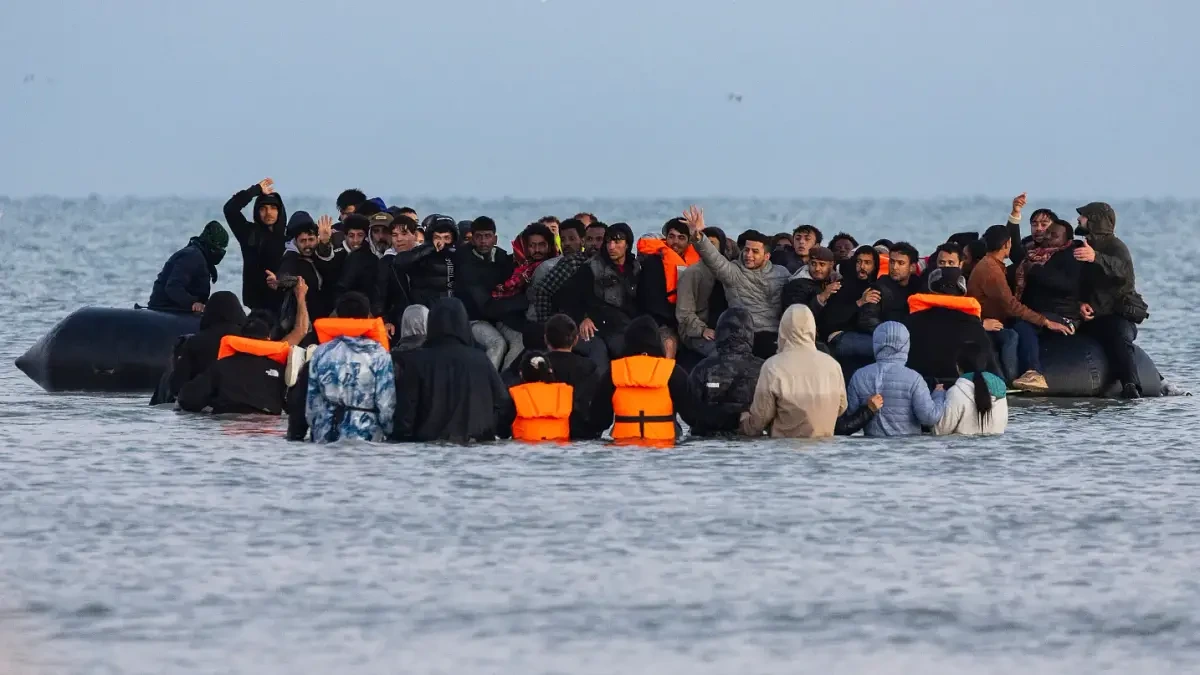
France rejected a significant number of migrants selected for deportation under its controversial one-in-one-out agreement with the UK, often without explaining its decisions, according to a new report.
The findings suggest that more migrants who crossed the English Channel in small boats could have been returned to France if French authorities had provided clearer explanations for rejecting candidates.
John Tuckett, the UK’s Independent Chief Inspector of Borders and Immigration, revealed that rejection rates sometimes reached 50 per cent, significantly reducing the number of migrants Britain could send back under the arrangement.
The report also highlighted frustrations among Home Office officials, who said they struggled to understand the criteria French authorities used when deciding which migrants to accept.
Officials Faced Difficulties Understanding French Decisions
The review found that UK caseworking teams frequently received simple yes-or-no responses from their French counterparts without explanations for rejected applications.
Although French officials raised concerns about the quality and content of information supplied by the Home Office, the report said the absence of transparent decision-making made it difficult for British officials to identify consistent reasons behind the rejections.
Mr Tuckett said greater engagement between the two countries would have improved the process.
The report stated that France’s criteria for accepting or rejecting migrants had a considerable impact on the number of people who could be returned under the agreement.
It also noted differences in how senior officials from both countries viewed the arrangement, with some indications that French authorities considered small boat crossings a more immediate problem for Britain than for France.
Only Around Four Per Cent of Small Boat Arrivals Were Returned
The one-in-one-out agreement was negotiated by former prime minister Sir Keir Starmer and French President Emmanuel Macron last summer.
Under the arrangement, Britain could return migrants who had crossed the Channel in small boats to France while accepting an equivalent number of migrants through an approved legal route.
Between August 2025 and June 30, 2026, Britain returned 1,087 migrants to France, while the UK accepted 1,117 in return.
However, almost 28,000 migrants arrived in Britain through small boat crossings during the same period.




This means that approximately four per cent of those who arrived were returned to France under the agreement.
Sir Keir had intended the arrangement to discourage people from making dangerous Channel crossings by demonstrating that those arriving illegally could be sent back.
France Wanted a Wider European Returns Agreement
The report also highlighted differences between the UK and France over the future direction of migration cooperation.
Paris has long advocated replacing the bilateral arrangement with a broader European Union initiative.
Under the proposed approach, Britain would return migrants to several European countries while accepting roughly equivalent numbers from those nations.
The one-in-one-out agreement officially expired last month after the Élysée Palace sought to bring it to an end.
The report’s findings are likely to intensify questions about France’s commitment to the arrangement and its willingness to cooperate fully with Britain’s efforts to reduce illegal Channel crossings.
Legal Challenges Against the Scheme Were Unsuccessful
The review also disclosed that organisations and lawyers representing migrants had submitted approximately 100 judicial reviews seeking to prevent deportations under the agreement.
However, the legal challenges were successfully defeated, largely because France is recognised as a safe country for returning migrants.
The report examined the scheme’s operational effectiveness and identified areas where cooperation and communication between the two governments could have been improved.
Chris Philp Criticises Government Over Failed Agreement
Conservative shadow home secretary Chris Philp criticised the government’s handling of illegal migration, describing the one-in-one-out arrangement as a failure.
He said: “First the government laughably claimed they would ‘smash the [smuggling] gangs’.
Now their one in one out deal has failed.”
Mr Philp also accused France of failing to take sufficient responsibility for preventing migrants from departing its coastline.
He said France had become a departure point for thousands of illegal Channel crossings, despite Home Secretary Shabana Mahmood providing the country with £660 million in funding.
Home Office Defends Cooperation With France
A Home Office spokesman defended the government’s efforts to tackle small boat crossings, insisting that cooperation with France was producing results.
The spokesman said arrivals had fallen significantly compared with the previous year, adding that summer crossings were at their lowest level in six years.
The department also welcomed the inspector’s recognition of the operational delivery of the UK-France pilot, saying the arrangement had demonstrated that this type of returns agreement could work.
Although the pilot has ended, the government said it was implementing lessons from the scheme.
It has also introduced a new Small Boats Returns Taskforce to accelerate efforts to return migrants who arrive in Britain through small boat crossings.
