
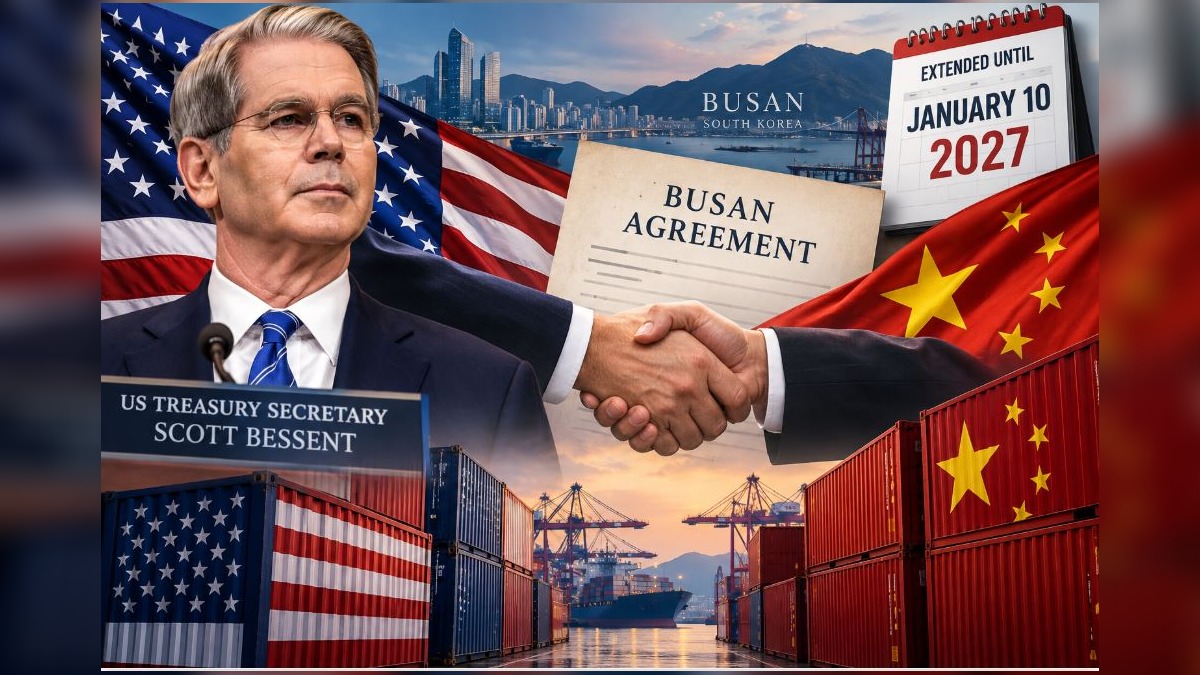
The United States and China have agreed to extend their trade de-escalation arrangement until January 10, 2027, buying both economic powers additional time to negotiate a potentially broader agreement.
US Treasury Secretary Scott Bessent announced the extension after talks between American and Chinese officials, confirming that the framework commonly referred to as the Busan Agreement will remain in place beyond its previous November deadline.
Rather than allowing the arrangement to expire while major economic disagreements remain unresolved, Washington and Beijing have chosen to maintain the existing framework for another two months.
Washington and Beijing Extend Busan Agreement
Bessent confirmed the decision during an interview with Fox News, saying both governments had agreed to preserve the economic détente established between the two countries.
The arrangement had been scheduled to expire on November 10.
It will now continue until January 10, 2027, providing negotiators with additional time to explore whether a more substantial economic agreement can be reached.
“We have agreed today that we will extend what we call the Busan agreement,” Bessent said.
Bessent Says Countries Are Looking Beyond Smaller Agreements
The latest discussions appear to be focused on whether the world’s two largest economies can move beyond a series of limited compromises.
Bessent said officials met to consider whether there was an opportunity to negotiate a larger agreement instead of continuing with individual arrangements covering separate economic disputes.
Extending the existing trade truce provides a window for those negotiations without immediately returning the two countries to another round of escalating trade restrictions.
The Treasury secretary said the additional time would allow both sides to determine what could be achieved on the economic front.
Trade Truce Was Previously Due to Expire in November
The Busan framework had been scheduled to remain in effect until November 10, meaning the latest decision effectively adds another two months to the arrangement.
The extension does not itself represent a comprehensive new US-China trade agreement.
Instead, it preserves measures previously adopted to reduce tensions while negotiations continue over unresolved economic issues.
That distinction means many existing tariffs and restrictions remain relevant even as both governments avoid an immediate escalation.
Busan Talks Helped Ease Earlier Trade Confrontation
The agreement takes its name from Busan, South Korea, where US President Donald Trump and Chinese President Xi Jinping met on October 30, 2025.
Their meeting produced measures intended to lower tensions after a period of escalating trade confrontation between Washington and Beijing.




The two governments agreed to partially reduce tariffs, extend suspensions affecting reciprocal tariffs and remove certain trade and economic restrictions.
Those steps created the framework that officials are now extending into January.
Tariffs Remain at Centre of US-China Economic Relationship
Tariffs have remained one of the most contentious elements of relations between Washington and Beijing.
Both governments have used import duties and other trade restrictions during their economic disputes, affecting businesses and supply chains operating across the world’s two largest economies.
The Busan arrangement helped prevent another immediate round of escalation while officials continued negotiations.
Its extension suggests both sides are prepared, at least temporarily, to preserve that period of relative trade stability.
Critical Minerals and Agriculture Remain Important Issues
The broader negotiations extend beyond headline tariff rates.
Recent US-China economic talks have included discussions involving critical minerals, agricultural trade, market access and other restrictions affecting bilateral commerce.
Critical minerals have become particularly important because of China’s major role in global supply chains for materials required by industries ranging from electronics to electric vehicles and defence manufacturing.
Agricultural trade is another significant issue, with American producers seeking greater access to the Chinese market.
Washington Has Also Discussed Artificial Intelligence With Beijing
Economic negotiations are increasingly overlapping with technological competition between the two countries.
Recent discussions between Bessent and Chinese Vice Premier He Lifeng have included artificial intelligence alongside more traditional trade questions.
American and Chinese officials have also agreed to continue discussions on AI safety and mechanisms for communicating about potentially serious artificial intelligence incidents.
That dialogue demonstrates how the economic relationship between Washington and Beijing now encompasses emerging technologies as well as tariffs, commodities and manufacturing.
Extension Gives Negotiators More Time for Bigger Deal
For both governments, the January deadline creates another negotiating window.
Bessent’s comments suggest Washington wants to determine whether several individual economic issues can eventually be incorporated into a broader package.
Whether such an agreement can be completed before January remains uncertain.
Significant differences continue to exist between the United States and China over trade policy, technology, industrial competition and market access.
Trump and Xi Relationship Remains Central to Negotiations
The trade extension comes as President Trump and President Xi remain personally involved in managing the wider US-China relationship.
Their Busan meeting established the framework now being preserved, while subsequent negotiations between senior officials have attempted to maintain that stability.
The relationship between Washington and Beijing extends far beyond commerce, encompassing technology, national security and major geopolitical disputes.
Trade nevertheless remains one of the most consequential areas because decisions made by either government can rapidly affect global markets and supply chains.
January 10 Becomes Next Major Deadline
The immediate consequence of the latest agreement is that businesses and markets will no longer face the November 10 expiration of the current trade truce.
Attention instead shifts to January 10, 2027.
Until then, American and Chinese negotiators have additional time to determine whether the temporary de-escalation can evolve into a wider economic settlement.
For now, Washington and Beijing have chosen to extend the existing framework rather than return to another immediate confrontation, keeping negotiations open as both sides consider whether a larger trade agreement is possible.
