
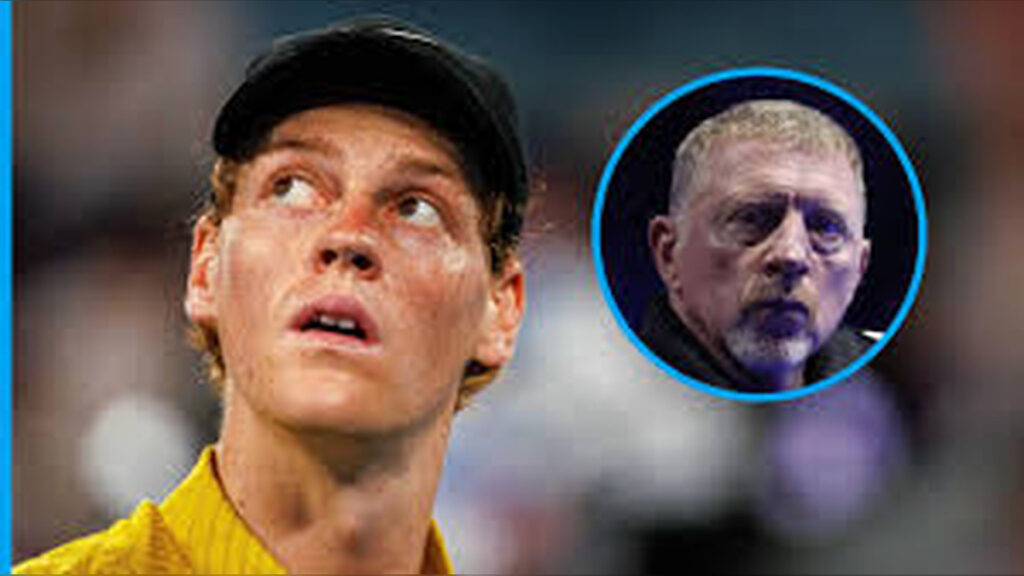
Tennis legend Boris Becker has stirred debate after suggesting that Jannik Sinner’s dramatic French Open exit was driven less by physical exhaustion and more by what was happening in his head.
The world No.1, Jannik Sinner, looked unstoppable early in his second-round match at the French Open, only to suffer one of the most unexpected collapses in recent Grand Slam history.
Up two sets and serving for the match, everything suddenly fell apart in the Paris heat—and what followed left fans, analysts, and former champions stunned.
From Total Control to Sudden Collapse on Court
For most of the match, Sinner played like he was cruising toward another routine win.
The conditions in Paris were brutal, with temperatures soaring above 30°C, but he still built a commanding lead against Juan Manuel Cerúndolo.
Then came the turning point. Serving for victory, Sinner lost focus, rhythm, and eventually control of the match entirely.
What looked like a straight path to the third round turned into a five-set defeat.
After leading by two sets and being just a few points from victory, he went on to lose 18 of the next 20 games—an implosion few saw coming.
Becker Says the Real Problem Was Mental Pressure
Becker didn’t hold back in his assessment.
He suggested that fatigue alone couldn’t explain such a dramatic shift.
In his view, the issue was psychological pressure building inside Sinner’s mind—stress, expectation, and overthinking at the worst possible moment.
Becker pointed to poor sleep and nervous tension as possible triggers that broke his rhythm.
He also noted that Sinner had been on an intense winning run leading into Paris, dominating tournaments across Monte Carlo, Madrid, and Rome, which may have added hidden pressure rather than confidence.
Heat, Fatigue, and a Brutal Tennis Schedule
While Becker focused on the mental side, others pointed to the physical toll.
Sinner had been competing almost nonstop since March, traveling across continents and playing deep into tournaments week after week.




The Paris heat only made things worse.
By the final stages of the match, he appeared drained, struggling with cramping and timing issues on serve.
Some analysts even suggested this was simply “one match too many” for a player who had already pushed his body to the limit this season.
Controversy Over Rules and On-Court Treatment
The match also reignited debate about tennis regulations.
Former champion Jim Courier argued that allowing stoppages for cramps creates unfair advantages and disrupts fairness for opponents.
Others disagreed, saying player safety in extreme heat must come first.
There was also criticism over how long breaks and medical checks are handled, with some claiming that top players receive more flexibility in tense situations.
Other Known Context Around Sinner’s Season
Sinner’s rise to the top of men’s tennis has been rapid.
Known for his calm baseline game and consistency, he had entered the French Open on a long winning streak and was widely seen as a favourite.
Historically, however, he has struggled in matches that stretch deep into physical territory.
Some analysts note that his longest matches often expose endurance limits compared to rivals like Novak Djokovic.
The defeat also reshaped the tournament draw significantly, opening opportunities for other contenders to advance further than expected.
Impact and Consequences
The loss immediately shifts the pressure narrative around Sinner.
Instead of being the dominant force expected to control the tournament, questions now circle around stamina, mental resilience, and handling expectation on the biggest stages.
For the wider tennis field, the result opens the door for veterans and rising stars to capitalize on a suddenly more unpredictable draw.
It also strengthens ongoing discussions about scheduling intensity, player burnout, and how extreme weather conditions affect performance at Grand Slam level.
What’s Next?
Sinner is expected to regroup and reassess his preparation schedule ahead of the next major tournaments.
His team will likely focus on recovery, conditioning, and managing match load to avoid similar late-match collapses.
Becker’s comments will also keep media attention on his mental game, especially heading into the rest of the season.
Meanwhile, the French Open continues with a reshaped men’s draw and renewed speculation about who can now take advantage of Sinner’s exit.
Summary
Jannik Sinner’s shock second-round defeat at the French Open has triggered debate over whether the collapse was mental, physical, or both.
Boris Becker believes pressure played the biggest role, while others point to heat, fatigue, and scheduling overload.
The result has reshaped the tournament and reignited conversations about player endurance at the top level.
Bulleted Takeaways
- Boris Becker says Sinner’s defeat was likely more mental than physical
- Jannik Sinner lost in five sets after leading by two sets
- Match played in extreme Paris heat above 30°C
- Sinner lost 18 of the final 20 games after serving for the match
- Tournament: French Open second round at Roland Garros
- Critics debate whether cramps and breaks affect fairness
- Heavy season schedule may have contributed to fatigue
- Loss opens up the draw for other Grand Slam contenders
- Novak Djokovic and other veterans benefit from Sinner’s early exit
- Questions now surround Sinner’s endurance and mental resilience

