
Military tensions in the High North escalated last year as Norway reported repeated aerial encounters with Russian fighter jets near its airspace.
According to defense activity data, Norwegian fighter jets were deployed more than 40 times to intercept, identify, and document 53 Russian military aircraft operating close to Norwegian-controlled airspace.
The incidents highlight growing strategic pressure in the Arctic, where NATO members maintain constant surveillance.
Frequent NATO Patrols Over the Arctic
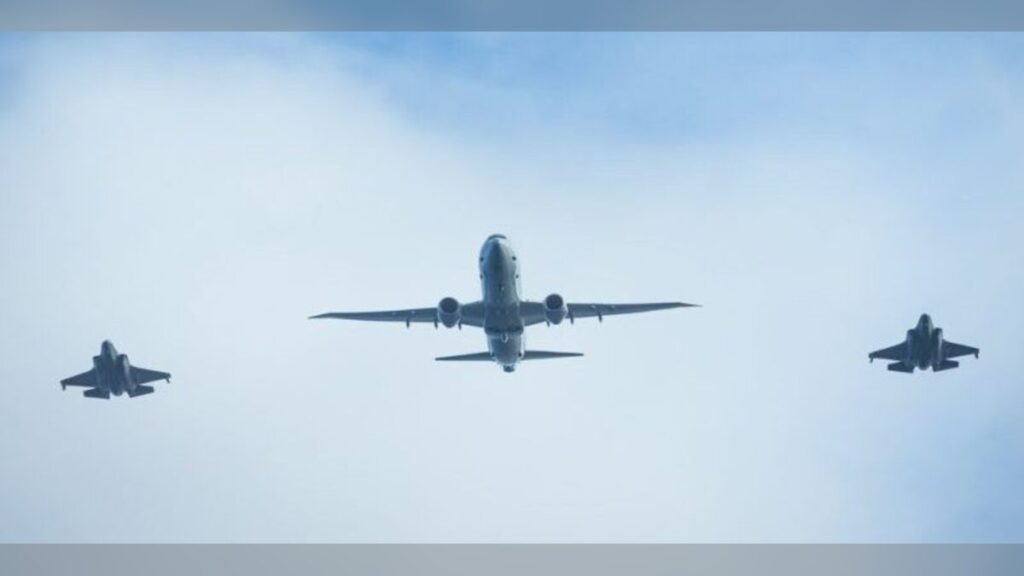
P-8 Poseidon patrols are routinely conducted in the region alongside Norwegian fighter escorts and naval support.
These missions are often supported by F-35 Lightning II aircraft and frigates as part of coordinated NATO monitoring operations.
Norway plays a key role in tracking Russian military activity in the Arctic and North Atlantic approaches.
Close Encounters Over Arctic Waters
During the Easter period, reports emerged of an unusually close aerial encounter in the Arctic region.
Norwegian forces confirmed that Russian aircraft were operating in proximity to NATO-monitored airspace during routine surveillance flights.
While Russian officials reportedly insisted the activity was non-hostile, NATO observers described the situation as highly sensitive.
Rising Activity Beneath the Sea
Tensions were not limited to the air.
Recent reports also describe joint Norwegian and British naval operations tracking Russian submarine movements in the North Sea.
These submarines were suspected of monitoring or attempting to disrupt undersea infrastructure such as communication cables and pipelines.
Submarine Movements Under Close Surveillance
One reported operation involved a Russian submarine departing from the Kola Peninsula, which initially appeared to act as a diversion in international waters.
However, surveillance aircraft and naval forces tracked multiple Russian submarines operating in the same region.
Coordinated monitoring by Norwegian and British forces reportedly led the vessels to withdraw under sustained observation.




Viral Fighter Jet Encounter Sparks Debate
Over Easter weekend, another incident gained attention after footage emerged showing a Russian fighter jet flying unusually close to NATO aircraft.
The aircraft reportedly flew alongside a Norwegian F-35 Lightning II and passed beneath a Norwegian P-8 surveillance plane known as “Ulabrand,” based at Evenes Air Base.
The pilot involved is believed to be part of an elite Russian aerobatic unit known for highly skilled flying maneuvers.
Norway Responds with Measured Tone
Norwegian defense officials confirmed the incident but described it as handled through established military communication channels.
They emphasized that encounters between Russian and Norwegian forces are routinely documented and communicated between command structures.
Military spokespersons noted that despite tensions, interactions in the air often remain professional.
Experts Divided on Conduct
Military analysts and academics have offered mixed interpretations of the incidents.
Some argue that the maneuvers reflect routine but risky military posturing in a highly strategic region.
Others suggest certain actions fall outside typical Norwegian operational standards, even if not considered immediately dangerous.
Political Messaging and Strategic Pressure
Commentators say the incidents may also reflect broader geopolitical signaling, particularly as NATO increases cooperation in the Arctic.
Some analysts believe Russia may be reacting to stronger Western coordination in the region, including joint operations with the United Kingdom.
Concerns have also been raised that rising global tensions could increase the likelihood of miscalculation.
Norway’s Defense Posture Remains Cautious
Norway continues to strengthen its military presence in the Arctic while maintaining a policy of non-provocation.
Prime Minister Jonas Gahr Støre has repeatedly stated that Norway does not pose a threat to any nation.
Impact and Consequences
The growing number of encounters underscores the Arctic’s rising importance as a geopolitical flashpoint.
Increased military activity raises the risk of accidental escalation, even when interactions remain non-hostile.
At the same time, NATO surveillance operations continue to expand to protect critical infrastructure in the region.
What’s Next?
Military monitoring in the Arctic is expected to continue at a high tempo, especially as submarine and aerial patrols increase.
NATO allies are likely to maintain coordinated surveillance efforts to track Russian activity in the region.
Future incidents may further test communication channels between the two sides.
Summary
Norway has reported frequent aerial and naval encounters with Russian forces in the Arctic and North Sea regions.
While both sides describe most interactions as controlled, the frequency and proximity of incidents highlight rising strategic tension.
Bulleted Takeaways
- Norway scrambled jets over 40 times to track 53 Russian aircraft
- Arctic region remains a key NATO surveillance zone
- Close aerial encounter reported during Easter patrols
- Russian submarine activity monitored by Norwegian and British forces
- Fighter jet incident involved F-35 and P-8 surveillance aircraft
- Officials describe encounters as largely professional but sensitive
- Experts warn of rising geopolitical tension in the High North
- Norway maintains defensive posture while avoiding provocation
