
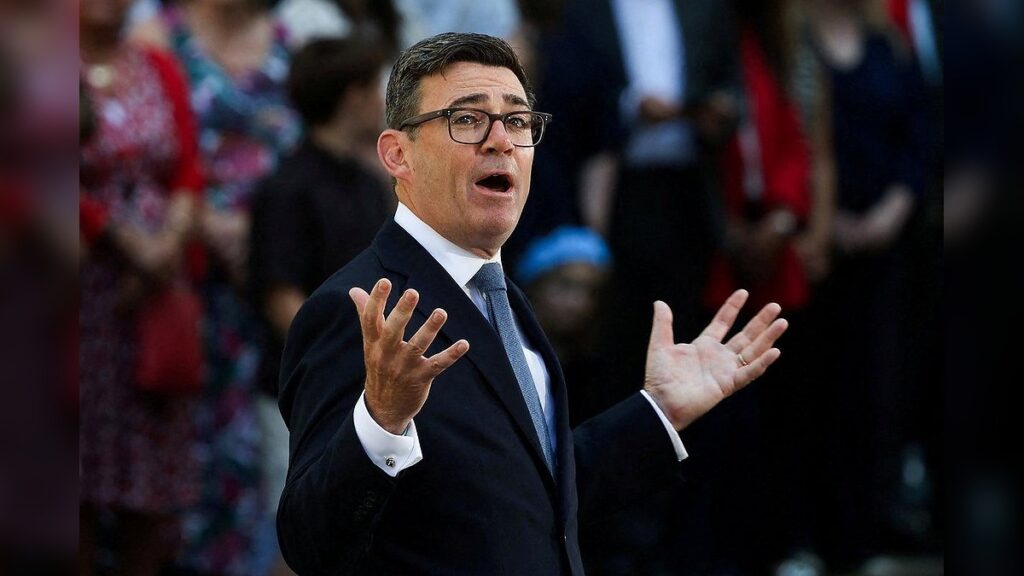
Prime Minister Andy Burnham has unveiled an £850 million package to remove VAT from household electricity bills across England, Scotland and Wales, marking one of the first major domestic policies of his administration.
The measure, due to take effect on October 1, is designed to reduce pressure on families facing high living costs, with the Government estimating average annual savings of around £45 per household.
However, the policy will not automatically apply in Northern Ireland because electricity VAT remains governed by European Union rules under the Windsor Framework.
Instead, the UK Government intends to provide funding to the Stormont Executive so that residents receive financial support equivalent to the tax reduction available elsewhere in the UK.
Stormont Minister Condemns Impact of Windsor Framework
Communities Minister Gordon Lyons has argued that Northern Ireland’s exclusion from the direct VAT cut highlights what he described as the flaws in the region’s post-Brexit arrangements.
Speaking during an interview with BBC Radio Ulster’s Nolan Programme, the Democratic Unionist Party (DUP) minister said the situation demonstrates how EU regulations continue to affect decisions that apply across the rest of the United Kingdom.
Lyons claimed Westminster has not done enough to restore Northern Ireland’s position within the UK internal market, arguing that the Government has been too willing to accept restrictions created by the Windsor Framework rather than challenge them.
Call for Direct Agreement With the European Union
Rather than relying on Stormont to distribute equivalent financial assistance, Lyons said ministers should seek a formal derogation from the European Union that would allow Northern Ireland to benefit from the same VAT exemption as the rest of the UK.
According to him, obtaining EU approval would provide a simpler and fairer solution for households.




He suggested the Government had instead chosen the easier option by transferring responsibility to the devolved administration instead of negotiating changes with Brussels.
Lyons questioned what practical impact a VAT reduction in Northern Ireland would have on the EU single market, arguing that existing rules create unnecessary complications instead of addressing genuine post-Brexit concerns.
DUP Welcomes Some Government Policies but Seeks Wider Reforms
While criticising the handling of the VAT issue, Lyons acknowledged that Burnham had introduced policies previously championed by the DUP.
Among the Prime Minister’s early decisions are the cancellation of the previous government’s proposed digital identity scheme and a commitment to expand council house construction.
Lyons welcomed those initiatives but said broader action is still required in areas including welfare policy, business support and incentives for workers.
He added that positive announcements must ultimately be matched by tangible outcomes.
Appointment of Northern Ireland Secretary Draws Political Response
Political debate also intensified following the appointment of Sir Chris Bryant as Northern Ireland Secretary.
Traditional Unionist Voice (TUV) leader Jim Allister criticised the appointment on social media, describing Bryant as strongly supportive of the European Union and expressing little confidence that he would defend Northern Ireland’s interests in future negotiations involving EU rules.
Bryant responded publicly by saying he looked forward to working with Allister in support of a strong Northern Ireland within a strong United Kingdom.
DUP Leader Raises Concerns Over Unequal Treatment
DUP leader Gavin Robinson echoed concerns over the electricity VAT arrangements while speaking to reporters in East Belfast.
Although acknowledging Bryant’s favourable view of the European Union, Robinson argued that Northern Ireland should not be disadvantaged compared with other parts of the UK.
He pointed to the Government’s decision to compensate Northern Ireland through funding rather than applying the VAT exemption directly, arguing this illustrated the continuing influence of EU approval mechanisms under the Windsor Framework.
Robinson questioned why ministers had not sought permission from Brussels to implement the same tax change across the entire United Kingdom, suggesting the approach raised wider questions about the Government’s strategy for managing relations with both the EU and Northern Ireland.
