
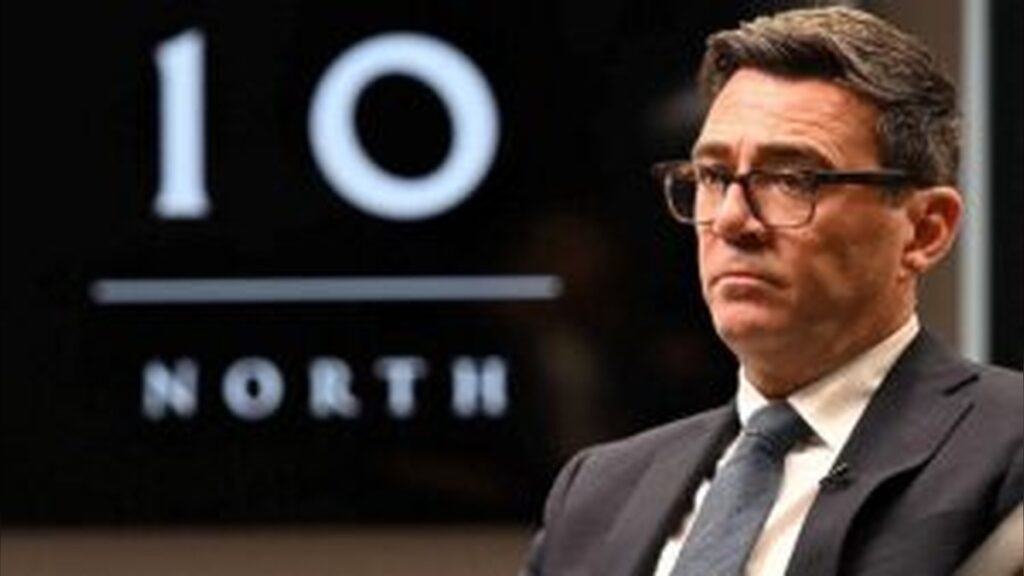
Andy Burnham is facing growing political opposition over claims that his planned social care reforms could involve an £18 billion-a-year “death tax” to fund a major overhaul of the system.
The Greater Manchester mayor is expected to outline his proposals in a major speech this week as he seeks support from political parties across the divide.
However, suggestions that the reforms could require new taxes have already triggered fierce criticism from opponents.
Proposed Care Levy Sparks Political Storm
Burnham has previously backed the idea of a national care levy, and reports suggest he supports introducing a 10 per cent charge on estates after someone dies as a replacement for the current inheritance tax system.
The proposal has been described by critics as a “death tax”, with opponents arguing it would unfairly affect families who have spent decades saving and building assets.
The estimated cost of making social care free at the point of use is around £18 billion annually, raising questions over how the government would cover the expense.
Reform UK Promises Fight Against New Tax
Reform UK leader Nigel Farage has strongly rejected any plan that increases the tax burden on households.
Farage said his party would oppose a death tax “every step of the way”, arguing that the policy would hit ordinary families who had worked hard and saved throughout their lives.
He claimed the proposed measure would mainly affect lower-middle-class households that had already contributed significantly through existing taxes.
Reform’s Treasury spokesman Robert Jenrick also criticised the idea, warning that an £18 billion levy would place additional pressure on people already facing high living costs.
Conservatives Demand Clear Funding Guarantees
Conservative leader Kemi Badenoch has also challenged Burnham’s plans, calling on him to rule out tax increases and additional borrowing to fund social care reforms.




In a letter to the Prime Minister, Badenoch warned against creating a system where future generations would be left paying for today’s decisions.
She said any solution must protect people who have saved for their retirement and argued that funding should come from reducing existing government spending rather than increasing taxes.
Long-Running Battle Over Social Care Reform
Reforming social care has been a long-standing ambition for Burnham, who first attempted to tackle the issue while serving as health secretary under Gordon Brown’s Labour government in 2010.
Those earlier proposals faced strong Conservative opposition and ultimately failed to become reality.
Burnham now believes fixing social care is essential to reducing pressure on the NHS, arguing that the current system contributes significantly to hospital overcrowding and delayed discharges.
Burnham Warns NHS Could Collapse Without Action
Speaking during a BBC interview, Burnham warned that the NHS would struggle to recover unless social care was fundamentally changed.
He argued that many patients end up in hospitals unnecessarily because support services in the community are unable to meet their needs.
According to Burnham, people often remain in hospital even after they are medically fit to leave because adequate social care arrangements are unavailable, creating additional costs and increasing pressure on healthcare services.
He said he would use his political influence to deliver major reform but admitted he could not provide a specific timeline for introducing a completely new system before the 2029 general election.
Current System Leaves Families Facing High Costs
Unlike NHS treatment, social care is not currently free at the point of use.
Many people are forced to contribute heavily towards their care costs, with some families facing the difficult decision of selling property to cover expenses.
People with savings above £23,250 are generally not eligible for council support towards care costs.
With adult social care spending already reaching around £35 billion a year and expected to rise as the population ages, politicians across parties agree that change is needed—but remain divided over how it should be paid for.
Liberal Democrats Call for Cross-Party Solution
Liberal Democrat leader Ed Davey welcomed the push for reform, saying many carers would feel encouraged that politicians were finally taking social care seriously.
Davey said he was prepared to work with other parties to create a long-term solution, insisting that family carers should be central to any new approach.
He argued that the ultimate goal should be ensuring everyone receives the care they need without people being forced to lose their homes because of the costs involved.

