
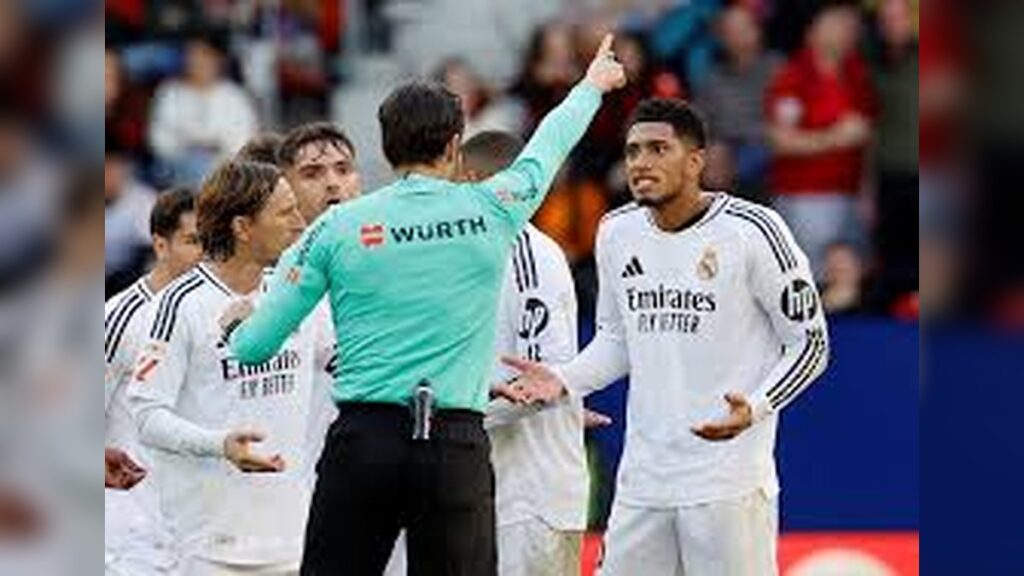
England’s goalless draw with Ghana at the World Cup has become the center of a growing controversy after Jude Bellingham avoided punishment for an incident that has already led to a red card elsewhere in the tournament.
Critics have questioned whether referees are applying the competition’s new disciplinary rules consistently, with some foreign media outlets accusing officials of showing England preferential treatment.
New Rule on Concealed Conversations Under the Spotlight
The debate revolves around a regulation introduced earlier this year by football lawmakers aimed at curbing misconduct hidden from cameras and officials.
The rule allows players to cover their mouths during ordinary conversations, but referees now have the authority to issue a red card if the action occurs during what they interpret as a confrontational exchange.
The law was created following controversy in European football last season, when allegations emerged during a Champions League match involving Real Madrid and Benfica.
The case eventually resulted in disciplinary action for homophobic conduct, prompting football authorities to tighten regulations around players concealing conversations during heated incidents.
Why Almiron Was Sent Off — and Bellingham Was Not
The contrast between Bellingham’s case and that of Paraguay’s Miguel Almiron has fueled accusations of inconsistency.
Almiron became the first player dismissed under the new regulation after covering his mouth while arguing with Turkey defender Mert Muldur during Paraguay’s opening World Cup match.
Although the referee initially missed the incident, VAR reviewed the footage after Muldur alerted officials, leading to a red card and subsequent suspension.
Bellingham, however, escaped any sanction when cameras captured him covering his mouth while speaking to Ghana striker Jordan Ayew during Tuesday’s match in Boston.
Because the referee did not view the exchange as a serious confrontation, no disciplinary action followed.
Grey Areas Leave Room for Interpretation
The differing outcomes have highlighted the subjective nature of the new rule.
Officials are required to judge not only the act itself but also the context in which it occurs.
In Almiron’s case, the exchange was clearly viewed as part of a heated dispute.
Bellingham’s interaction with Ayew appeared less aggressive, creating a situation where interpretation played a decisive role.




That uncertainty has led many observers to question whether players are receiving equal treatment under the law, especially when similar actions can result in dramatically different consequences.
International Media Questions England’s Treatment
Several European publications seized on the incident after the match.
French outlet RMC Sport argued that Bellingham had been fortunate to avoid punishment, comparing the situation directly with Almiron’s dismissal.
The publication also pointed to other contentious moments during the match, including appeals for a Ghana penalty and complaints regarding challenges involving England goalkeeper Jordan Pickford, suggesting that multiple decisions favored the Three Lions.
The criticism added to a wider narrative that England benefited from a series of close calls during a frustrating evening for Thomas Tuchel’s side.
Tensions Boil Over Before Half-Time
The controversy was intensified by events leading into the halftime break.
The flashpoint began when Bellingham collided heavily with Ghana defender Jerome Opoku.
Many expected the England midfielder to receive a booking, but no card was shown.
Shortly afterward, tempers flared as players from both teams headed toward the tunnel.
Bellingham exchanged words with Ghana players and was also seen involved in a heated discussion near the technical area.
The confrontation required intervention from staff members as emotions threatened to spill over.
Queiroz Reveals What Happened
After the match, Ghana manager Carlos Queiroz provided his account of the confrontation.
The veteran coach claimed Bellingham reacted angrily following the challenge on Opoku and admitted that strong language was exchanged during the heated moment.
Queiroz insisted his primary concern was the welfare of his player after the challenge, but acknowledged that emotions escalated quickly as both sides became involved.
Despite the tension, the Ghana boss dismissed the incident as a normal part of high-level football, describing it as an emotional exchange rather than something extraordinary.
England’s Performance Also Comes Under Fire
While refereeing dominated many headlines, England’s display attracted criticism of its own.
Despite controlling possession for long stretches, Tuchel’s team struggled to create clear opportunities against Ghana’s disciplined defensive setup.
England managed only a handful of efforts on target and were unable to find a breakthrough.
Their best chance arrived late in the contest when Nico O’Reilly struck the post before Harry Kane blasted the rebound over the crossbar.
Concerns Over Familiar Problems Resurface
The disappointing performance prompted comparisons with the latter stages of Gareth Southgate’s reign.
Spanish media suggested England’s difficulties against a deep defensive block echoed familiar frustrations that supporters hoped had disappeared following Southgate’s departure.
For Tuchel, the challenge now is ensuring the lack of cutting edge against Ghana proves to be an isolated setback rather than a recurring issue as the tournament progresses.
Although debate over Bellingham’s conduct continues, England’s bigger concern may ultimately be their inability to turn dominance into goals when it matters most.

