
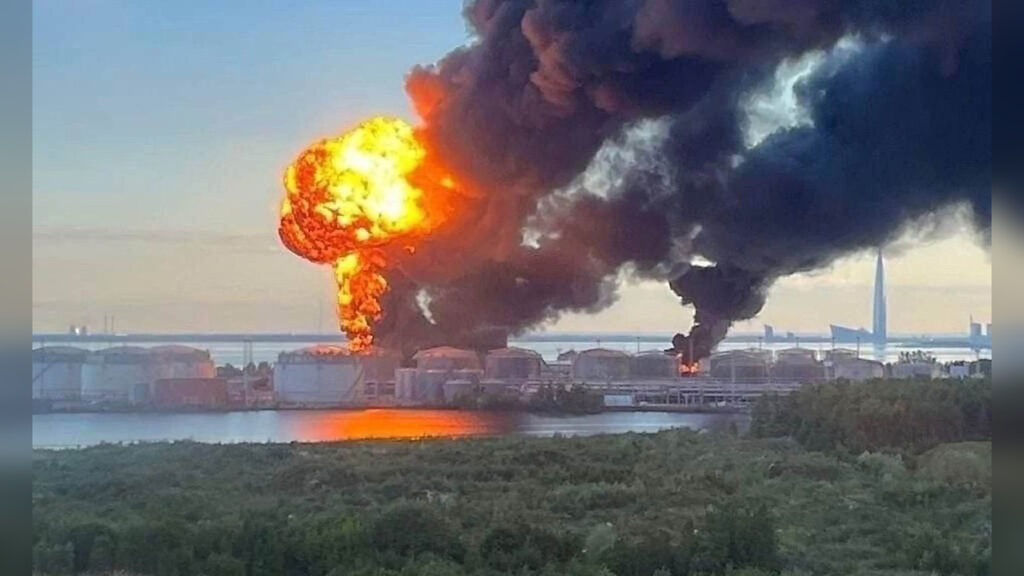
A major oil terminal in St Petersburg was struck in a coordinated Ukrainian drone attack, sending thick smoke over one of Russia’s key Baltic export facilities just hours before a flagship international economic forum opened in the city.
The facility, located at the Great Port of St Petersburg on the Gulf of Finland, is among Russia’s largest fuel storage and export hubs, processing millions of tons of petroleum products annually.
The strike disrupted operations at a site positioned only a short distance from the venue hosting the St Petersburg International Economic Forum.
The timing of the attack appeared deliberately aligned with preparations for the high-profile event, often referred to as “Russia’s Davos,” which is designed to project economic strength and attract foreign investment despite ongoing Western sanctions.
Explosions Shake City Ahead of Putin’s Economic Showcase
Residents across St Petersburg reported hearing sustained explosions and witnessing drones moving across the skyline, including areas near the Lakhta Centre, the city’s tallest skyscraper.
Flights at Pulkovo Airport were significantly delayed, with dozens of services affected as air defence systems were activated.
Local authorities later claimed that a large number of incoming drones had been intercepted, though visible damage and fires suggested multiple successful strikes.
Witnesses described hours of continuous blasts, with one resident saying the city experienced “thunderous explosions” that left neighbourhoods shaken as emergency services moved toward affected areas.
Naval Base at Kronstadt Also Targeted
Alongside the oil terminal strike, Ukraine also hit infrastructure linked to the naval base at Kronstadt, a key facility for Russia’s Baltic Fleet.
Regional officials confirmed damage to “infrastructure facilities” at the base and reported several injuries, though they denied any fatalities.
Independent footage and Ukrainian sources suggested that up to four vessels may have been struck during the operation.
Among the vessels reported damaged was the corvette Boykiy, a Steregushchy-class warship valued at approximately £120 million and in service since 2013.
Video circulating online appeared to show the ship engulfed in flames, though these claims have not been independently verified by Russian authorities.
Kremlin Region Officials Downplay Damage Amid Contradictory Reports
St Petersburg governor Alexander Beglov acknowledged that infrastructure had been hit at Kronstadt but avoided confirming the extent of the damage to military assets.




Cleanup operations were said to be underway, with injured personnel receiving treatment.
Elsewhere, regional authorities claimed that dozens of drones were intercepted before reaching their targets.
However, those claims contrasted with widespread visual evidence of fires at the oil terminal and port facilities.
Russian sources also alleged, without presenting evidence, that Baltic states may have enabled Ukrainian operations through airspace access—an accusation firmly denied in previous incidents by Estonia, Latvia, Lithuania, and Finland.
Economic Forum Proceeds Under Shadow of War
The strikes occurred just as the St Petersburg International Economic Forum opened, bringing delegates from dozens of countries, including a limited US presence, while most Western NATO states stayed away.
The event is a cornerstone of Russia’s economic diplomacy and is intended to signal resilience amid sanctions and war-related isolation.
This year’s theme emphasised “pragmatic dialogue,” a message quickly overshadowed by the scale of the attacks unfolding nearby.
High-profile attendees were expected to include senior Russian officials and international guests, while family members of Vladimir Putin were also scheduled to appear as speakers during the forum programme.
Intelligence Claims Raise Questions Over Kremlin Awareness
A Washington-based defence think tank assessing the war suggested that Russian leadership may be receiving distorted battlefield assessments, potentially shaping strategic decisions in Moscow.
The analysis argued that repeated overstatements of military success may be contributing to a false perception within the Kremlin that Russia can still achieve its objectives in the medium term, despite mounting battlefield pressure and economic strain.
Wider Escalation Across Russian Territory
The St Petersburg strikes formed part of a broader wave of attacks across Russian-controlled areas.
Reports indicated a bus strike in occupied Donetsk that left multiple casualties, while a weapons production facility in the Tambov region was also engulfed in flames following separate drone activity.
The Progress plant, which produces aviation and missile control systems, was among the industrial sites reportedly affected.
These developments came shortly after Russia launched one of its largest coordinated aerial barrages on Ukraine in recent months, involving hundreds of drones and missiles that caused significant casualties across several Ukrainian cities.
Economic Strain Deepens Behind the Frontlines
Beyond the battlefield, Russia’s wartime economy is facing mounting pressure, with rising defence spending, sanctions, and declining fiscal flexibility combining to strain national finances.
Government forecasts have pointed to widening budget deficits and slowing growth, while fuel shortages have been reported in regions such as Crimea, where residents have faced long queues at petrol stations and rationing measures.
Economic analysts warn that sustained military expenditure is increasingly difficult to maintain without structural adjustments, with internal debate emerging over whether defence spending can continue to expand without deeper cuts elsewhere.
Uncertainty Grows as War Enters New Phase
With attacks now reaching deeper into symbolic and strategic Russian territory, the conflict is increasingly shaping both economic and political narratives inside Russia.
The strike on St Petersburg’s oil infrastructure—carried out as the country hosted its most prominent economic showcase—underscores how the war continues to spill into core domestic spaces once considered far from the frontline.
As both sides escalate operations, the overlap between battlefield pressure and economic strain appears to be tightening, leaving Russia facing growing challenges on multiple fronts simultaneously.
