
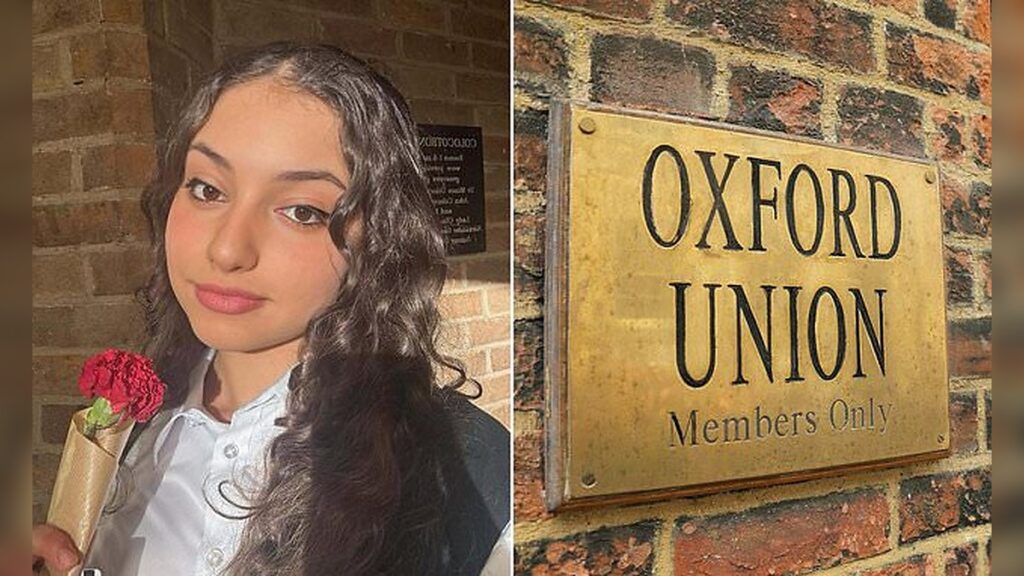
Pressure is intensifying on the president of the Oxford Union after private messages allegedly attributed to her surfaced, prompting accusations that she made comments suggesting Hamas could one day be “lauded as heroes” and describing the October 7 attacks in terms of “proportionality.”
The remarks were reportedly shared in a WhatsApp group made up of around 100 incoming students preparing to begin their studies in Politics, Philosophy and Economics at the University of Oxford.
The group became the setting for a heated exchange over the Israel–Gaza conflict, during which Arwa Elrayess, a PPE student and current Union president, responded to questions about her interpretation of the violence and its context.
According to the messages, she referenced what she described as decades of mistreatment of Palestinians and argued that the events of October 7 should not be viewed in isolation from that broader historical backdrop.
Debate Over “Proportionality” and October 7 Comments
In the exchange, one student challenged the framing of the October 7 attacks as potentially “proportional.”
Elrayess is said to have replied that she did, in fact, view the argument as defensible, while adding that some could even consider the response “less than proportional,” given the circumstances she attributed to long-standing conflict.
She also stated that proportionality, in her view, should not be interpreted as moral justification, but rather as an explanation of why such events were not unexpected.
Her comments further expanded into a broader argument about cycles of violence in conflict zones.
She suggested that resistance movements are often labeled as terrorist organisations by Western governments until political outcomes shift historical narratives, citing examples such as the Irish Republican Army and the Palestine Liberation Organization, which she described as having engaged in guerrilla warfare and violence before later receiving reassessment in historical memory.
In another message, she wrote that attempts by Palestinians to achieve independence through non-violent methods had, in her view, been met with failure and further suffering, reinforcing what she characterised as the inevitability of violent escalation under prolonged oppression.
She also referred to personal family experiences connected to Gaza, stating that her relatives had endured repeated loss and trauma, and described the scale of suffering in the region as comparable to “many October 7ths.”
Growing Institutional and Student Response
The comments have triggered strong condemnation from sections of the university community, with critics arguing that the remarks cross the line between political analysis and the normalisation of extremist violence.




A student organisation, Oxford Students Against Discrimination, said the messages were deeply distressing for Jewish students and contributed to an environment of fear and exclusion.
The group called for her resignation, arguing that leadership of a major student institution carries responsibility for maintaining trust and safety across the university community.
Former members of the Oxford Union have also weighed in, with one describing the statements as “sickening” and incompatible with the principles of open academic debate.
They argued that the comments amounted to the normalisation of violence rather than legitimate political discourse.
Oxford Union Leadership Under Renewed Scrutiny
The controversy adds to a series of recent leadership challenges within the Oxford Union.
The organisation has faced internal turbulence in recent months, including the removal of a previous president following unrelated controversial remarks made after the assassination of conservative commentator Charlie Kirk.
Under Elrayess’ tenure, the Union has also drawn attention for inviting a range of high-profile and polarising speakers, including political commentators whose planned appearances were later affected by visa decisions linked to public interest considerations.
These developments have placed renewed focus on the Union’s governance, its speaker choices, and the wider question of how it balances free speech with institutional responsibility.
Response From Arwa Elrayess
Responding to the criticism, Elrayess said her messages were taken from informal conversations and were not intended as formal or public statements.
She stated that her comments were aimed at discussing proportionality in conflict rather than endorsing violence.
She emphasised that she does not support breaches of international law, including the targeting of civilians, hostage-taking, or other actions she described as grave violations, regardless of which side commits them.
Elrayess also argued that her remarks were meant as a contextual analysis of long-running political and humanitarian conditions, not as an endorsement of any specific act of violence.
She further noted that part of the discussion referenced the broader regional conflict and related political developments at the time.
Wider Reactions and Calls for Action
The messages have also drawn strong responses from advocacy organisations.
Campaign groups opposing antisemitism described the comments as deeply offensive and argued that they were incompatible with holding a leadership role in a prominent student institution.
Some critics have gone further, suggesting the matter should be examined by university authorities and potentially reviewed through legal channels, citing concerns over the potential impact of such statements on campus safety and community relations.
As debate continues across the university, pressure is mounting on both the Oxford Union and the wider institution to determine whether disciplinary action or resignation is warranted, or whether the comments fall within the boundaries of protected political expression in an increasingly polarised academic environment.
