
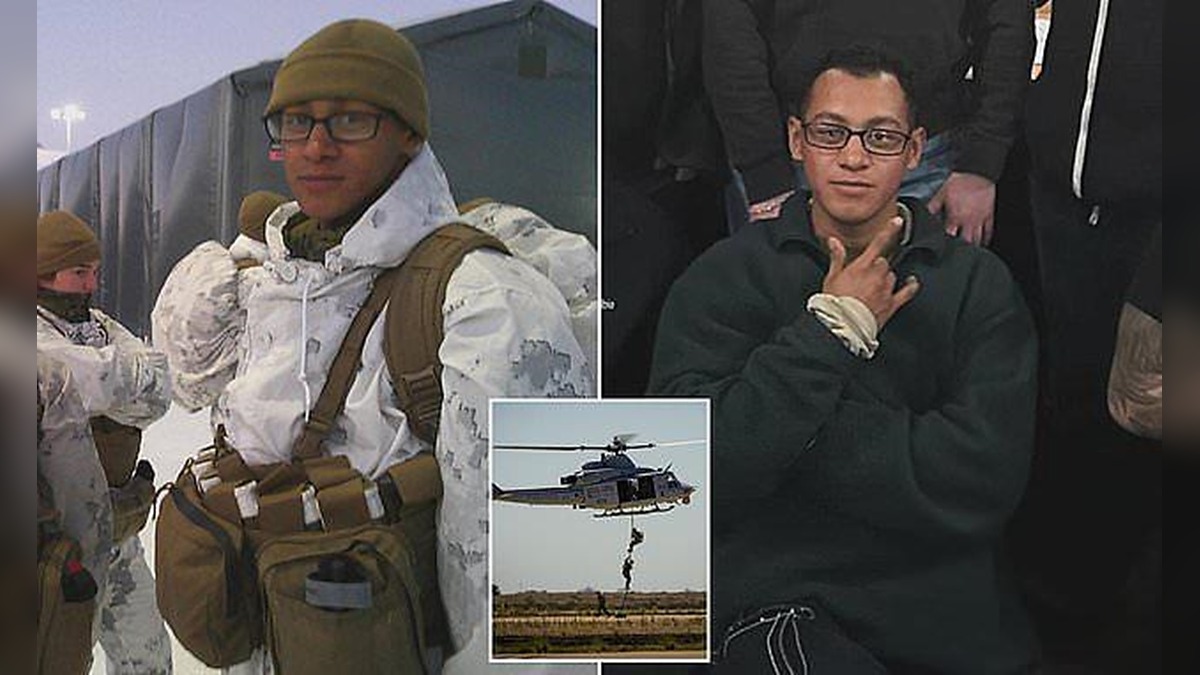
A 25-year-old US Marine has died after sustaining injuries during a military training exercise in Japan, just weeks after another American service member was killed in a fatal rappelling accident at a football stadium in Texas.
Lance Cpl Devin J Hernandez was taken to hospital on Tuesday evening following an incident during fast-roping training at Marine Corps Camp Schwab in Japan.
He was later pronounced dead at US Naval Hospital Okinawa at Camp Foster, military officials confirmed.
The circumstances surrounding the incident have not yet been established, and an investigation is underway.
Marine Sustains Fatal Injuries During Training in Japan
Hernandez, who was from Maryland, served as a combat engineer with the 2nd Battalion, 6th Marine Regiment, 2nd Marine Division, based at Camp Lejeune in North Carolina.
During his military service, he had earned the Navy Arctic Service Ribbon.
Officials have not disclosed the nature of the injuries he suffered or explained what happened during the exercise.
Fast-roping is a military technique that enables personnel to descend rapidly from helicopters or Osprey tiltrotor aircraft using thick ropes.
The method is used to deploy troops into locations where a conventional landing may not be possible.
At Camp Schwab, Marines first practise the technique on a rappel tower before advancing to exercises involving aircraft.
Marine Division Pays Tribute to Hernandez
Maj Gen Kyle Ellison, commander of the 3rd Marine Division, confirmed the Marine’s death in a statement, expressing condolences to his family and colleagues.
“The Marines and Sailors of 3rd Marine Division mourn the loss of one of our own,” Ellison said.
He added that the division extended its deepest sympathies to Hernandez’s relatives, friends and fellow Marines.
Ellison also said the military’s immediate priority was supporting those affected by the death while investigators worked to establish the circumstances surrounding the incident.




Maryland Governor Wes Moore also paid tribute to Hernandez, describing him as a resident of the state who had volunteered to serve the United States.
“We are stronger and safer because of his dedication and patriotism,” Moore said.
The governor added that he and his wife were mourning alongside Hernandez’s family, friends and fellow service members and would keep them in their prayers.
Death Comes Weeks After Airman’s Fatal Stadium Accident
Hernandez’s death comes weeks after another US military serviceman, Tech Sergeant Ian Patterson, 37, died following a rappelling accident during a Navy-University of Texas football game at the Alamodome in San Antonio.
Patterson, a decorated airman who had served in the military for more than 15 years, fell from the stadium rafters after apparently losing his grip on a rope during a pre-game stunt.
Footage of the incident showed him descending from the stadium structure before losing control and plunging to the ground.
Emergency personnel treated him on the field for approximately 10 minutes before he was transported to hospital, where he later died, according to Nellis Air Force Base Public Affairs.
Investigation Examines Equipment Used in Patterson’s Fatal Fall
Investigators are examining the circumstances of Patterson’s death, including whether his harness and rope were correctly configured and whether the equipment had undergone an independent inspection before the stunt.
The San Antonio Express-News reported that questions had also been raised about a possible adjustment to Patterson’s rappelling equipment before he began his descent.
Patterson was a father of two and served as a tactical air control party (TACP) airman.
Personnel in the role work alongside combat units, coordinating precision airstrikes and artillery support.
Their training includes fast-roping from structures between 15 and 30 feet high, as well as rappelling from helicopters at heights of 100 feet or more.
A retired special operations officer told the Express-News that he had heard reports Patterson may have attempted to correct a problem with his rappelling equipment before stepping off the platform.
However, the information had not been independently verified.
The former officer stressed that investigators needed to establish the facts before drawing conclusions about the incident.
Military Stresses Need for Equipment Inspections
The retired officer also highlighted the importance of checking rappelling equipment whenever adjustments are made, regardless of an individual’s experience.
He explained that personnel must verify the equipment’s connections and load-bearing components before use, with another inspection required whenever changes are made.
He said established safety procedures were designed to protect all personnel, including those familiar with the equipment.
Meanwhile, the 6th Combat Training Squadron declined to discuss specific details of the investigation.
In its statement, the squadron said the incident remained under investigation to establish the verified facts and determine its causes.
It added that discussing particular equipment or procedures before the independent investigation was completed would be inappropriate.
