
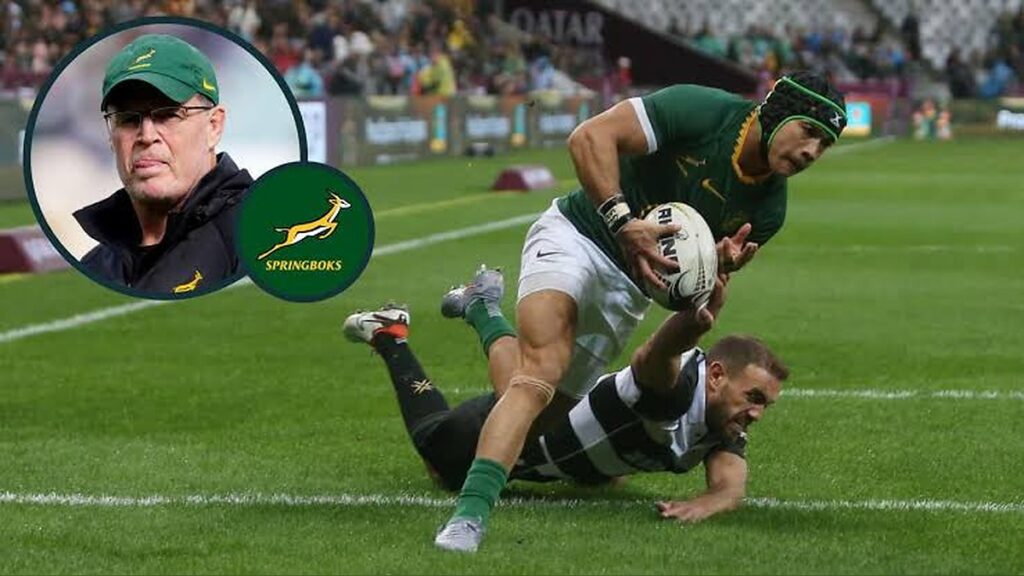
South African rugby has entered a new international cycle with head coaches Rassie Erasmus and Mzwandile Stick confirming their matchday squads for two opening fixtures against the Barbarians and Zimbabwe, scheduled for Saturday, 20 June, in Gqeberha.
The fixtures will see the national side take on an invitational Barbarians outfit, while a developing SA ‘A’ squad faces Zimbabwe earlier in the day at the Nelson Mandela Bay Stadium.
Double Header Set for Nelson Mandela Bay Stadium
The matchday schedule will begin at 12:00 with South Africa A rugby union team taking on Zimbabwe national rugby union team, before the main event at 15:00 featuring the Springboks against the Barbarians.
Both encounters are set to be broadcast live on SuperSport, with organisers expecting strong interest as the international season gets underway.
Blend of Experience and Emerging Talent in Springbok Squad
Erasmus has named a Springbok side featuring a mix of seasoned internationals and emerging talent, with a total of 18 capped players included in the matchday squad.
The starting XV includes established names such as Siya Kolisi, who will lead the team, alongside players like Aphelele Fassi, Cheslin Kolbe, and Jesse Kriel, forming a backline built around pace and physicality.
One of the key selection talking points is the inclusion of Quan Horn at flyhalf, a relatively unfamiliar role for the player at senior level, adding intrigue to the team composition.
Quan Horn Shift to Flyhalf Draws Major Attention
The decision to deploy Quan Horn in the No.10 jersey has emerged as one of the most discussed aspects of the squad announcement.
Horn, who has limited Test experience and has not previously established himself as a specialist flyhalf at senior level, will partner Grant Williams in a new-look halfback combination.




The tactical experiment highlights Erasmus’ intention to test squad depth and versatility early in the season.
Forward Pack Anchored by Senior Leadership
Up front, the Springboks will rely on a physically imposing pack featuring Ox Nche, Carlu Sadie, and Andre-Hugo Venter in the front row, while Franco Mostert and debutant Riley Norton form the engine room.
The loose trio of Kolisi, Pieter-Steph du Toit, and Jasper Wiese completes a forward unit designed to balance power and mobility.
On the bench, a six-forward split includes several uncapped or fringe players, reinforcing the developmental focus of the selection.
Erasmus Explains Selection Strategy and Squad Rotation
Head coach Rassie Erasmus said the selection reflects a broader plan to integrate returning injured players, overseas-based talent, and younger prospects into the international system.
He emphasized that the opening fixture provides an opportunity to test combinations while maintaining competitive standards against strong opposition.
Erasmus also noted that the Barbarians’ unpredictable playing style would present a unique challenge, requiring discipline and focus from his squad.
SA ‘A’ Side Built for Development and Depth Testing
In the earlier fixture, the South Africa A rugby union team will be led by Vincent Tshituka and features a combination of senior players and rising talent.
The squad includes experienced figures such as Lukhanyo Am, Phepsi Buthelezi, and Neethling Fouche, alongside younger players gaining exposure to international-level rugby.
Coach Mzwandile Stick has structured the team to provide both competitive balance and development opportunities across positions.
Zimbabwe Fixture Seen as Key Test Ahead of Rugby World Cup Cycle
Zimbabwe’s squad arrives with growing confidence following qualification for the 2027 Rugby World Cup, adding competitive significance to their clash with the SA ‘A’ side.
Stick described the fixture as an important evaluation tool for South Africa’s wider player pool, as the team continues building toward future international campaigns.
Season Opener Marks Start of New International Phase
With both squads finalised and training concluding in Johannesburg before departure to Gqeberha, South African rugby now turns its attention to on-field execution.
The double-header is expected to provide early indicators of squad depth, tactical experimentation, and emerging talent as the Springboks begin a demanding international season.

