
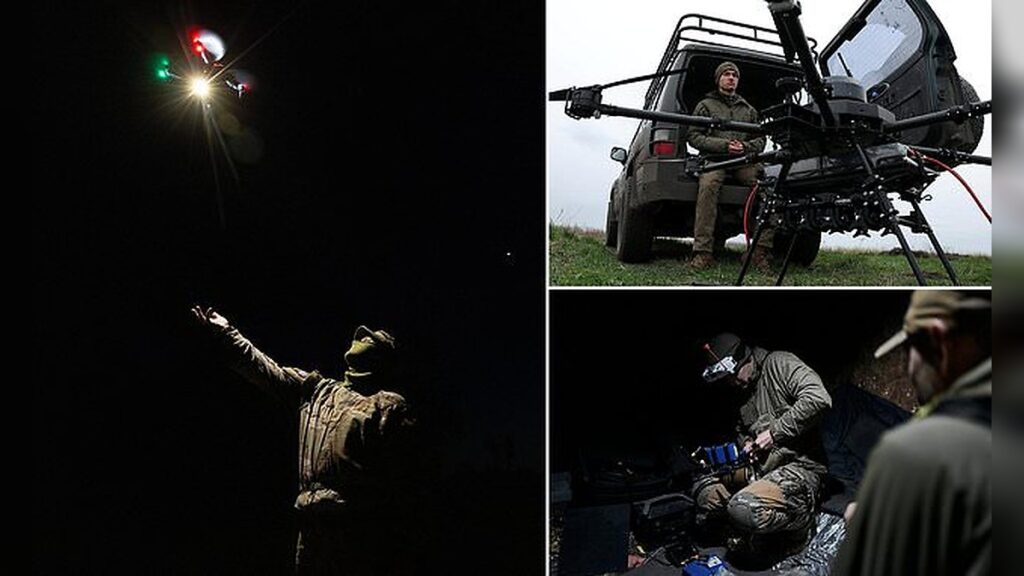
Military planners inside NATO are increasingly concerned that future conflicts could be shaped not by tanks or fighter jets, but by vast swarms of AI-coordinated drones operating in the thousands.
According to senior defence officials, this emerging form of warfare could reach a destructive scale that rivals traditional nuclear deterrence.
The warning reflects a rapid acceleration in both drone technology and artificial intelligence since Russia’s full-scale invasion of Ukraine in 2022, a conflict that has effectively turned into a real-time testing ground for autonomous systems and battlefield automation.
“Thousands of Drones, One Coordinated Brain”
Major-General Constantin-Adrian Ciolponea, representing the Supreme Allied Commander Transformation (SACT), has urged NATO to prepare for what he describes as a fundamental shift in military strategy over the next five years.
Speaking to The Times, Ciolponea said the next stage of drone evolution will move far beyond small-scale deployments.
Instead, future attacks could involve “thousands of drones commanded from a single point,” either by a human operator or a central “mother” drone acting as a control hub.
He warned that such swarm-based systems would merge mass and precision in ways current defence systems struggle to counter, reshaping traditional ideas of deterrence between rival states.
AI and Drone Technology Converging on the Battlefield
Since 2022, both artificial intelligence and unmanned aerial systems have evolved at exceptional speed in combat conditions, particularly in Ukraine.
NATO analysts now fear the two technologies are converging into fully autonomous battlefield systems.
Ciolponea described this integration as both “scary and reassuring,” noting that autonomous systems operating across land, air, and sea would be significantly harder to intercept or neutralise than conventional weapons.
He also warned that countries without access to such swarm capabilities could be forced into strategic dependency, either aligning with major security blocs or accepting the terms of more technologically advanced adversaries.
Reports of Fully Autonomous Drone Kill Systems
Concerns over automation in warfare intensified following reports published by New Scientist suggesting that fully autonomous drones may already have been used in combat without human oversight.
The report described quadcopter systems capable of travelling several miles in minutes before switching into an autonomous targeting mode reportedly referred to as “Terminator Mode.”




According to drone manufacturer Alexander Kokhanovskyy, these systems were designed to identify and eliminate targets independently once deployed, with no live video feed or remote control connection during execution.
While the claims remain difficult to independently verify, follow-up assessments reportedly indicated that such systems had struck multiple targets, including soldiers and a vehicle.
Ongoing War in Ukraine Fuels Escalation
The war between Russia and Ukraine continues to serve as the primary testing ground for these emerging technologies, with both sides increasingly relying on drone strikes and electronic warfare.
Volodymyr Zelensky has continued to call for stronger Western support while also pushing for accelerated integration into the European Union.
Meanwhile, Ukrainian officials reported renewed Russian strikes across multiple regions, including injuries in Zaporizhzhia, Sumy, and Kharkiv.
Local authorities confirmed that air raid alerts were briefly issued in Kyiv before being lifted.
Ukrainian counterstrikes have also targeted Russian industrial infrastructure, including facilities linked to missile electronics production in the Voronezh region, which reportedly resulted in multiple casualties.
Fuel Shortages and Economic Strain Inside Russia
Beyond the battlefield, the conflict is also placing pressure on Russia’s domestic economy.
Ukrainian attacks on supply routes and energy infrastructure have contributed to a widening fuel crisis across several Russian regions, including areas far from the front line.
Regions such as Omsk and Novosibirsk have introduced fuel restrictions to prevent panic buying and stabilise supply chains.
Limits on petrol and diesel purchases have already been implemented in some areas, with additional controls expected.
Local authorities have described the measures as necessary to manage speculative demand, as shortages spread across annexed territories and parts of Siberia.
Civilian Impact and Continued Strikes Across Frontline Cities
Daily life in frontline regions of Ukraine remains heavily affected by ongoing drone and missile attacks.
Reports from Zaporizhzhia describe residential buildings burning following overnight strikes, while emergency crews continue to respond to repeated bombardments.
Residents in eastern cities have described repeated strikes on civilian infrastructure, including apartment blocks and commercial areas.
In Kharkiv, Mayor Ihor Terekhov confirmed injuries following a drone attack, underscoring the continued reach of aerial warfare deep into populated areas.
NATO Expands Defence Planning as Tensions Rise in Europe
The escalation has prompted NATO members to accelerate defence spending and explore joint development of drone and counter-drone systems alongside Ukraine.
The conflict has also reshaped European security policy, contributing to the expansion of the alliance to include countries such as Sweden and Finland.
Military officials warn that drone swarm warfare represents not just a technological shift, but a structural change in how wars may be fought in the future—where speed, scale, and automation could outweigh traditional battlefield strength.
As both sides continue to adapt, NATO planners say the coming years will determine whether defensive systems can keep pace with a rapidly evolving, AI-driven form of conflict.
