
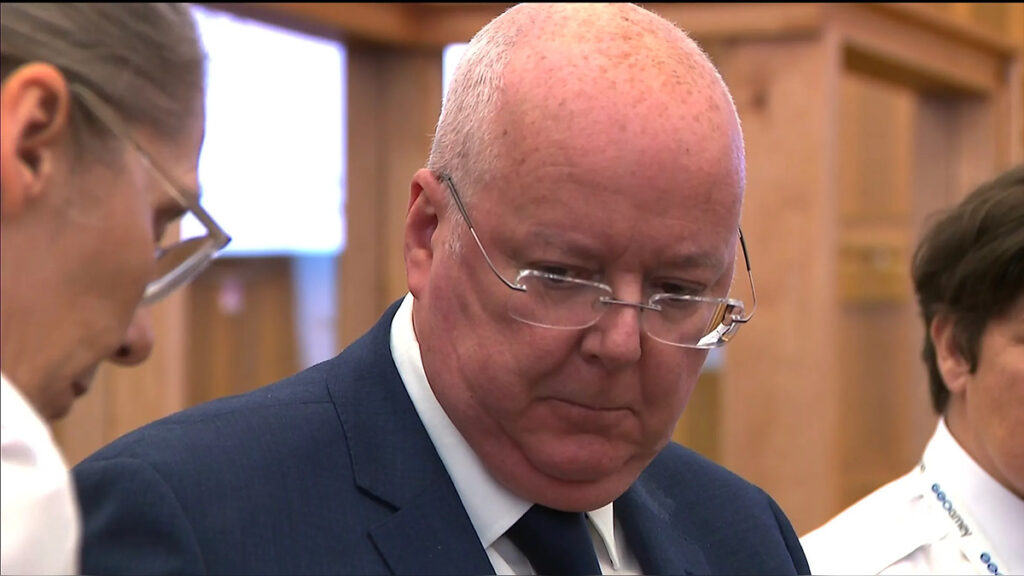
Former Scottish National Party chief executive Peter Murrell has been sentenced to five years and three months in prison after admitting he embezzled more than £400,000 from party funds over a 12-year period, a case that has sent shockwaves through Scotland’s political establishment.
The sentencing took place at the High Court in Edinburgh, where the judge described the conduct as a sustained and calculated pattern of dishonesty involving repeated fraudulent activity while Murrell held one of the most powerful administrative roles in the party.
Court Labels Crime as “Calculated Dishonesty” Over Years of Fraud
Delivering judgment, Lord Young said Murrell’s actions amounted to a deliberate and prolonged abuse of trust.
The court heard that the offending did not occur in isolated incidents but instead escalated steadily over more than a decade.
Murrell, who is the estranged husband of former First Minister Nicola Sturgeon, admitted to falsifying accounting records and generating fake invoices in an attempt to disguise the diversion of party money.
According to the judge, the offences grew in both frequency and scale over time, only coming to an end once investigators uncovered the scheme.
Luxury Spending Funded by Party Money
Evidence presented in court detailed how the stolen funds were used to finance a series of high-end personal purchases, including a £124,550 motorhome, luxury cars, jewellery, designer stationery, and expensive household items.
Prosecutors also revealed that Murrell spent nearly £43,000 on Amazon purchases delivered to the couple’s home near Glasgow, while some expenses were even disguised under vague descriptions such as “leadership costs.”



One particularly striking example cited in court was a £3,500 silver wine coaster, also logged as a party-related expense.
Fraud Hidden Through Fake Invoices and Manipulated Records
The court heard that Murrell used his position as chief executive of the Scottish National Party to access its main bank accounts, which were funded by membership fees, donations, and legacies.
He reportedly made direct transfers, used party charge cards, and submitted false expense claims while deliberately altering financial records to avoid detection.
Investigators later found that invoices had been fabricated and purchases were deliberately mislabelled within the party’s accounting system.
Investigation Triggered by Financial Concerns
The scheme came to light in March 2021 after complaints were raised about the management of SNP finances.
The resulting police investigation, known as Operation Branchform, uncovered extensive evidence of financial misconduct.
Authorities ultimately concluded that Murrell had repeatedly siphoned funds for personal benefit over many years before being arrested and charged.
Sturgeon Says She Was “Deceived and Betrayed”
The fallout from the case has also heavily affected Murrell’s estranged wife, Nicola Sturgeon, who has insisted she had no knowledge of the embezzlement.
She has described herself as “deceived, misled and betrayed” by her husband.
Sturgeon was previously arrested and questioned as part of the investigation but was later cleared of any wrongdoing, with Police Scotland confirming she would face no further action.
Political Pressure Mounts for Wider Inquiry
The case has sparked ongoing political debate, with senior figures calling for deeper scrutiny of how the SNP’s finances were managed during the period of the fraud.
Suggestions have been made for both Holyrood and Westminster committees to launch formal inquiries, while others have pushed the Scottish Affairs Committee to examine potential weaknesses in oversight systems.
Lawmakers have also questioned how public funds allocated to opposition parties, known as “short money,” may have been monitored during the years the offences took place, raising broader concerns about financial safeguards within political institutions.
