
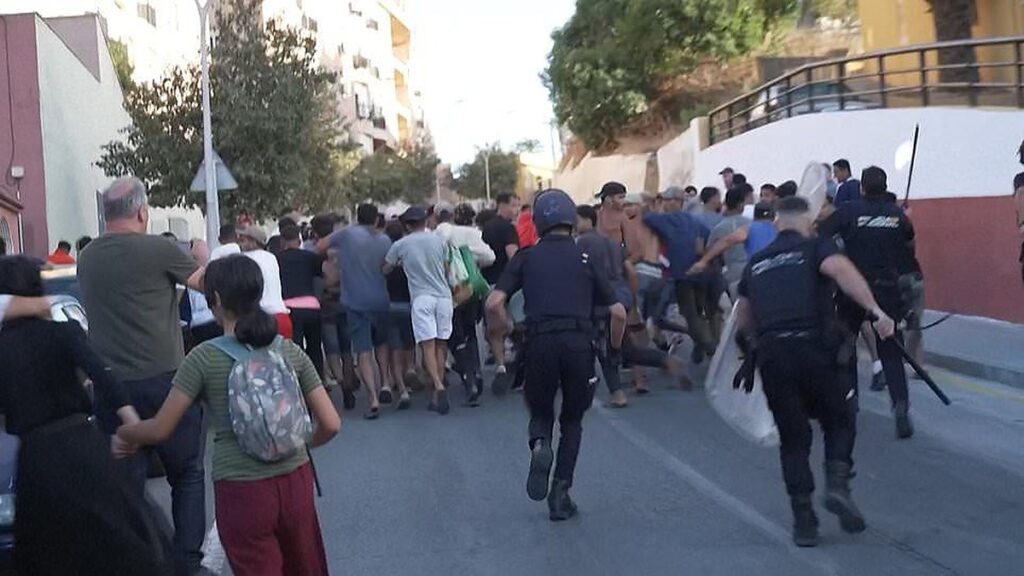
Spain’s North African enclave of Ceuta remains on edge after fresh confrontations erupted between migrants and Spanish police, just days after an unprecedented wave of arrivals overwhelmed the territory.
Demonstrations on Sunday escalated into clashes as tensions continued to mount following the mass crossing that saw around 60,000 people enter the enclave from neighbouring Morocco.
Video footage circulating online showed migrants carrying an injured man wrapped in a blanket while claiming he had been assaulted during police operations.
The group marched through parts of Ceuta chanting religious slogans before riot police moved in, leading to confrontations in which officers armed with batons dispersed demonstrators.
Historic Influx Overwhelms Spanish Territory
The unrest follows one of the largest migrant movements ever recorded into Ceuta, a Spanish territory bordering Morocco.
Within a single day, tens of thousands of people crossed into the enclave, with many reportedly swimming around coastal barriers to reach Spanish soil.
The extraordinary scale of the arrivals overwhelmed local authorities, with dramatic scenes showing migrants emerging from the sea, running along beaches and spreading across the city.
While many later returned to Morocco, the event left Ceuta struggling to cope with the humanitarian, logistical and security challenges created by the sudden influx.
Migrants Describe Border Crossing Circumstances
Several migrants claimed they were encouraged to make the journey toward Ceuta by Moroccan security personnel.
Mohammed Ahmidho, 37, said he travelled after seeing reports on social media and alleged that Moroccan officers urged people to continue toward Spain as they approached the border.
Others said viral social media posts promoted what they believed to be a legal opportunity to enter Spain after a recent ruling by Spain’s Supreme Court.
The court determined that migrants intercepted at sea while attempting to reach Ceuta or Melilla could not automatically be returned to Morocco, a decision some migrants reportedly viewed as creating a new pathway into Spanish territory.
Diplomatic Questions Surround Morocco’s Role
The scale and speed of the crossings have prompted renewed debate over Morocco’s role in the crisis.
Some analysts have suggested that Rabat may have relaxed border controls to increase diplomatic pressure on Madrid, particularly as Spain has strengthened relations with Algeria, Morocco’s regional rival.
Although Moroccan authorities have not accepted those claims, the political backdrop has added another layer of complexity to an already sensitive migration dispute between the neighbouring countries.
Violence Extends Beyond Ceuta
The instability spread beyond Ceuta into Spain’s other North African enclave, Melilla, where authorities also reported unrest.
In both territories, migrants were accused of forcing entry into buildings, while several vehicles were set on fire during days of disorder following the mass arrivals.




Large groups of migrants established makeshift camps along beaches, where many spent the night and held evening prayers while awaiting further developments.
European Governments Push for Coordinated Response
The migrant surge has triggered sharp reactions across Europe.
The European Union scheduled discussions after 22 member states signed a joint letter calling for urgent coordination to prevent additional uncontrolled crossings.
Italy announced it was considering extraordinary measures, including reviewing aspects of the Schengen free-travel system involving Spain.
Italian Prime Minister Giorgia Meloni argued that the events highlighted the security risks posed by irregular migration.
France responded by strengthening controls along its border with Spain, while Finland publicly backed proposals calling for tougher measures.
German Chancellor Friedrich Merz also urged Morocco to immediately readmit migrants who had entered Spain illegally.
Spanish Prime Minister Pedro Sánchez, however, criticised what he described as the “selfish” responses from some European partners, insisting that the situation required solidarity rather than political division.
Conflicting Fatality Figures Deepen Uncertainty
Authorities have released differing estimates regarding the number of deaths linked to the mass crossing.
Spanish officials reported that at least 72 people died during the incident, raising the previously announced toll.
Morocco’s Interior Ministry later disputed that figure, stating that 11 people had died while attempting to reach Ceuta, including 10 who drowned and one person who reportedly fell from a rocky coastal area.
The differing casualty counts have added further uncertainty to an already complex humanitarian situation.
Residents Describe Climate of Fear
Although conditions have gradually stabilised, many businesses temporarily closed and residents say anxiety remains widespread throughout the enclave.
Local resident Salvador Ortega described the scale of the migration surge as unlike anything previously experienced in Ceuta.
He said the heavy presence of police, ambulances and helicopters reflected what he viewed as a national emergency and called for additional military support from Spain and the European Union.
Others offered a different perspective.
Restaurant worker Mohamad Abdelkader Driss argued that responsibility lay with authorities rather than the migrants themselves, saying that opening the border inevitably encouraged large numbers of people to cross.
Political Divide Widens Over Immigration
The crisis has reignited Spain’s already heated debate over immigration policy.
The Sánchez government has faced renewed criticism following its earlier decision to introduce a programme aimed at granting legal status to hundreds of thousands of undocumented migrants.
The situation also drew prominent figures from Spain’s far-right political movement to Ceuta over the weekend.
European Parliament member Alvise Pérez called for the expulsion of migrants during a rally before being escorted away by police after facing hostile counter-protesters.
Vox leader Santiago Abascal later visited the enclave, accusing the government of failing to defend Spain’s borders and describing the migrant surge as an invasion.
Counter-protesters rejected those characterisations, arguing that politicians were exploiting a humanitarian emergency for political gain.
Student Noor Ahmed said the presence of far-right activists did little to help residents coping with the consequences of the crisis.
Humanitarian Crisis Continues to Shape Debate
Beyond the political fallout, the events in Ceuta have reignited broader European discussions over migration management, border security and humanitarian responsibility.
As authorities continue restoring order in the enclave, the crisis remains a focal point in debates over how Europe should respond to large-scale irregular migration and balance security concerns with humanitarian obligations.
