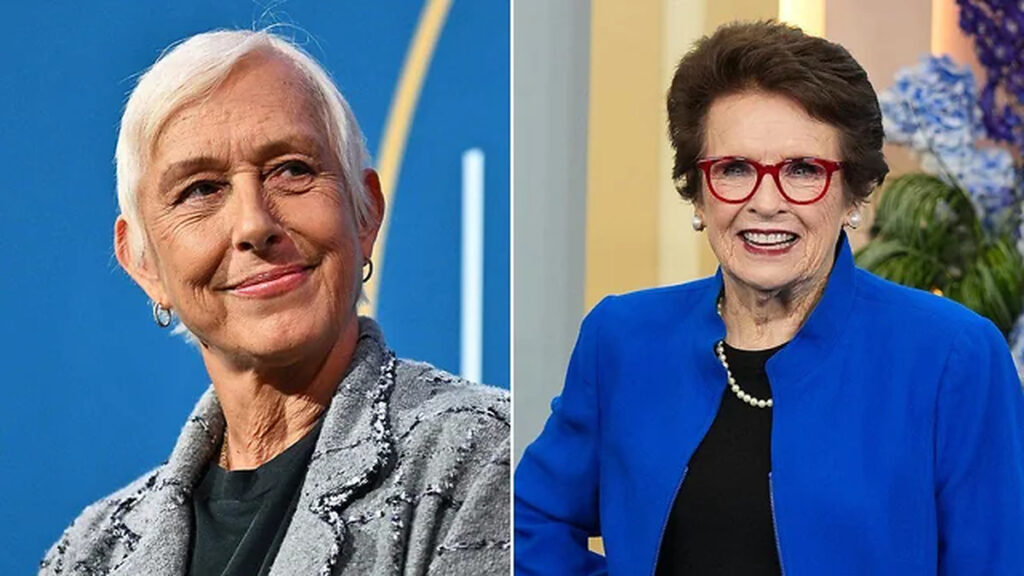
Martina Navratilova has once again publicly challenged the position of fellow tennis great Billie Jean King, accusing her of inconsistency in her long-held support for transgender athletes competing in women’s sports.
The renewed clash highlights a dispute that has followed both legends for years, particularly around fairness and inclusion in athletic competition.
Navratilova, a former world No. 1 and one of tennis’s most outspoken voices on sports policy, maintains that biological differences between sexes should remain central to eligibility rules in women’s categories.
A Long-Running Divide Between Two Tennis Icons
The disagreement between the two Hall of Famers is not new.
King has repeatedly expressed support for transgender participation in sports, at one point describing blanket bans on trans athletes as deeply harmful and “a nightmare.”
She has also emphasized access and opportunity for transgender competitors who wish to participate in sport.
Navratilova, however, has consistently opposed allowing transgender women in female categories, arguing that inclusion policies risk undermining competitive fairness.
The contrast in their positions has turned a decades-long friendship and shared legacy of advocacy into a recurring public tension point.
Navratilova Questions “Fairness” in Inclusion Approach
Speaking in a recent interview with OutKick, Navratilova said King’s stance “doesn’t square” with what she sees as biological realities in sport.
She suggested King believes competition remains fair even when transgender women—whom she described in terms of male biology undergoing hormonal transition—compete in female categories.




Navratilova referenced historical figure Renée Richards, one of the earliest high-profile transgender athletes in tennis, as part of her framing of the debate.
For Navratilova, the core issue is not inclusion itself but competitive balance, which she believes is compromised when athletes with male physiological development compete in women’s events.
Hypothetical Scenario Used to Illustrate Concern
To explain her argument, Navratilova offered a hypothetical sports example involving school basketball tryouts.
In her scenario, if a boys’ team selected additional male players who were then excluded from that roster, and those same players subsequently joined a girls’ team, she argued it would displace female athletes who originally earned those spots.
She described such an outcome as fundamentally unfair, insisting that it would amount to what she sees as structural displacement rather than equal opportunity.
Navratilova concluded that, in her view, fairness in women’s sports requires clear eligibility boundaries based on sex.
“No Male Bodies in Women’s Sports” Position Reaffirmed
Expanding on her stance, Navratilova reiterated her belief that women’s sports and certain female-only spaces should exclude individuals with male biological development.
She argued this position is tied not only to competitive integrity but also to broader concerns about safety, privacy, and dignity for women athletes.
Her comments reflect a hardline position she has maintained in recent years as governing bodies across multiple sports continue to revise eligibility rules for transgender athletes.
Frustration Over Unheld Private Conversations
Navratilova also claimed that King has repeatedly expressed a willingness to discuss the issue privately over several years, but that such conversations never took place in any substantive way.
According to Navratilova, this absence of direct engagement has left her frustrated and convinced that King has not fully engaged with opposing viewpoints before publicly advocating her position.
She suggested that King’s statements—along with those from the Women’s Sports Foundation—were made without fully addressing counterarguments she believes are important to the debate.
Renewed Call for Public Clarification
Closing her remarks, Navratilova called for King to more directly address the concerns raised by critics of trans inclusion in women’s sports.
She said she would like a clearer explanation of how inclusion policies can be reconciled with fairness in female competition.
Her comments ensure that one of sport’s most prominent ideological divides remains firmly in the spotlight, with two of tennis’s most influential figures still far apart on how the issue should be resolved.
