
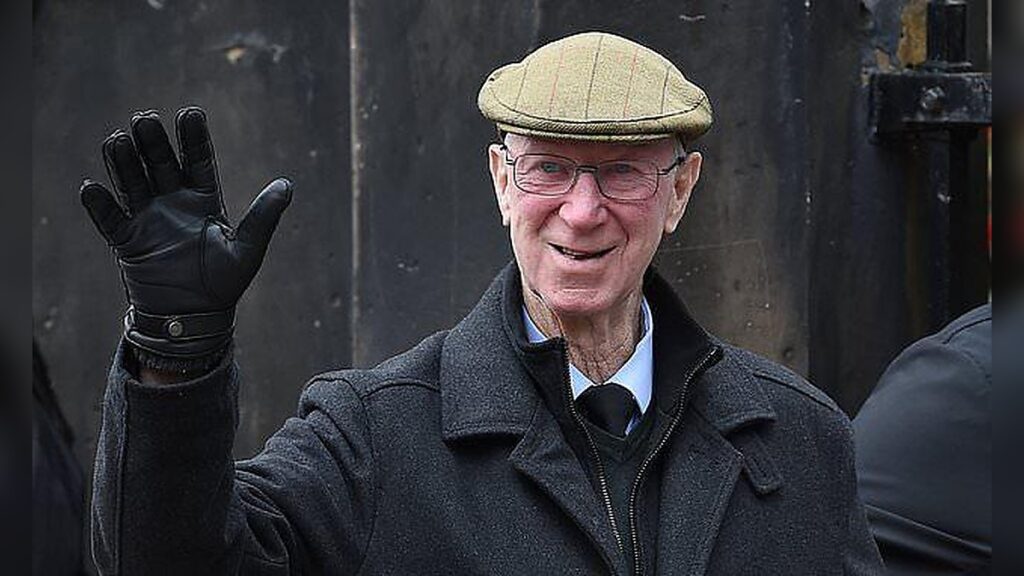
The family of England football legend Jack Charlton is facing an unexpected financial challenge after his son revealed that inheriting the defender’s iconic 1966 FIFA World Cup winner’s medal could result in a substantial Inheritance Tax bill.
John Charlton said the treasured medal was left to him under his father’s will, but taking legal ownership of the historic item could require him to pay around £200,000 in tax.
To avoid the immediate financial burden, he explained that the medal remains in the possession of his mother, Pat Charlton.
Medal Remains with Jack Charlton’s Widow
Speaking about the situation, John explained that although the medal was intended for him, he has chosen not to take possession while his mother is still holding it.
According to him, transferring ownership now would trigger the tax liability, making it financially impractical to claim the inheritance.
As a result, one of English football’s most famous pieces of memorabilia has been kept safely within the family rather than formally passing to its intended beneficiary.
Rare Piece of England Football History
Jack Charlton earned the medal after playing at centre-back during England’s memorable 4-2 victory over West Germany in the 1966 World Cup final at Wembley Stadium.
The triumph remains the only time England’s men’s national team has won the World Cup.
John noted that his father and his uncle, fellow England legend Bobby Charlton, were among the few members of the victorious squad who kept their winners’ medals.
Many of their teammates either sold or donated theirs over the years, making the remaining medals exceptionally rare and historically valuable.




Family Also Preserves Shirt and Tournament Cap
Beyond the famous medal, the Charlton family has also safeguarded several other important pieces of football history.
John revealed that his father’s World Cup final shirt is securely stored alongside the medal.
He also said the family still possesses Jack Charlton’s England cap from the tournament, explaining that his father had only one official cap for the entire competition because he had given away his other international caps during his lifetime.
Debate Over the Value of the Collection
The reported tax liability has attracted attention, although the exact figures remain disputed.
Earlier reports suggested that HM Revenue & Customs valued Jack Charlton’s World Cup medal and related memorabilia—including the shirt and other items—at between £100,000 and £200,000, resulting in an estimated tax demand of about £80,000.
More recent comments by John referenced a potential £200,000 tax bill, creating differing estimates over the financial impact.
Regardless of the precise amount, the case has reignited discussion over how valuable sporting memorabilia is treated for inheritance purposes.
Calls for Changes to Inheritance Tax Rules
John Charlton argued that the issue extends beyond his own family, pointing to Olympic athletes and other sporting champions whose families could encounter similar tax obligations when passing on medals and awards.
He said there are existing tax exemptions covering certain military decorations, but equivalent protections do not apply to internationally significant sporting achievements such as England’s 1966 World Cup medals.
John has previously criticised the UK’s Inheritance Tax system, describing it as unfair and questioning whether families should face substantial tax bills simply to retain historic sporting artefacts that hold immense sentimental and national significance.
Remembering Jack Charlton’s Football Legacy
Born in the Northumberland mining village of Ashington in 1935, Jack Charlton rose from modest beginnings to become one of English football’s most respected figures.
Growing up in a working-class family, he shared a bed with his brothers during childhood as the family struggled financially.
He spent his entire playing career with Leeds United, where he enjoyed more than two decades of success, helping the club win the First Division title and the FA Cup.
Following his playing career, he achieved further acclaim as manager of the Republic of Ireland, guiding the national team to two FIFA World Cup tournaments and an historic quarter-final appearance in 1990.
Jack Charlton died in July 2020 at the age of 85 after living with lymphoma and dementia, leaving behind his wife Pat and children John, Debbie and Peter, along with a football legacy that continues to resonate both on and off the pitch.
