
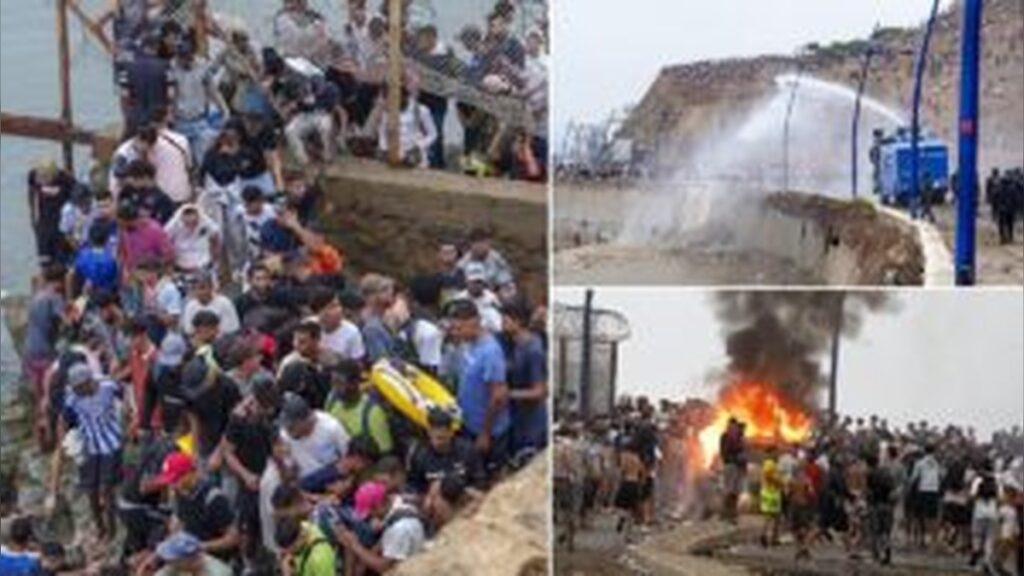
Spain’s government is facing mounting political and diplomatic pressure after an unprecedented surge of migrants crossed from Morocco into the North African enclave of Ceuta, triggering a humanitarian emergency and sparking calls from several European nations for tougher border controls.
The crisis has intensified debate over migration policy as authorities struggle to restore order in the Spanish territory.
Spanish Government Labels Crisis an Attack
Speaking during a visit to Ceuta, Spanish Prime Minister Pedro Sanchez described the mass arrival of migrants as a direct challenge to Spain’s sovereignty.
He characterized the situation as an attack on the country’s territorial integrity while acknowledging the seriousness of the emergency unfolding in the enclave.
The visit itself highlighted growing public frustration, with Sanchez reportedly facing criticism from residents demanding stronger action to secure the border.
The pressure comes only months after his government introduced a program aimed at granting legal status to approximately half a million undocumented migrants already living in Spain.
Europe Weighs Tougher Measures
The migrant surge has prompted concern well beyond Spain’s borders.
Italy announced it is considering extraordinary steps, including possible restrictions linked to the Schengen open-border system, arguing that uncontrolled migration presents a security challenge for Europe.
France has also ordered tighter checks along its border with Spain, while Finland publicly backed proposals questioning Spain’s continued participation in the passport-free Schengen zone unless external border security improves.
European leaders say stronger protection of the bloc’s external frontiers is essential to prevent similar crises from spreading across the continent.
Violence Spreads Beyond Ceuta
The unrest soon expanded to Melilla, Spain’s second North African enclave.




Authorities reported clashes near the border, with warning shots allegedly fired as security forces attempted to disperse large crowds.
Overnight violence left burned vehicles, damaged property, and widespread disorder.
Dramatic scenes showed migrants entering Spanish territory by swimming around coastal barriers while others gathered along border fences searching for opportunities to cross.
Humanitarian Emergency Declared
Ceuta’s regional president, Juan Jesus Vivas, declared a total humanitarian and social emergency as reception facilities became overwhelmed by the influx.
Local officials argued that recent legal rulings limiting Spain’s ability to immediately return migrants arriving by sea had exposed weaknesses in the country’s immigration framework.
Madrid has accused human trafficking networks of exploiting those legal changes by encouraging more migrants to attempt dangerous crossings.
Death Toll Rises Amid Dangerous Crossings
Authorities confirmed that at least 18 people died during Thursday’s crossings, although officials fear the true number of casualties could be higher.
Many victims reportedly drowned while attempting to swim around border defenses, while others are believed to have died in overcrowded stampedes near crossing points.
Despite increased security, groups of migrants continued gathering along the coastline in search of alternative routes into Spanish territory.
Reinforcements Deployed to Secure the Border
Spain has responded by sending additional military personnel, Civil Guard officers, specialized divers, boats and drone units to reinforce security around Ceuta.
The government says it is coordinating closely with Moroccan authorities while mobilizing all available resources to stabilize the situation and restore order.
Officials insist cooperation between both countries remains essential to preventing further mass crossings.
Residents Fear Escalating Disorder
The rapid influx has unsettled many residents and business owners in Ceuta, where shops closed early amid fears of looting and unrest.
Some local business leaders said they were organizing their own security measures because they believed police resources were stretched too thin.
Residents also reported shortages of basic supplies and expressed concerns that migrants seeking food, water and shelter could attempt to enter private homes as authorities struggled to cope with the scale of the emergency.
Long-Running Migration Challenge Reaches Breaking Point
Even before the latest crisis, Ceuta had been experiencing a steady increase in migrant arrivals by sea. Local reception centers were already operating beyond capacity, particularly facilities housing unaccompanied minors.
The latest mass crossing has pushed those systems to the brink, highlighting the continuing challenge faced by Spain’s two North African enclaves, which remain key gateways for migrants hoping to reach Europe in search of better opportunities.

