
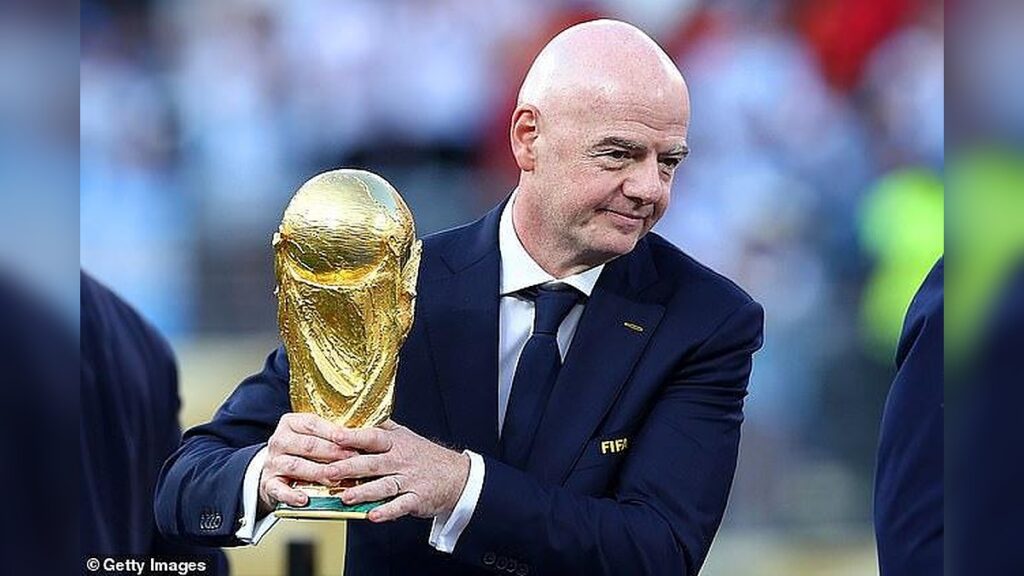
FIFA President Gianni Infantino is facing one of the most significant challenges of his leadership after a growing coalition of football federations rejected a controversial proposal to introduce private investment into the governing body’s flagship tournaments.
The plan, which sought to raise approximately £3.1 billion through the creation of FIFA Forward Enterprise (FFE), has encountered overwhelming resistance from key confederations, leaving its future in serious doubt.
The latest setback came after the Asian Football Confederation (AFC) aligned itself with UEFA and CONCACAF in opposing the initiative, pushing the number of publicly dissenting FIFA member associations to 136—well above the 106 votes required to prevent the proposal from advancing.
Senior FIFA Adviser Steps Down in Protest
The controversy deepened with the resignation of Carlos Cordeiro, a senior adviser to Infantino and former president of the U.S. Soccer Federation.
Cordeiro, a retired investment banker who also served on the White House task force for the 2026 FIFA World Cup, became the first senior figure within FIFA to publicly distance himself from the project.
In announcing his resignation, Cordeiro stated that he had played no role in developing the proposal and described it as damaging to both FIFA’s member associations and the future of world football.
He argued that selling ownership stakes in the World Cup would undermine the game’s long-term interests and urged others within FIFA to voice similar concerns.
His departure represents a major internal blow to Infantino as criticism expands beyond football federations to include senior figures within FIFA’s own ranks.
AFC Declares Proposal Lacks Football-Wide Consensus
In a detailed statement, the AFC said it was standing alongside UEFA and CONCACAF due to serious concerns about both the proposal itself and the process used to develop it.
The confederation warned that the possibility of a World Cup boycott demonstrated how deeply divided global football had become.
According to the AFC, the World Cup derives its value from the participation and unity of every confederation, making any initiative that threatens that collective foundation unacceptable.
The AFC concluded that the FIFA Forward Enterprise proposal no longer had any realistic path toward obtaining the broad consensus required for implementation.
Governance Concerns Move to the Forefront
While objecting to private investment, the AFC also criticized FIFA’s decision-making structure.




The confederation argued that an initiative capable of reshaping football’s commercial future should never have been developed without meaningful consultation with member associations, confederations, the FIFA Council, and other statutory bodies.
According to the AFC, transparency, early engagement, and genuine participation are essential components of democratic governance.
It called on FIFA to undertake an urgent review of its governance procedures to ensure that future decisions affecting global football are developed through open consultation rather than confidential negotiations.
The confederation further warned that consultation after major decisions have effectively been made cannot replace proper involvement at the earliest stages of policy development.
FIFA Defends the Initiative
Despite mounting resistance, FIFA insisted that the proposal had been misunderstood and rejected suggestions that it intended to sell football itself.
In an official statement, FIFA maintained that the FIFA Forward Enterprise project was designed to allow member associations to benefit more directly from football’s commercial opportunities while preserving the sport’s governance structure.
The organization also argued that inaccurate media reports had disrupted its planned consultation process.
FIFA emphasized that every one of its 211 member associations should have the opportunity to review the proposal independently rather than having their views represented by regional confederations alone.
It pledged to continue consultations before any final decisions are made.
UEFA Maintains Firm Resistance
UEFA and its 55 member associations unanimously rejected the proposal, describing the World Cup as a sporting legacy that should never become an investment asset.
European football leaders argued that allowing private investors to acquire ownership interests would permanently shift decision-making toward satisfying shareholder expectations rather than protecting the interests of players, supporters, clubs, leagues, and national associations.
UEFA also criticized the manner in which the proposal was developed, saying it emerged through secret discussions without meaningful consultation with football’s governing institutions.
The confederation announced that its member associations would refuse to participate in FIFA competitions while the proposal remains under consideration unless it is completely abandoned and FIFA provides guarantees that similar ownership models will not be pursued in the future.
CONCACAF Raises Similar Objections
CONCACAF also rejected the proposal after convening a meeting involving the presidents of all 41 of its member associations.
The confederation questioned both the necessity of seeking private investment following FIFA’s most profitable World Cup and the governance process behind the proposal.
Officials cited concerns over the compressed timeline, limited consultation, and lack of review through FIFA’s established decision-making bodies.
Rather than introducing outside investors, CONCACAF called for FIFA to explore the use of existing financial reserves to expand football development programs across member nations.
Pressure Mounts on Infantino’s Leadership
The broad coalition opposing the proposal has significantly increased pressure on Infantino, who is expected to seek a fourth term as FIFA president next year.
With UEFA, CONCACAF, and the AFC now united against the initiative—and more than half of FIFA’s membership publicly rejecting it—the proposal faces overwhelming institutional resistance.
The dispute has evolved beyond the financial merits of private investment into a wider debate over governance, transparency, and the future direction of world football, leaving FIFA confronted by one of the largest internal challenges in its modern history.
