
Israel’s military says it has carried out a series of operations targeting Hezbollah figures and infrastructure in Lebanon, claiming the elimination of several senior commanders and militants over recent days.
The announcements come as tensions along the Israel-Lebanon border remain elevated, with both sides continuing to exchange attacks amid the wider regional conflict.
Senior Hezbollah Figure Reportedly Killed
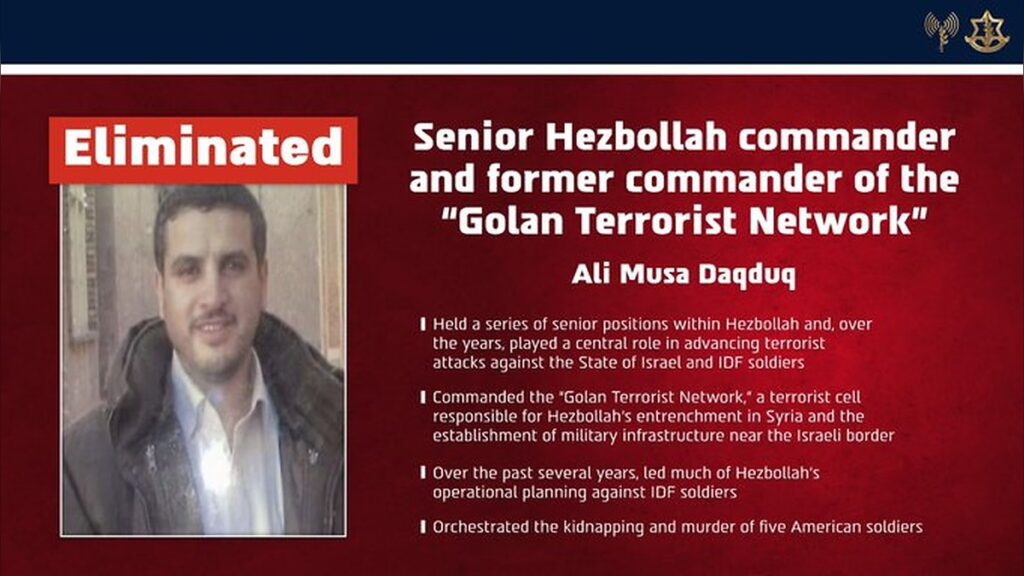
According to the Israel Defense Forces (IDF), Ali Musa Daqduq, described as a high-ranking Hezbollah commander, was killed during an Israeli operation.
The military said Daqduq held multiple senior roles within Hezbollah over the years and was involved in coordinating operations directed against Israel and Israeli forces. Israeli officials also linked him to the 2007 attack that resulted in the kidnapping and deaths of five American soldiers in Iraq.
The IDF characterized Daqduq as a key figure within the organization, alleging that he played an important role in planning and advancing militant activities.
Underground Route in Southern Lebanon Targeted
In a separate operation, Israeli forces reported striking a group of Hezbollah operatives who were allegedly using an underground route in southern Lebanon.




The military stated that seven militants were killed during the operation. According to the IDF, the underground network served as a logistical corridor where ammunition, mortar rounds, and food supplies were stored to support attacks against Israeli troops operating in the area.
Israeli forces further claimed that weapons and military equipment, including Kalashnikov rifles, were discovered following the strike.
Command Structure Hit in Recent Operations
The latest developments follow another Israeli announcement regarding a broader campaign against Hezbollah’s command structure.
The IDF said more than ten Hezbollah field commanders and individuals designated as their successors had been eliminated in recent operations. Among those named were Hajj Salameh, identified as the commander of Hezbollah’s Nasser Unit, along with two figures the military described as his successors, Mahdi Bazzi and Ashraf Salloum.
Israeli officials also reported the deaths of Nasser Shaqir, who was said to command the Shaqif Sector, and Ahmad Sablini, identified as his successor. Additional field commanders were also reportedly targeted during the operations.
Escalating Pressure on Hezbollah Leadership
The Israeli military says the strikes form part of an ongoing effort to disrupt Hezbollah’s operational capabilities and leadership structure in southern Lebanon.
Israeli officials argue that targeting commanders, logistical networks, and supply routes is intended to reduce the group’s ability to coordinate attacks and maintain military activities near the border.
Border Tensions Continue
The announcements highlight the continuing volatility along the Israel-Lebanon frontier, where military operations and cross-border exchanges have intensified over the past months.
As both sides remain engaged in hostilities, concerns persist that further escalation could widen the conflict and increase instability across the region.
