
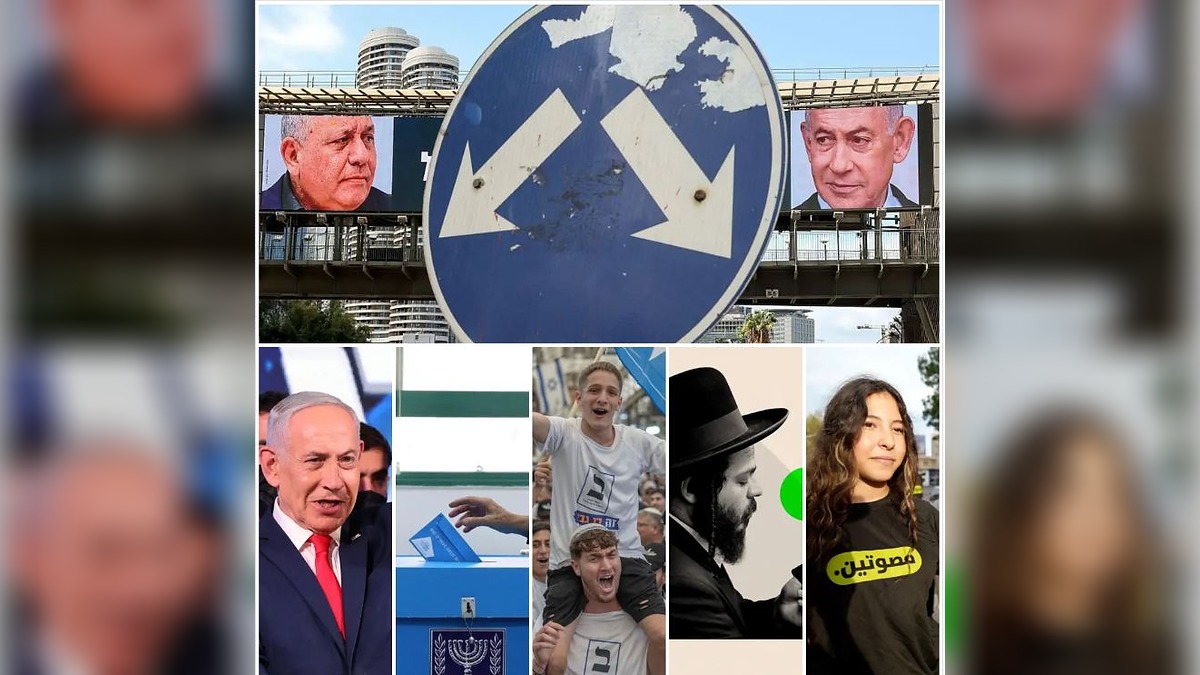
Israel is facing a potential political deadlock after election results showed neither Prime Minister Benjamin Netanyahu’s coalition nor the opposition bloc led by Gadi Eisenkot was on course to secure a parliamentary majority.
With 85% of votes counted following Tuesday’s election, negotiations between political parties are expected to determine whether a government can be formed. However, several parties have ruled out alliances that could be necessary to secure enough seats.
The situation has raised the possibility of another election if political leaders cannot reach an agreement.
Four main scenarios have emerged: a national unity government led by Netanyahu, an Eisenkot-led coalition supported by Arab parties, a Netanyahu government involving right-wing opposition parties, or a fresh election.
Netanyahu Could Seek Unity Government With Eisenkot
One possible outcome would involve Netanyahu persuading Eisenkot’s Yashar Party to join his Likud Party in a national unity government.
Such an agreement would require Eisenkot to abandon his campaign pledge to remove Netanyahu from office. During his election-night speech, Eisenkot called on the prime minister to retire from political life, accusing him of promoting a “culture of lies”, division and incitement.
His remarks came before a major exit poll was revised, changing the projected standings and placing Netanyahu ahead of Eisenkot’s bloc.
Netanyahu, meanwhile, thanked his existing coalition partners and called for a strong right-wing government. His comments were interpreted by some as a sign that he intended to retain his current alliance rather than form a unity government.
A renewed conflict with Iran could also influence negotiations. Israeli and US media reported before the election that Netanyahu was pushing for fresh strikes against Iran and had urged US President Donald Trump to approve American involvement.
Critics of Netanyahu could portray any renewed military action as an attempt to strengthen his political position, although the potential effect of such a conflict on government negotiations remains uncertain.
Arab Parties Could Become Essential to an Eisenkot Government
Another possible route to power would involve Eisenkot forming an opposition coalition with support from Arab parties, a significant departure from established political practice in Israel.
Only one independent Arab party has formally joined an Israeli governing coalition, doing so in 2021. That arrangement did not last long.




Eisenkot and the other Jewish parties in his bloc, with one exception, have ruled out forming a government with Arab parties. Nevertheless, their support may be necessary if the opposition is to secure a parliamentary majority.
Arab parties performed strongly in the election, with projections suggesting they could win a record 19 seats. The result followed high turnout among Arab citizens of Israel, who make up approximately one-fifth of the population and often identify as Palestinian citizens of Israel.
Many Arab voters had previously boycotted elections, arguing that participation legitimised a political system they believed treated them as second-class citizens. This time, turnout was driven in part by opposition to what they regarded as Israel’s most right-wing governing coalition.
The United Arab list, projected to win around seven seats, has said it would join an opposition government. The Joint List, projected to secure 12 seats, has indicated it would support an opposition administration from outside the coalition.
Yair Golan, leader of The Democrats, is currently the only Jewish political leader openly advocating this arrangement.
However, a government dependent on Arab party support could face difficulties maintaining unity, particularly over the war in Gaza and Israeli policy in the occupied West Bank.
Netanyahu Could Attempt to Recruit Right-Wing Opposition Parties
Netanyahu could also seek to form a majority by persuading right-wing parties in Eisenkot’s opposition bloc to abandon their current alliances and join his government.
Potential partners include Naftali Bennett, joint-leader of the Beyachad political alliance, and Avigdor Lieberman, leader of Yisrael Beiteinu. Both hold right-wing positions and take a hard line on security issues.
However, Bennett and Lieberman campaigned against Netanyahu’s continued leadership. They also support extending military conscription to ultra-Orthodox men, putting them at odds with the ultra-Orthodox parties currently in Netanyahu’s coalition.
Suggestions that Bennett and Lieberman could replace those parties have also faced a numerical obstacle, with current projections indicating that the proposed grouping may not have enough seats to command a majority.
Fresh Election Remains a Possible Outcome
If political leaders fail to negotiate an agreement under any of the proposed arrangements, Israel could hold another election.
Netanyahu would remain caretaker prime minister until a new government was formed, giving him additional time to prepare for another vote.
Some analysts believe the unusually high turnout among Arab voters may be difficult to repeat, particularly if their increased parliamentary representation fails to produce significant political changes. A second election could also encourage greater participation among right-wing voters.
Another factor could be the estimated 70,000 Israelis who returned from abroad to vote. They are thought to have leaned towards parties opposing Netanyahu, and some analysts believe they might not return for another election.
Several right-wing parties that failed to clear Israel’s 3.25% electoral threshold could also attract fewer votes or decide not to contest a new poll. That could benefit Likud and its allies by concentrating votes among parties that secure parliamentary representation.
Israel Has Experienced Repeated Elections in Recent Years
The current impasse follows a period of repeated elections and difficulties in forming stable governments.
Between 2019 and 2022, Israel held five separate elections as Netanyahu and his political opponents repeatedly struggled to reach agreements.
The latest results have again left political leaders facing difficult negotiations, with no clear route to a parliamentary majority and the possibility of another election if coalition talks fail.
