
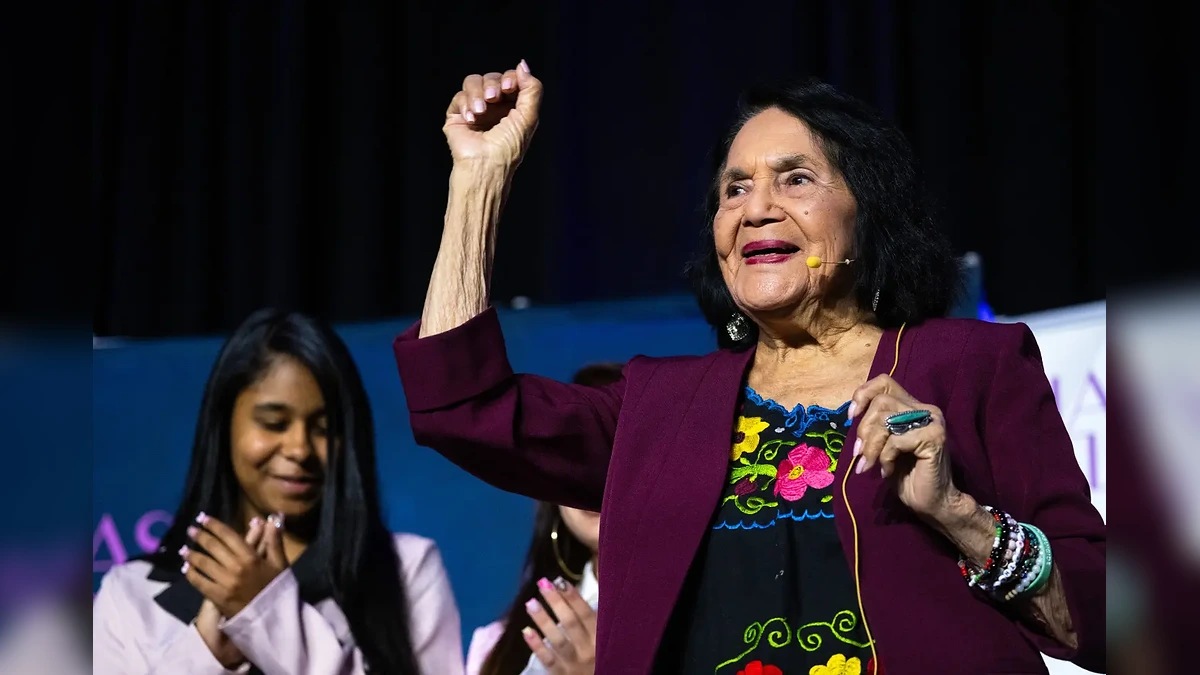
Dolores Huerta, the influential labour organiser who co-founded the United Farm Workers union and popularised the slogan “Sí, se puede!”, has died at the age of 96.
Her family confirmed that she died at home on Wednesday in a statement shared through her foundation.
“We know that many of you around the world share in our mourning, and we will be following up on plans to recognize and celebrate her incredible life and legacy,” the family said.
Huerta remained active well into her 90s, participating in protests and speaking across the United States on issues including racial equality, poverty, LGBTQ+ rights and women’s rights through her foundation based in Bakersfield, California.
Her Slogan Became a Rallying Cry for Change
Huerta’s phrase “Sí, se puede!”, meaning “Yes, it can be done”, became a widely recognised slogan associated with activism and collective action.
Her decades of work as a labour leader, civil rights campaigner and feminist activist earned her numerous honours, including the Presidential Medal of Freedom, the highest civilian award in the United States.
President Barack Obama presented her with the medal in 2012, praising her determination and acknowledging that he had borrowed her slogan for his 2008 presidential campaign.
Huerta’s influence extended beyond the labour movement, with her name becoming closely associated with civil rights campaigns in the United States and internationally.
Huerta Revealed Decades-Old Sexual Abuse Allegations Against César Chávez
Earlier in 2026, Huerta disclosed that she had been sexually abused by César Chávez, her fellow farmworker movement co-founder, during the 1960s. She said the abuse resulted in the birth of two children, a secret she had kept for approximately 60 years.
Huerta explained that she had remained silent because she feared that speaking publicly could undermine her life’s work and damage the progress achieved by the farmworker movement.
In a 2026 interview with Latino USA, she described the decision to remain silent as a personal burden.
“It was my personal pain, it was my personal problem and, you know, I think it was worth it because it was my cross to bear. I’ll say it that way,” she said.
From the early 1970s, Huerta’s life partner was Richard Chávez, César Chávez’s brother. They had four children together. She also had seven children from two earlier marriages.
From New Mexico to California’s Farmworker Communities
Born Dolores Clara Fernández in 1930 in Dawson, New Mexico, Huerta was the daughter of a miner and union activist who later won a seat in the state legislature.
Her parents separated when she was three, and her mother moved with Huerta and her brothers to California.
Growing up among Mexican, Filipino, African American, Japanese and Chinese working families, Huerta was influenced by her mother, who owned a restaurant and hotel and taught her about independence, compassion and activism.
Huerta initially worked as an elementary school teacher in California’s agricultural San Joaquin Valley. However, she became frustrated by the poverty experienced by many of her pupils and decided to focus on organising farmworkers.
“I couldn’t stand seeing kids come to class hungry and needing shoes,” she said in a 2017 PBS documentary about her life. “I thought I could do more by organizing farmworkers than by trying to teach their hungry children.”
United Farm Workers Founded in 1962
Huerta’s early involvement with a civil rights organisation in Stockton led to her meeting Chávez. Both wanted to focus on improving conditions for agricultural workers.




In 1962, they established the National Farm Workers Association, which later became the United Farm Workers of America.
Huerta became one of the union’s key leaders and negotiators, working to secure better conditions and employment protections for farmworkers.
She joined Filipino grape pickers on the picket line during the campaign that became known as the five-year Delano Grape Strike. Alongside Chávez, she negotiated collective bargaining agreements with major agricultural growers.
Those negotiations helped secure the first health and benefit plans for farmworkers.
Chávez, who died in 1993, described Huerta as fearless, committed to the cause and tough during negotiations.
Protests, Political Campaigns and Arrests
Huerta’s activism also brought her into contact with prominent political figures. She met Massachusetts Senator Robert Kennedy during his 1968 visit to Delano and volunteered for his presidential campaign, registering Mexican American voters in California.
She was on stage with Kennedy after he won the California primary and heard him publicly thank her shortly before he was shot.
His assassination devastated Huerta, but she continued organising. She was jailed 22 times for participating in union demonstrations.
In 1988, Huerta suffered serious injuries during a protest in San Francisco against Republican presidential candidate George H.W. Bush’s opposition to the United Farm Workers’ grape boycott.
She was struck with a police baton while caught in a crowd, suffering three broken ribs and a severely damaged spleen. She required more than a dozen blood transfusions and later reached a settlement with the city over her claims.
Following a lengthy recovery, Huerta expanded her campaigning to women’s rights and encouraged Latinas to seek elected office.
She also campaigned for Democratic presidents Bill Clinton, Barack Obama and Joe Biden. California Governor Gavin Newsom considered her a close friend.
Campaigns Helped Secure Farmworker Rights
Huerta developed expertise in lobbying politicians and worked to secure financial assistance for unemployed people and disability insurance for California farmworkers.
She campaigned against toxic pesticides, advocated amnesty for immigrants living in the country illegally and opposed federal guest-worker programmes.
In the early 1970s, she helped direct nationwide boycotts of grapes and lettuce. The campaigns contributed to the political and economic pressure that led California to pass the first state law recognising farmworkers’ right to collective bargaining.
Her son Emilio Huerta said his mother’s courage was central to her work.
“To dedicate your life to building a dream of a union for farmworkers, to take on agriculture, which to this day is still a powerhouse. … That took a lot of guts,” he said.
Awards and Recognition for Her Activism
Huerta received numerous honours throughout her life. She became the first Latina inducted into the National Women’s Hall of Fame and received nine honorary doctorates from universities across the United States.
Schools in California, Texas and Colorado have been named in her honour, while murals and streets across the country also bear her name.
Her political endorsements occasionally attracted criticism. In 2016, she backed Hillary Rodham Clinton over Senator Bernie Sanders in the Democratic presidential primary.
Actor Rosario Dawson, a Sanders supporter who portrayed Huerta in a 2014 film about Chávez, criticised the endorsement, saying Huerta had become “an instrument of the establishment”. The two later reconciled.
Music and Film Reflected Her Life and Legacy
Guitarist Carlos Santana later oversaw a documentary about Huerta’s life after the two spoke about music during a late-night conversation in Hawaii.
Their discussion included jazz, with Santana discovering that Huerta was a major fan of bebop saxophonist Charlie Parker.
“I even met Charlie Parker. That’s my claim to fame,” Huerta joked in an interview with The Associated Press when she was 87.
In the 2025 documentary Seeds of Change: The Life and Legacy of Dolores Huerta, she reflected on her decades of organising and the influence of the women’s movement during the 1970s.
Huerta said she hoped to be remembered for organising people to challenge injustice and passing a commitment to justice on to future generations.
“I hope that my legacy will be one of an organizer that organized to fight injustice,” she said in the film.
“We want to give our children an inheritance of justice, right, not jewels or property or money because they’ll just fight over it. So the main thing to do is to give them this love for justice — and that is the greatest gift I think that any of us can have.”

