
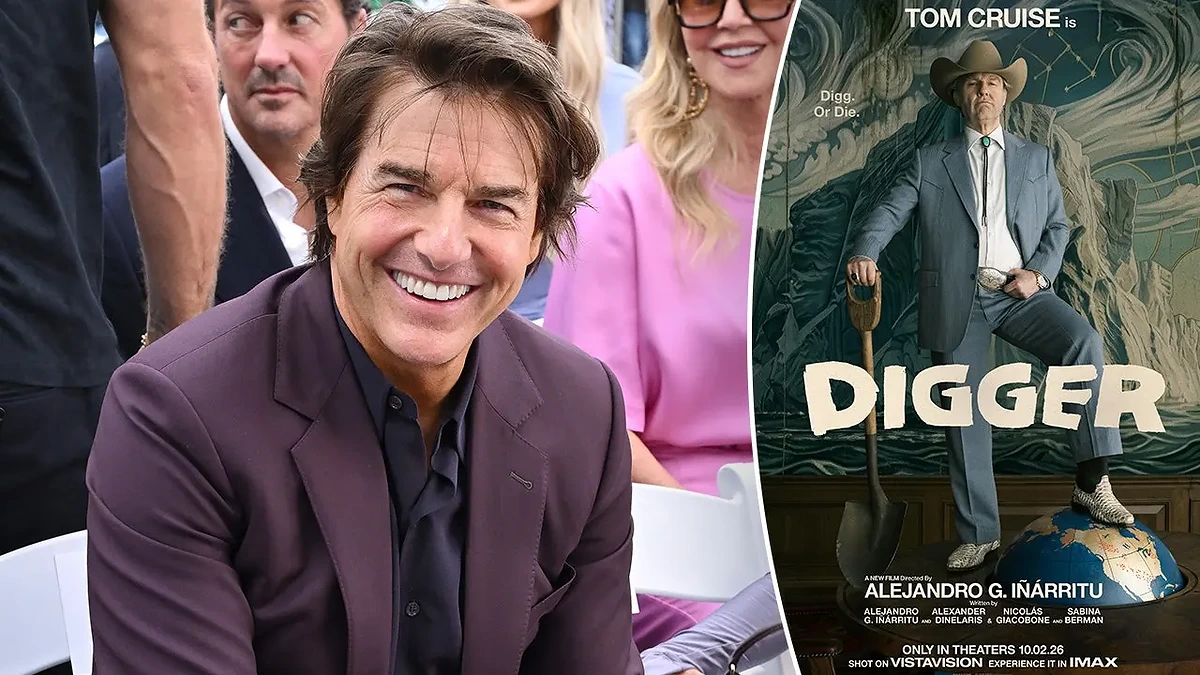
Tom Cruise’s latest film, Digger, is facing the prospect of becoming one of Hollywood’s most expensive box office failures after ticket sales fell sharply during its second weekend in cinemas.
The satirical drama, directed by four-time Oscar winner Alejandro González Iñárritu, recorded an estimated 60 per cent drop in ticket sales, adding to concerns about its commercial performance.
The film earned just $8 million in US cinemas during its opening weekend, while international markets contributed another $12 million across 74 countries.
Following the second-weekend decline, its domestic earnings reached $14.4 million, with global box office revenue standing at $35.3 million.
Industry estimates suggest the film could finish its theatrical run with approximately $50 million worldwide, leaving it far below the amount required to recover its production and marketing expenses.
Production and Marketing Costs Push Break-Even Target to $350 Million
Warner Bros. initially approved a production budget of $125 million for Digger.
However, delays and an extended production schedule reportedly pushed the figure to around $180 million.
The studio also spent an estimated $100 million promoting the film, bringing its combined production and marketing expenditure to approximately $280 million.
According to Variety, the movie needs to generate about $350 million at the global box office to break even, partly because cinemas retain roughly half of the money collected from ticket sales.
With its worldwide earnings currently trailing far behind that threshold, industry insiders estimate that the film could lose as much as $245 million during its theatrical run.
The projected figure would place Digger among the most financially unsuccessful films ever released, despite an extensive promotional campaign led by Cruise.
Disney’s John Carter and The Lone Ranger Set Costly Precedents
A potential $245 million loss would put Digger in competition with some of Hollywood’s most notorious commercial disappointments.
Disney’s John Carter, released in 2012, holds the Guinness World Record for the biggest box office flop, with reported losses of $161 million.
The studio suffered another major setback the following year when The Lone Ranger reportedly lost approximately $160 million.
The financial difficulties stretch further back to 1995, when Renny Harlin’s Cutthroat Island became another infamous example of a costly production that failed to attract audiences.
The pirate adventure earned only $16 million against an estimated $100 million budget.
After adjusting for inflation, its losses amount to approximately $105 million.
The film’s failure also contributed to the bankruptcy of its production company, Carolco Pictures.
If the current projections for Digger prove accurate, its estimated losses would exceed those associated with these earlier productions.
Cruise Has Experienced Previous Box Office Disappointments
Although Cruise is widely associated with successful blockbusters, his career has also included films that struggled commercially.
His 2007 political thriller Lions for Lambs underperformed despite featuring a cast that included Meryl Streep and Robert Redford.
However, its production budget was approximately $35 million, considerably lower than the reported cost of Digger.
A decade later, Cruise attempted to revive Universal’s monster franchise with The Mummy.
The 2017 film failed to meet expectations and reportedly lost around $95 million.
The financial exposure surrounding Digger is substantially greater, largely because of its production costs and extensive advertising expenditure.
Warner Bros. Pursues an Unconventional Marketing Strategy
As the initial box office figures emerged, Warner Bros. began leaning into the sharply divided reactions to Digger through its social media campaign.
The film’s official accounts have shared favourable audience reviews, often accompanying them with forceful responses written in the voice of Cruise’s character, oil tycoon Digger Rockwell.
One such reply read, “HIT ’EM WITH THE HARD TRUTH.”
The studio also experimented with an advertisement that appeared to challenge American critics who had delivered negative reviews.
The promotional clip, shared on X last month, featured Cruise’s character declaring, “America has stood beside the world in its darkest of hours.”




Riz Ahmed’s character then responded, “Not anymore.”
The advertisement proceeded to display reviews from critics in different countries, pairing each quotation with a flag representing the critic’s nationality.
A Mexican YouTuber described the film as “Epic, Extraordinary and Biting”, while US publication The Playlist called it “Grotesque, Deliberately Tacky”.
A French critic praised it as “a Gem of Intelligence”, contrasting with The New York Post’s description of the film as “An Unintentionally Bad Movie”.
The clip ended with Cruise’s character declaring, “You decide which!”
The advertisement was no longer available on X by Monday, although reactions to the campaign remained visible.
Some users praised the confrontational approach, with one suggesting that a film’s marketing campaign criticising American audiences was bold enough to persuade them to watch it.
Another urged Americans to prove European critics wrong by attending cinemas, describing it as a patriotic duty.
A third argued that the campaign was directly calling out Americans for being the only audience that had responded negatively.
Despite the online discussion, the film’s international ticket sales have also fallen short of expectations.
Oscar Ambitions Remain Part of the Digger Campaign
The commercial difficulties have not eliminated speculation about Cruise’s chances of securing his first competitive Academy Award.
Digger was viewed as a potential awards vehicle for the actor, marking one of his relatively rare appearances in a film positioned primarily around awards recognition in nearly three decades.
Its director, Iñárritu, has won four Academy Awards and is known for acclaimed films including Birdman and The Revenant.
Warner Bros. is also estimated to have allocated approximately $15 million to an Oscar campaign for the film.
Cruise received an honorary Academy Award last year in recognition of his four decades in the entertainment industry, but he has yet to win a competitive Oscar.
According to Gold Derby, awards experts currently place him fourth in their predictions for a Best Actor nomination, with reported odds of 63 per cent.
The 2027 category is expected to feature strong competition, with Andrew Scott for Elsinore, John Malkovich for Wild Horse Nine and Matt Damon for The Odyssey among the names considered likely contenders.
Critics Remain Divided Over Cruise’s Performance
Reviews of Digger have varied considerably, with some critics praising Cruise’s commitment to an unconventional role while others have criticised the film’s length, tone and ambitious approach.
The Daily Mail’s Brian Viner awarded the film four stars, saying he enjoyed it more on a second viewing after becoming familiar with its twists.
He described the production as bold and frequently brilliant, while acknowledging that its elaborate storytelling could become self-indulgent.
BBC critic Nicholas Barber also gave it four stars, praising Cruise’s imposing performance and the film’s environmental message.
However, he suggested that some scenes were excessively long and that viewers might grow tired of the film’s intensity.
Robbie Collin of The Telegraph awarded four stars as well, highlighting the spectacle of watching Cruise and Iñárritu pursue their ambitious artistic vision.
The Los Angeles Times’ Amy Nicholson described oil magnate Digger Rockwell as Cruise’s riskiest role in years, despite the actor’s history of performing dangerous stunts involving cliffs, skyscrapers and aircraft.
Collider also praised Cruise’s ability to hold the audience’s attention without relying on special effects or stunts, describing his performance as one with the qualities of an Oscar moment.
Other publications were considerably less enthusiastic.
Peter Bradshaw of The Guardian gave the film two stars, arguing that its environmental themes were undermined by an approach he considered glib and overblown.
He compared its premise with Adam McKay’s Don’t Look Up, while questioning whether its message justified its excesses.
Kevin Maher of The Times awarded it one star, suggesting that an older actor such as Dustin Hoffman or Ben Kingsley might have been more effective in the leading role.
He characterised Cruise as both the film’s main selling point and its central weakness.
Empire critic Olly Richards gave it two stars, praising Cruise’s fearless commitment while arguing that the film itself was not sufficiently rewarding.
Major Publications Question the Film’s Length and Ambition
Several other reviews focused on the gap between Digger’s considerable budget and its reception among critics.
Variety’s Owen Gleiberman questioned whether the film would connect with audiences, describing it as overly self-important and suggesting that its high production cost reflected an assumption that viewers would embrace its ambitious approach.
The Hollywood Reporter’s David Rooney compared it with expensive, critically divisive productions such as Damien Chazelle’s Babylon and David O. Russell’s Amsterdam.
He argued that the filmmakers appeared to have lost sight of the audience while pursuing their creative ambitions.
The Boston Globe described Digger as a tedious, unfunny and difficult-to-watch 128-minute production.
The Wrap’s William Bibbiani compared the film to a Saturday Night Live sketch that had been given an inexplicably large budget and an inflated sense of importance.
Johnny Oleksinski of The New York Post criticised its framing device, arguing that it made much of the film difficult to take seriously and left long stretches without meaningful tension or humour.
The Independent’s Clarisse Loughrey, who awarded it two stars, questioned the suggestion that Cruise’s performance represented a major reinvention of his acting career.
She argued that the role recalled the kind of work he had done before his extended run of blockbuster action films.
Some Critics Defend Iñárritu’s Unconventional Approach
Not all reviewers dismissed the film’s artistic ambitions.
IndieWire critic David Ehrlich offered a more sympathetic assessment, describing Digger as a failure that was nevertheless more rewarding than some of Iñárritu’s earlier work, including Birdman and Bardo.
Ehrlich argued that Cruise’s character functions as an exaggerated, almost cartoonish figure, allowing the film to explore existential questions more directly than it might have through a conventional portrayal of a real person.
The contrasting reviews underline the sharp divide surrounding the production.
While some critics have celebrated Cruise’s willingness to embrace an oversized and unconventional character, others have questioned whether the film’s ambition and elaborate presentation ultimately work in its favour.
