
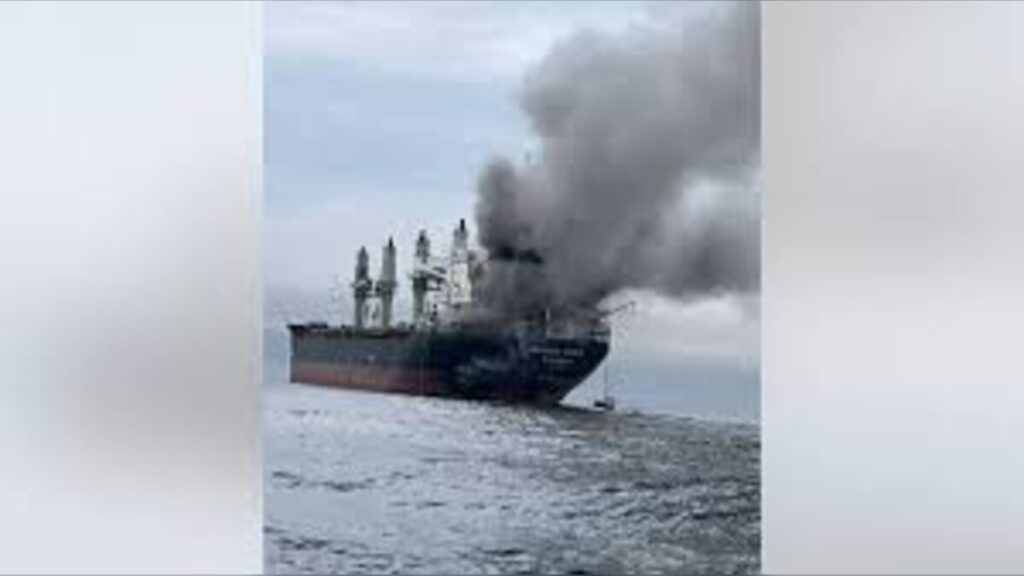
The already fragile calm in the Middle East has taken another sharp turn, with reports that Tehran has launched drone attacks targeting US military vessels in the Gulf of Oman.
The escalation follows a dramatic sequence of naval interceptions, tanker seizures, and rapidly shifting ceasefire conditions between Iran and the United States.
According to the semi-official Tasnim News Agency, Iranian forces responded after a US Navy operation intercepted an Iranian-flagged tanker.
The situation has quickly escalated into a wider confrontation involving maritime routes that are vital to global energy supply.
Drone strikes reported after US Navy tanker interception
The latest claims suggest Iranian forces launched drone operations against US naval vessels in retaliation for what Tehran described as “armed piracy” during the seizure of a tanker in the Arabian Sea.
The US side, however, framed the operation differently.
According to US Central Command, troops aboard the USS Spruance intercepted the vessel after repeated warnings, eventually taking control of the ship as it attempted to continue its route toward Iran.
No major damage has been independently confirmed from the alleged drone attacks, but the symbolism of escalation has already reverberated across global markets.
Strait of Hormuz becomes the world’s most sensitive chokepoint again
At the center of this conflict is the Strait of Hormuz, one of the most important oil transit routes in the world.
Iran’s announcement that it would restrict or shut access to commercial tankers has immediately triggered concern among shipping companies and governments.
Even temporary disruptions in this narrow waterway can send shockwaves through global energy markets.
History shows that whenever tensions rise here, oil prices react almost instantly—and this time is no exception.
Oil prices surge as markets react to renewed instability
Global energy markets responded sharply to the developments.
Brent crude and US benchmark oil prices jumped significantly as traders priced in the risk of disrupted supply flows.




Markets are particularly sensitive because the Strait of Hormuz handles a large share of the world’s seaborne oil exports.
Even the perception of risk can push prices higher, tightening global financial conditions.
This volatility comes on top of already fragile inflation trends in many economies, adding pressure on policymakers.
Political messaging intensifies on both sides
Former US President Donald Trump described the tanker interception as a successful enforcement of a naval blockade, claiming US forces had taken control of the vessel after it ignored warnings.
Iranian officials, meanwhile, have doubled down on their position, arguing that US actions violate international norms and threaten maritime freedom.
The rhetoric on both sides has become increasingly hardened, making diplomatic de-escalation more difficult in the short term.
Ceasefire uncertainty adds another layer of tension
A fragile two-week ceasefire arrangement between the two sides is now hanging in the balance.
With accusations of violations and counter-accusations of aggression, the truce appears increasingly unstable.
At the same time, international diplomatic efforts are continuing behind the scenes.
A US delegation reportedly led by senior officials is expected to engage in discussions aimed at preventing further escalation.
Impact and Consequences
The immediate consequence of this escalation is instability in global energy markets.
Oil prices are already reacting sharply, and continued disruption in the Gulf region could sustain inflationary pressure worldwide.
Shipping insurance costs are also expected to rise, potentially affecting global trade routes far beyond the Middle East.
Politically, the confrontation risks widening mistrust between Iran and Western powers, making future negotiations more complex.
Even a limited naval incident can now trigger global economic consequences due to the interconnected nature of energy supply chains.
What’s next in the Gulf of Oman crisis?
The next phase depends heavily on whether diplomatic talks can hold under pressure.
If negotiations fail, further naval incidents or retaliatory actions cannot be ruled out.
International observers will also be watching the Strait of Hormuz closely, as any sustained closure or restriction could trigger a broader economic shock.
At the same time, both sides face pressure to avoid full-scale escalation, suggesting that behind-the-scenes diplomacy will intensify despite public rhetoric.
Summary
Tensions between Iran and the United States have escalated sharply following reports of drone attacks in the Gulf of Oman, triggered by a US naval interception of an Iranian tanker.
The situation has led to renewed instability in the Strait of Hormuz and significant volatility in global oil markets.
With a fragile ceasefire in place and diplomatic talks ongoing, the region remains on edge as maritime security and energy stability hang in the balance.
Bulleted Takeaways
- Iran reportedly launched drone attacks on US naval vessels in the Gulf of Oman
- The escalation followed a US Navy interception of an Iranian-flagged tanker
- No confirmed major damage has been reported from the drone strikes
- The Strait of Hormuz remains a critical and highly sensitive oil transit route
- Oil prices surged due to fears of supply disruption and maritime instability
- Donald Trump described the US operation as enforcement of a naval blockade
- Iran condemned the action as “armed piracy” and threatened retaliation
- A fragile ceasefire remains uncertain amid rising tensions
- Diplomatic negotiations are still expected but face significant pressure
- Global markets remain highly sensitive to further escalation in the region

