
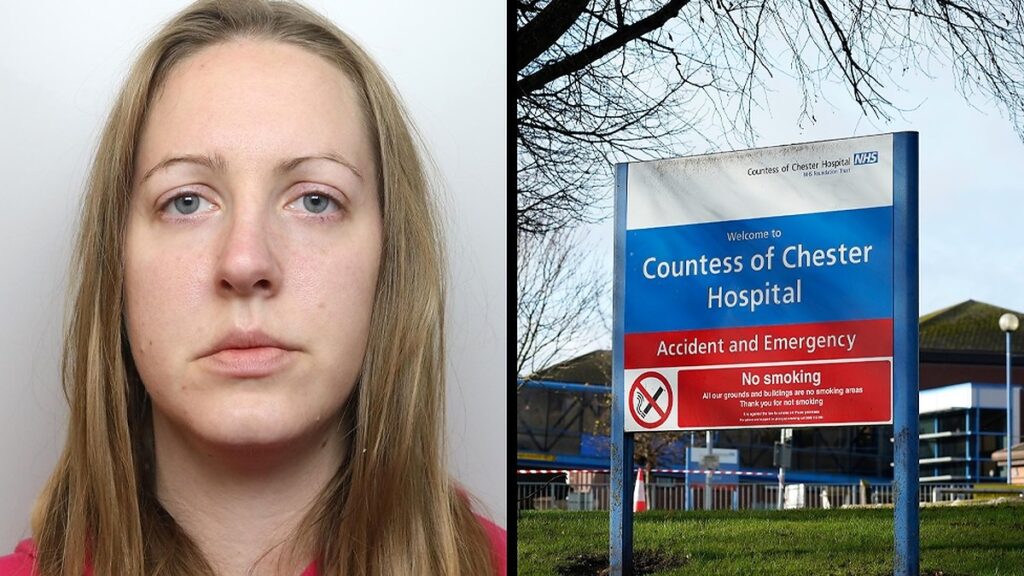
Families of babies murdered or harmed by Lucy Letby have criticised former senior leaders at the Countess of Chester Hospital after a public inquiry found serious failures in management, safeguarding and the handling of doctors’ concerns.
The Thirlwall Inquiry, published on September 15, concluded that there was a “complete failure” to protect babies on the hospital’s neonatal unit.
Lady Justice Kathryn Thirlwall found that three babies might have survived and seven others could have been protected had concerns about Letby been acted upon sooner.
The families’ lawyer, Tamlin Bolton, described the findings as a shocking account of repeated failures by organisations and individuals who, they said, did not put patient safety first.
Hospital Reputation Took Priority, Report Says
The 822-page report was sharply critical of the hospital’s former leadership, concluding that protecting the institution’s reputation was given greater importance than investigating the unusual rise in neonatal deaths.
The inquiry found that senior managers repeatedly sought alternative explanations for the deaths and commissioned external reviews rather than treating doctors’ concerns about deliberate harm as a safeguarding matter.
Lady Justice Thirlwall described hospital management and governance as dysfunctional, with a widening divide between consultants and senior executives.
She said the organisation failed to understand that safeguarding action was required once there was suspicion that a member of staff might deliberately be harming patients.
Tony Chambers Criticised Over Police Investigation
Former chief executive Tony Chambers was among those singled out in the report.
Lady Justice Thirlwall concluded that he obstructed the police investigation and became so focused on challenging doctors who had raised concerns about Letby that he lost objectivity.
Chambers, a former nurse who was paid around £160,000 a year, was also criticised for the way the hospital handled the developing concerns.
Rather than immediately involving police, managers pursued other explanations and investigations.
The inquiry found that the delay in escalating the concerns meant Letby remained in a position where she could continue working with vulnerable babies.
Nursing Leaders Defended a Colleague
Former director of nursing Alison Kelly was also heavily criticised.
The report concluded that her determination to protect Letby because she was a fellow nurse affected her professional judgment.
Lady Justice Thirlwall found that Kelly did not refer the consultants’ concerns to the local safeguarding board or NHS England, despite being the hospital’s safeguarding lead.
The inquiry also criticised nursing director Karen Rees, who refused to remove Letby from the neonatal unit after the deaths of two triplet brothers, Baby O and Baby P, on consecutive shifts in June 2016.
Doctors had regarded those deaths as a critical point and urged Rees to prevent Letby from returning to work.
The inquiry concluded that she refused because she did not accept that the doctors’ concerns were made in good faith.
Doctors Were Treated as the Problem
Rather than being supported as whistleblowers, consultants who raised concerns found themselves in conflict with hospital management.
The inquiry found that doctors faced threats of referrals to the General Medical Council and attempts were made to manage them out of their positions.
Three consultants were also told to apologise to Letby, while plans were developed, although later abandoned, that could have seen her return to the neonatal unit.




The dispute created what the report described as a damaging divide between clinical staff and hospital leadership.
Senior managers continued to maintain that they had taken the doctors’ concerns seriously.
Lady Justice Thirlwall, however, rejected that account.
Families Were Kept Unaware of Suspicions
The inquiry found that parents were not properly informed about concerns surrounding their babies or about the possibility that some of the collapses and deaths could have involved deliberate harm.
The official inquiry said families were kept in the dark for years.
Parents were also not informed about some reviews into their babies’ deaths, and consent was not obtained before medical records were shared with external experts and organisations.
Lady Justice Thirlwall described the treatment of the families as reprehensible, particularly given that hospital leaders believed a police investigation would not lead anywhere.
Three Babies Could Have Been Saved
One of the report’s most significant findings concerned three babies who might have survived had safeguarding measures been introduced earlier.
They included Baby O and Baby P, two triplet brothers who died on consecutive shifts in June 2016, and Baby I, a two-month-old girl.
The inquiry also examined the case of Baby F, a twin boy who was poisoned with insulin in August 2015.
An abnormal insulin result was disregarded by a consultant who reviewed it, allowing Letby to remain in the neonatal unit.
The report found that seven other babies — identified as Babies G, H, J, K, L, M and N — were also harmed before Letby was eventually removed from the ward in July 2016. At least one suffered life-changing brain damage.
Medical and Management Errors Were Also Identified
The inquiry did not place every failure solely on hospital executives. Lady Justice Thirlwall identified mistakes involving nurses, doctors and managers.
Former medical director Ian Harvey, an orthopaedic surgeon who was paid around £175,000 annually, was criticised for commissioning external reviews without properly consulting the doctors who had raised concerns.
The report also found that Harvey and Chambers misled the hospital board and affected families about the findings of those reviews.
The inquiry concluded that both men had failed to appreciate the seriousness of the safeguarding concerns.
Inquiry Recommends Changes Across Neonatal Care
Lady Justice Thirlwall made 17 recommendations aimed at strengthening safeguarding and oversight within NHS neonatal services.
Among them are the installation of cameras in cots and incubators so parents can remotely observe their babies, as well as CCTV or digital monitoring of refrigerators used to store insulin.
The recommendations also include stronger arrangements for dealing with staff suspected of deliberately harming patients, greater accountability for NHS executives and changes to the duty of candour so that it applies to senior executives as well as doctors and nurses.
The inquiry also called for improvements in national oversight of neonatal care.
Government Apologises to Affected Families
Health Secretary Yvette Cooper apologised for what she described as the “unthinkable loss” suffered by the families and acknowledged the failure of the NHS to keep babies safe.
Cooper said officials had been instructed to urgently develop plans for video baby monitors in neonatal units, allowing parents to remain connected to their children when they cannot be physically present.
The inquiry itself was established in 2023 following Letby’s convictions and examined events at the Countess of Chester Hospital between 2015 and 2018.
Its hearings ran from September 2024 to March 2025 before the final report was published in September 2026.
Letby Maintains Her Innocence
Letby, 36, is serving 15 whole-life sentences after being convicted of murdering seven babies and attempting to murder seven others.
She continues to maintain her innocence, while the Criminal Cases Review Commission is examining her case for a possible miscarriage of justice.
Lady Justice Thirlwall made clear that the inquiry was not established to reconsider Letby’s criminal convictions or determine whether she was guilty.
Its focus was on how the hospital responded to concerns, how babies were safeguarded and how the wider healthcare system handled the events.
Letby’s barrister, Mark McDonald, criticised the inquiry’s conclusions, arguing that it had proceeded from what he described as the wrong premise.
He called for the evidence supporting Letby’s case to be considered by the Criminal Cases Review Commission.
Police Investigation Remains Open
Separately, Cheshire Constabulary continues to investigate potential corporate manslaughter and gross negligence manslaughter offences connected with the hospital.
Chambers, Harvey and Kelly said they would carefully review the inquiry’s findings but declined to provide detailed comments while police and CCRC investigations remain ongoing.
The Thirlwall Inquiry has therefore drawn a detailed account of how warnings about Letby were handled, exposing serious disagreements between clinicians and hospital leadership and identifying failures that the judge concluded allowed opportunities to protect vulnerable babies to be missed.
