
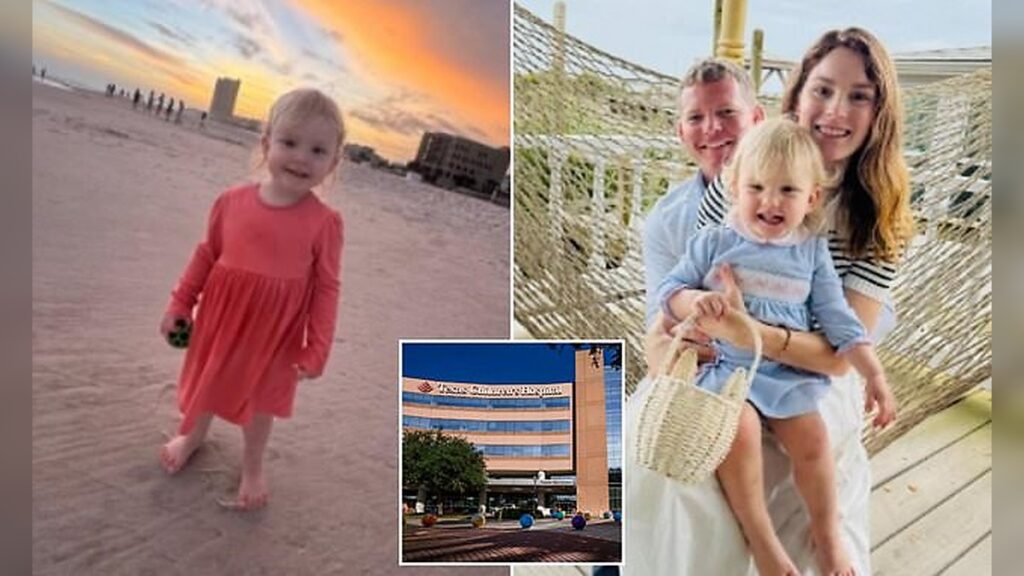
A Texas family has launched urgent legal action to stop a hospital from declaring a two-year-old girl brain dead after a near-drowning incident at a Houston hotel pool that has left her fighting for life in intensive care.
The child, Annelise Camp, was with relatives on May 25 during a Memorial Day gathering when the accident occurred.
According to her father, Johnston Camp, she had removed her life jacket and wandered toward the swimming pool before falling in.
Her older cousin reportedly pulled her from the water, and family members immediately began CPR while waiting for emergency responders to arrive.
Emergency Response and Critical Fight for Survival
Johnston Camp told FOX 26 that it took nearly an hour before Annelise’s heartbeat was restored.
Paramedics later transported her to Texas Children’s Hospital, where she has remained under intensive care since the incident.
Doctors have been treating her in the pediatric intensive care unit as her condition remains critical, with the family closely monitoring every update.
Despite the severity of the situation, her father said he has witnessed moments that gave the family hope, insisting that signs of progress should not be ignored.
Medical Recommendation Sparks Legal Battle
Tension escalated days after admission when a doctor recommended that Annelise be declared brain dead, according to her family.
That recommendation prompted immediate resistance from her parents, who refused to accept the determination at that stage.




“If there’s a one percent chance or even a five percent chance, we’re going to take it,” her father said, emphasizing their determination to pursue continued treatment.
The family argued that moving forward with a brain death declaration could limit further medical intervention while they believe recovery may still be possible.
Court Steps In to Halt Final Determination
On Friday, the Camp family secured a temporary restraining order preventing Texas Children’s Hospital from proceeding with a formal brain death declaration.
Court documents reviewed by the Daily Mail confirmed that both parties agreed to allow brain death testing to proceed, but the final determination has been paused pending a hearing scheduled for June 11.
The hospital has also reportedly agreed to explore the possibility of transferring Annelise to another medical facility that could offer additional treatment options.
Doctors, Ethics Experts, and a Divided Perspective
Medical experts say disputes like this, while emotionally devastating, are not unusual in critical care settings.
Dr. Heidi Russell, a medical ethics specialist with Rice University’s Baker Institute, told FOX 26 that such cases often arise because families and physicians interpret outcomes differently.
She explained that families may still be processing trauma and holding onto hope, while medical teams rely on clinical assessments and established neurological criteria.
Typically, multiple doctors and specialists are involved in brain death evaluations, often alongside ethics committees and legal advisors before a final decision is made.
Hospital Response and Ongoing Care
Texas Children’s Hospital acknowledged the case in a statement, expressing sympathy for the family and confirming ongoing efforts to provide care.
“Our hearts, thoughts and prayers are with the family and their loved ones,” the hospital said, adding that its medical team is “exhausting all medically viable options” while continuing to respect the family’s wishes.
Officials declined to provide further details, citing privacy concerns.
Hope, Fundraising, and an Uncertain Road Ahead
As the legal and medical process unfolds, the family has turned to the public for support. Two online fundraisers have been created to help cover the cost of ongoing treatment and care.
One campaign described Annelise as “fighting for her life in the PICU,” while another stressed the long and uncertain road ahead involving extensive therapies and medical support.
For the Camp family, the situation remains a delicate balance between clinical reality and enduring hope as they await the next court hearing and continued medical evaluations.
