
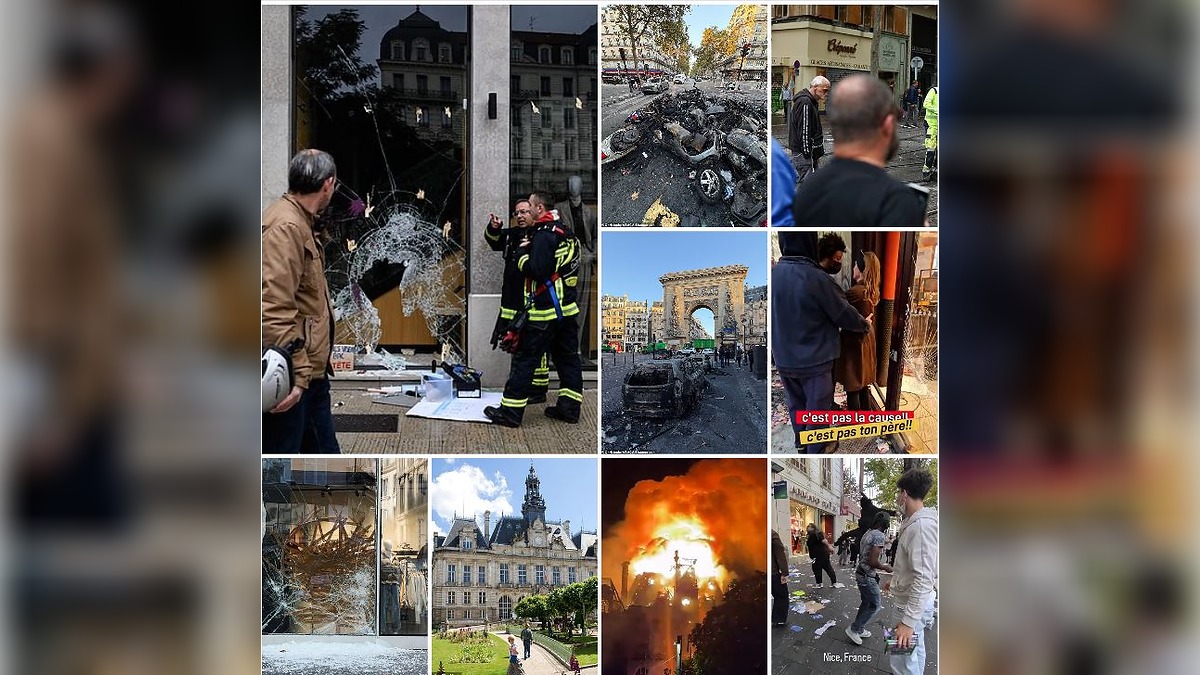
Violent clashes, arson and widespread looting swept across France on Saturday as approximately 550,000 people took part in nationwide demonstrations over the cost of living, education standards and government policies under President Emmanuel Macron.
More than 1,200 people were arrested during the unrest, while 60 law enforcement officers were injured, including two who were taken to hospital unconscious.
Major cities, including Paris, Marseille, Lyon, Nantes, Bordeaux, Rouen, Toulouse and Nice, experienced clashes between demonstrators and police. Shops, restaurants, vehicles and public buildings were damaged, while several locations were set on fire.
The demonstrations brought together students, trade unionists, members of the Yellow Vest movement and other groups protesting against rising living costs, inequality and changes affecting public services.
Woman Pleads With Looters to Spare Supermarket
Footage circulating on social media showed a woman pleading with a group of young men not to loot a supermarket during Saturday’s unrest.
The woman repeatedly asked the rioters why they were carrying out the destruction and told them that looting was not part of the cause they were demonstrating for.
“This is not the cause,” she was heard shouting as masked men pushed past her and entered the damaged shop.
The footage appeared to show the group leaving with their arms full of goods as people nearby cheered.
Other businesses across the country were ransacked, with shop owners left to assess broken windows, damaged doors and missing stock.
In one incident, a comic book shop owner attempting to protect his business was reportedly struck in the back by a looter who delivered a flying kick.
Historic Limoges Town Hall Destroyed by Fire
One of the most significant incidents occurred in Limoges, south-western France, where the town hall was engulfed by flames on Saturday night.
The historic building, constructed in 1883, was severely damaged as fire spread through the structure. Footage shared online showed its bell tower surrounded by flames before part of the building collapsed.
The town hall had historical significance, including its association with the French Resistance during the Second World War.
Images taken the following day showed extensive damage to the building’s facade.
Elsewhere, a tourist office in Lyon was set on fire, while protesters briefly entered Marseille’s city hall and vandalised a statue of Marianne, the symbolic female representation of the French Republic.
In Bordeaux, hundreds of demonstrators reportedly stormed the recently renovated Galeries Lafayette department store. Restaurants, fast-food outlets and sportswear shops were also targeted in several cities.
Police Admit They Were Overwhelmed by Violence
French police acknowledged difficulties containing the unrest as simultaneous incidents spread across the country.
A senior police commander told Le Parisien that officers had been unable to control the number of attacks taking place in different locations.
“It was apocalyptic,” the commander said, adding that law enforcement had been overwhelmed by determined protesters.
The source also said there had been insufficient personnel and ammunition as some districts fell under the control of rioters.
Police deployed tear gas, water cannon and baton charges to disperse crowds and respond to attacks. Vehicles and rubbish bins were set alight, barricades were erected and projectiles, including fireworks and bottles, were thrown during confrontations.
Rioters also broke into and vandalised municipal police premises in some locations.
By Sunday morning, streets in Paris were covered with broken glass, burnt debris and damaged vehicles, while business owners began inspecting their premises.



Macron Vows Prosecution as Government Blames Far-Left Groups
President Macron condemned the violence and warned that those responsible for destruction and looting would face legal consequences.
“There’s no place for violence in our Republic,” he said on Sunday.
He added that people who attacked government offices and businesses or looted town halls would be prosecuted and punished.
Macron also called for unity against those he said were attempting to undermine public institutions and prevent people from expressing their grievances peacefully.
Interior Minister Laurent Nuñez pointed to what he described as a significant mobilisation of far-left groups, naming Antifa, the New Anticapitalist Party and Permanent Revolution.
Prime Minister Sébastien Lecornu also accused far-left groups of organising violence in several cities, while distinguishing between peaceful demonstrations and criminal acts.
“Peaceful demonstrations have a rightful place in our Republic. Arson, looting, and attacks do not,” Lecornu said.
Opposition Politicians Challenge Government’s Handling of Protests
Left-wing politicians rejected accusations that their movement had encouraged the violence and criticised the police response.
Jean-Luc Mélenchon, leader of France Unbowed, argued that excessive tear gas had been used against peaceful demonstrators.
He said the public-order strategy appeared to encourage confrontation rather than prevent it.
Marine Tondelier of the Ecologists party also called on the government to reconsider its approach, warning that a failure to exercise restraint could increase tensions.
Meanwhile, Marine Le Pen of the far-right National Rally party accused the far left of exploiting legitimate public grievances to create disorder.
She said peaceful concerns had once again been taken over by groups she accused of legitimising violence.
Le Pen hopes to succeed Macron as president, although her potential candidacy is affected by a criminal conviction related to the misuse of European Parliament funds, which she is appealing.
Macron is due to leave office in May after completing the maximum two terms permitted under French law.
Cost of Living and Education at Centre of Protests
The demonstrations followed almost five weeks of protests by school and university students opposing problems in the education system and changes they fear could make higher education less accessible.
The movement expanded to include other groups concerned about rising prices, inequality and public services.
Members of the Yellow Vest movement, which emerged in 2018 in opposition to increases in diesel taxes before broadening into a wider protest over living costs, also joined the demonstrations.
Some protesters in Paris threw baguettes at riot police, while others wore black clothing and balaclavas as confrontations intensified.
In Saint-Etienne, a protester reportedly suffered the loss of a hand after a police crowd-control grenade exploded. The incident followed another case on October 5, when a 15-year-old student lost his left hand after a stun grenade exploded outside his school in Lens.
Police responses have also come under scrutiny following reports of serious injuries to demonstrators. These include a 16-year-old who was blinded by a rubber bullet.
An officer was charged with aggravated violence on Tuesday over an alleged shooting involving a student in Tours on September 30. The internal police watchdog is also investigating at least two dozen alleged cases of police violence.
France had suspended the use of stun grenades during student demonstrations, but Nuñez said such intermediate weapons could be used if clashes occurred during Saturday’s protests.
Yellow Vest Movement Returns as Economic Pressures Persist
The renewed protests have drawn comparisons with the Yellow Vest demonstrations that disrupted France during Macron’s first term.
The movement began over fuel taxation but developed into a broader campaign against the cost of living and income inequality. It later became less active after the government agreed to billions of euros in tax cuts.
Yannick Maillou, a teacher from western France who participated in the movement, said protesters had organised meeting points ahead of Saturday’s demonstrations, while trade unions encouraged members to take part.
He said groups were also preparing to provide medical assistance in anticipation of possible police violence.
Another Yellow Vest participant, Myrtil Devillers, said he understood the range of grievances being expressed, citing concerns over fuel prices, the justice system, education, healthcare and the difficulties facing businesses.
The protests come as France faces political divisions and pressure over its public finances, with rising borrowing costs adding to concerns about government debt.
Violence Spreads to Italy and Belgium
Demonstrations inspired by the unrest in France also took place in Italy and Belgium on Saturday.
In Milan, protesters gathered near the city’s Gothic cathedral and inside the Galleria Vittorio Emanuele II shopping centre. Clashes broke out after police said demonstrators had thrown stones, prompting officers to use tear gas.
Shopkeepers lowered their shutters as tourists left the area, and the central Duomo metro station was temporarily closed. Italian media reported injuries and arrests.
In Brussels, several hundred demonstrators, many of them young people, took to the streets to protest against education costs and reforms they believe could restrict access to higher education.
Clashes also occurred between demonstrators and police, while images showed protesters standing on an overturned car.
Authorities in France continued to deal with the aftermath of Saturday’s unrest, with damaged businesses, burnt vehicles and public buildings left across affected cities.

