
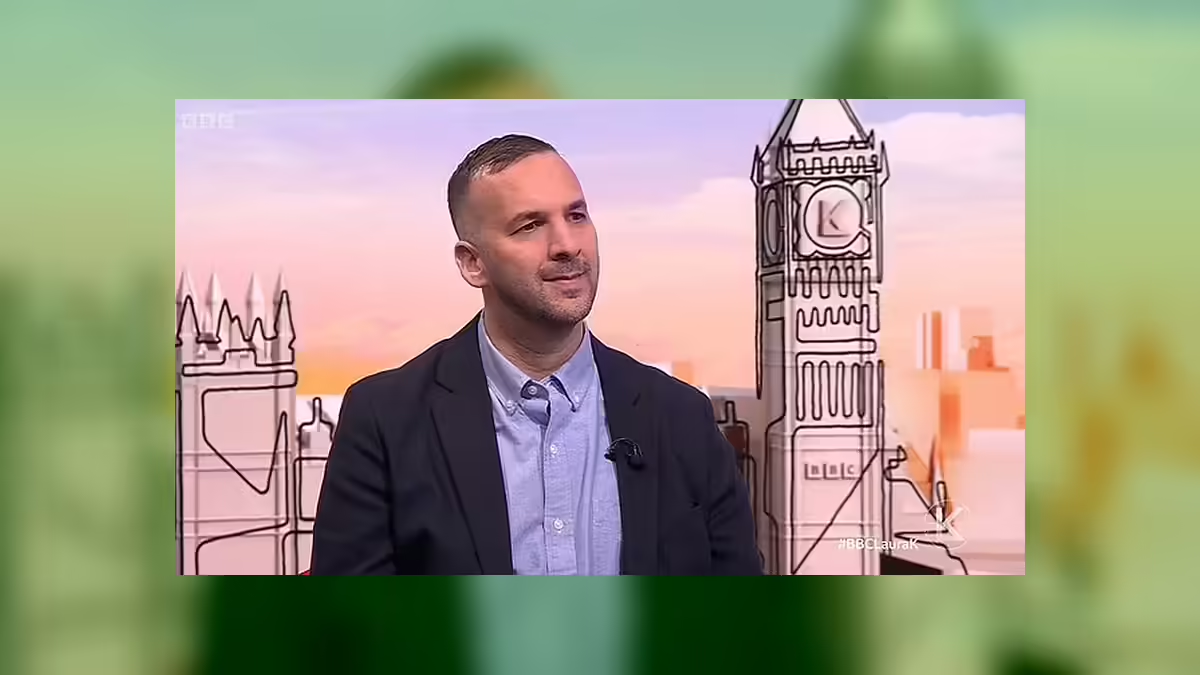
Green Party leader Zack Polanski has refused to say that Israel has a right to exist, arguing that international law does not grant any country such a right, while describing Zionism as a racist ideology.
Polanski made the remarks during an appearance on the BBC’s Sunday with Laura Kuenssberg, his first major televised interview since a controversy over antisemitism and the party’s position on Zionism intensified.
He argued that the concept of a Jewish homeland, as implemented in Israel, had come at the expense of Palestinians in Gaza and the West Bank.
Green Party Conference Backs Motion on Zionism
The controversy followed the Green Party conference in Brighton, where members backed a motion describing Zionism as racism. Polanski did not participate in the vote.
The motion called for Israel to be treated in the same way as apartheid-era South Africa and proposed its eventual replacement with a Palestinian state with Jerusalem as its capital.
Although Polanski said he disagreed with the policy, he confirmed that he would not attempt to change the party’s rules to bring forward a vote on the issue before 2028.
The decision has drawn criticism from within and outside the party, including from members concerned about the implications of its position on Zionism.
Green Party Leader Says People Have the Right to Exist
Asked directly whether Israel had a right to exist, Polanski said he did not believe any country possessed such a right under international law.
He argued instead that individuals had the right to exist and said Israelis and Palestinians should be able to live alongside one another, exercise self-determination and enjoy equal rights, freedom and security.
Polanski also criticised Israel’s territorial policies, arguing that its borders remained disputed and accusing the country of repeatedly entering other people’s land.
Polanski Describes Zionism as Racist
During the interview, Polanski was asked whether he considered Zionism racist. He pointed to Palestinian deaths in Gaza during Israeli military operations and argued that Palestinians were being killed because of their identity.
He described this as evidence of what he called a racist ideology.
Polanski, who is Jewish and grew up in a Zionist family, said the debate over the definition of Zionism was largely a matter of semantics.
When it was suggested that some people understood Zionism as the pursuit of a safe homeland for Jewish people, he argued that its practical implementation had come at the cost of the Palestinian population.




He said he wanted equal rights for Israelis and Palestinians, adding that the implementation of Zionism had not achieved that outcome.
Jewish Greens Leader Calls for Polanski to Resign
The party conference decision prompted Vivien Lichtenstein, leader of the Jewish Greens, to call for Polanski to resign. Lichtenstein also said she was considering leaving the party.
The Labour Party has separately issued an ultimatum to local Green groups with which it currently works in coalition, telling them to disown the motion or risk losing Labour’s support.
Polanski, however, said the policy would remain in place until the party could reconsider it under its existing rules.
Polanski Says Policy Could Be Changed in 2028
Polanski said he would not seek to overturn the conference decision immediately, but wanted to amend the policy when the next opportunity arose.
He said he wanted to move away from a one-state approach and towards a position in which Israelis and Palestinians could determine their own future.
Under the party’s rules, the policy cannot be put to another vote before 2028. Polanski said he would not attempt to change those rules to bring the vote forward.
He defended his position by saying he respected the democratic decision made by party members and did not intend to override it.
By-Election Defeat Adds to Pressure on Green Leader
The controversy was followed by another setback for Polanski when the Green Party suffered defeat in the Holborn and St Pancras by-election, just days after the conference decision.
The result came as polling showed a decline in public views of the Green Party leader.
An Ipsos survey conducted between 9 and 13 October found that 52 per cent of respondents viewed Polanski unfavourably, an increase of six percentage points from September.
Only 16 per cent said they had a favourable view of him, leaving his net favourability rating at minus 36. According to the survey, this was the lowest rating among the national party leaders included.
Poll Shows Declining Support Among Younger Voters and Former Labour Supporters
The Ipsos findings indicated that unfavourable views of Polanski were particularly concentrated among older respondents. However, his standing had also weakened among people under 35.
His net favourability among under-35s fell from plus 16 in April to plus two in October.
The survey also recorded a substantial change among people who voted Labour in the 2024 general election. Polanski’s net rating within that group dropped from plus seven in April to minus 24 in October.
Keiran Pedley, Ipsos’ UK director of politics, said the public had noticed what he described as a difficult month for the Green Party leader.
Ipsos Survey Records Ratings for Other Political Leaders
The poll found that Labour politician Andy Burnham was the only senior UK political figure surveyed with an overall positive favourability rating.
Prime Minister Keir Starmer recorded a net rating of plus eight, while Conservative leader Kemi Badenoch stood at minus 12 and Liberal Democrat leader Sir Ed Davey at minus 15.
Reform UK leader Nigel Farage recorded a net rating of minus 31, with 56 per cent of respondents saying they viewed him unfavourably.
Pedley said Burnham appeared to be gaining ground among left-leaning voters, adding that people who voted Green in 2024 viewed him almost as favourably as Polanski.
The online Ipsos survey interviewed 2,257 British adults between 9 and 13 October.

