
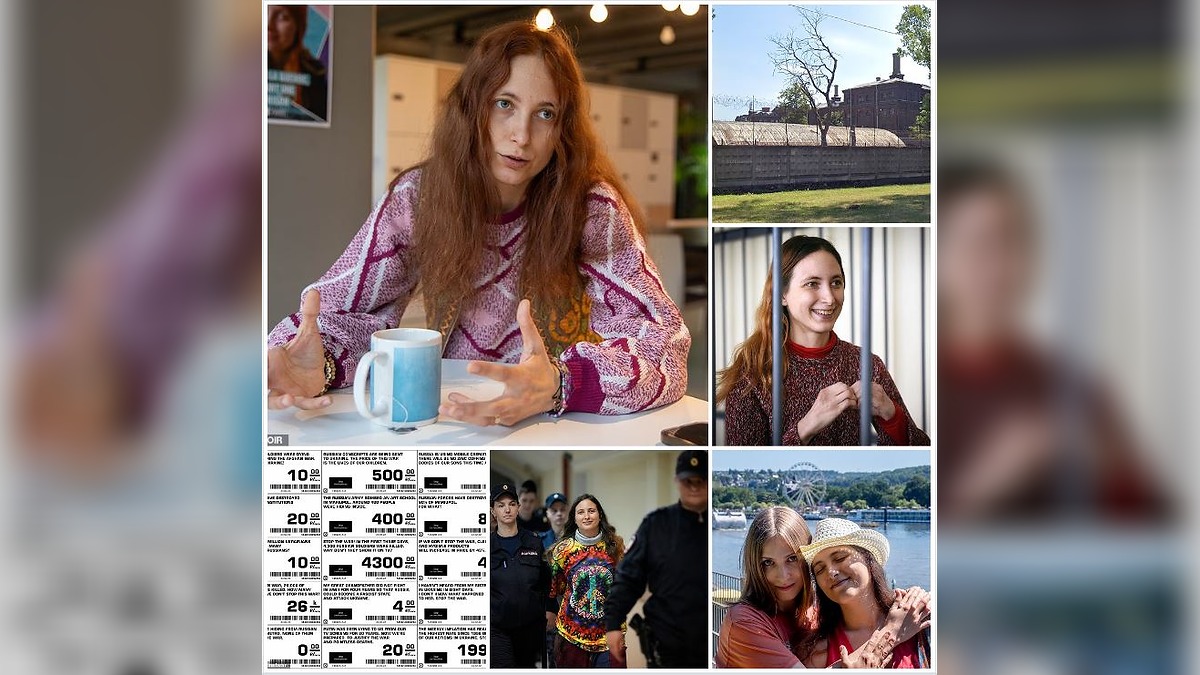
Russian artist and musician Aleksandra “Sasha” Skochilenko has spoken about the harsh conditions she endured in detention after being sentenced to seven years in prison for an anti-war protest following Russia’s invasion of Ukraine in February 2022.
In April that year, Skochilenko replaced five supermarket price tags with printed messages opposing the war and criticising Russian state propaganda. The protest was intended to encourage shoppers to question the information being presented by the authorities.
One of the messages accused Russian President Vladimir Putin of spreading lies through television for two decades, arguing that the propaganda had contributed to public support for the war and the resulting deaths.
However, an elderly shopper reported the activity to the authorities, leading to an investigation that ended with Skochilenko’s arrest and prosecution.
Authorities Track Down Activist After Supermarket Incident
According to Skochilenko, investigators used CCTV footage to trace her movements to a friend’s home. Although officers initially arrived after she had left, they allegedly pressured her friend to contact her and persuade her to return.
Speaking in an interview with the Daily Mail, Skochilenko said officers seized her when she arrived, without identifying themselves.
She recalled shouting for help and resisting because she feared she was about to be sexually assaulted.
The then 36-year-old was subsequently subjected to hours of questioning as investigators sought to establish whether she had acted independently or belonged to a wider activist organisation.
Authorities detained her while investigating the incident before charging her under legislation used to prosecute people accused of spreading false information about Russian military activities.
Activist Describes Deteriorating Health in Detention
Skochilenko said her physical and mental health deteriorated during her time at Detention Centre No. 5 in St Petersburg, where she was held before, during and after her trial.
She also alleged that she was denied essential medication and dietary provisions needed to manage coeliac disease, bipolar disorder and a heart condition.
Coeliac disease is an autoimmune condition in which consuming gluten triggers an immune response that damages the small intestine.
Skochilenko said the meals provided in detention frequently contained food she could not safely eat. She recalled being unable to consume the porridge served at breakfast or the soup provided at lunch, leaving her dependent on limited dinner options such as cabbage or potatoes.
According to her account, the lack of suitable food caused her health to deteriorate significantly.
Prisoners Allegedly Subjected to Contaminated Water and Freezing Conditions
Skochilenko also described concerns about the quality of drinking water at the detention centre, alleging that prisoners were forced to consume contaminated tap water that contributed to hair loss and serious skin problems.
She said the accommodation was overcrowded, with 18 women, including herself, sharing a small cell monitored by an internal surveillance camera.
The activist alleged that some inmates repeatedly subjected her to humiliation and psychological pressure, including making derogatory comments about her smell and forcing her to wash her clothes by hand.
After washing them, she said she had to dry the clothes in freezing conditions before wearing them again, only to face the same accusations and repeat the process.
She also recalled being criticised over the placement of everyday items, describing the treatment as collective bullying.
War Propaganda Programmes Played Repeatedly in Cell
Skochilenko said her fellow inmates repeatedly played television programmes about the war in Ukraine from morning until night.
She told the Daily Mail that the broadcasts were particularly distressing because she had friends in Ukraine and had previously worked as a counsellor at a children’s camp in the country.




She said her decision to protest was motivated by her inability to remain silent while children were forced to hide from shrapnel during the conflict.
Skochilenko also claimed she later discovered that prison officials had deliberately recruited inmates to subject her to psychological abuse. She linked the alleged treatment to the publicity surrounding her arrest and complaints about her detention.
Separation From Wife Added to Prison Ordeal
During her detention, Skochilenko was prevented from speaking to or seeing her then-girlfriend, Sofya Subbotina, for approximately a year.
Subbotina had been called as a witness by the authorities, according to the activist’s account. Skochilenko’s family also left Russia for France amid concerns about possible pressure from the state.
The couple, whose relationship was not legally recognised under Russian law, were eventually granted permission by a judge to communicate for two hours each month.
Subbotina later helped campaign for Skochilenko’s release and supported efforts to secure better conditions and medical care for her.
Cold Cells and Restricted Exercise Raised Further Concerns
Skochilenko recalled entering detention to find a thin, scratchy blanket and a mattress that offered little protection from the metal bed frame.
She said the cold became particularly difficult during winter, when she was left shivering in her cell. She also described suffering from anaemia and low blood pressure, which made the conditions harder to endure.
Exercise opportunities were limited to a small outdoor courtyard enclosed by bars. Although prisoners were allocated one hour outside, Skochilenko said staffing shortages sometimes left inmates waiting in freezing temperatures for extended periods.
She estimated that approximately 800 prisoners were supervised by only eight staff members during some shifts.
She also alleged that inmates were occasionally left in shower rooms for hours, despite being permitted to shower only twice a week.
As her condition worsened, Skochilenko said she feared dying in prison. With assistance from Subbotina and human rights organisations, she eventually secured accommodation in a room shared with just one other prisoner and gained access to medical attention.
She credited regular physical activity with helping her survive the psychological strain, saying that walking around the courtyard had helped her cope with depression.
Year-Long Trial Ends With Seven-Year Sentence
Skochilenko remained in detention throughout her trial, which lasted more than a year.
She said she spent up to eight or nine hours in a cage inside the courtroom during hearings, sometimes without access to drinking water or bathroom facilities.
In November 2023, she was convicted under Russian laws targeting the alleged discrediting of the country’s armed forces and spreading false information about military activities. The court sentenced her to seven years in prison.
Her prosecution was among the early cases brought under legislation introduced following the invasion of Ukraine. The case attracted international criticism over the treatment of anti-war activists.
Skochilenko said she had anticipated receiving a prison sentence, although she had hoped it would be four or five years.
She recalled that accepting the sentence allowed her to focus on counting down the days until her eventual release.
Activist Initially Feared She Was Being Taken to Be Killed
Skochilenko’s release came approximately a year after her conviction, when authorities moved her from the prison without initially explaining her destination.
She spent four days at another prison before being told to pack her belongings.
According to her account, a group of masked men then escorted her onto a bus carrying other detainees. The group was warned against speaking and told they could be hooded and handcuffed if they disobeyed.
One of the men eventually informed them that they were participating in a political prisoner exchange.
Skochilenko said she initially doubted the explanation and feared they were being transported to a forest to be executed.
The group was flown to Ankara, Turkey, on a journey lasting approximately four hours before being transferred to another aircraft bound for Cologne, Germany.
Prisoner Exchange Included Journalists, Spies and Convicted Assassin
Skochilenko was among 16 people involved in a multinational prisoner exchange that brought together Russian prisoners and individuals held by Russia.
Those included Russian assassin Vadim Krasikov, Russian intelligence operatives, Wall Street Journal reporter Evan Gershkovich and former US Marine Paul Whelan.
The exchange resulted in Skochilenko’s release from Russian custody and her departure from the country.
Sasha Continues Anti-War Activism From Berlin
Skochilenko now lives in Berlin, Germany, with her wife, Sofya Subbotina. She continues to oppose Russia’s war against Ukraine through her artwork and music.
She is also working on a comic book documenting her experiences in detention.
Asked whether she regretted replacing the supermarket price tags with anti-war messages, Skochilenko said she did not.
She described the experience as a journey that had shaped her life, while reflecting on the years of turmoil that followed what began as a protest involving five stickers.

