
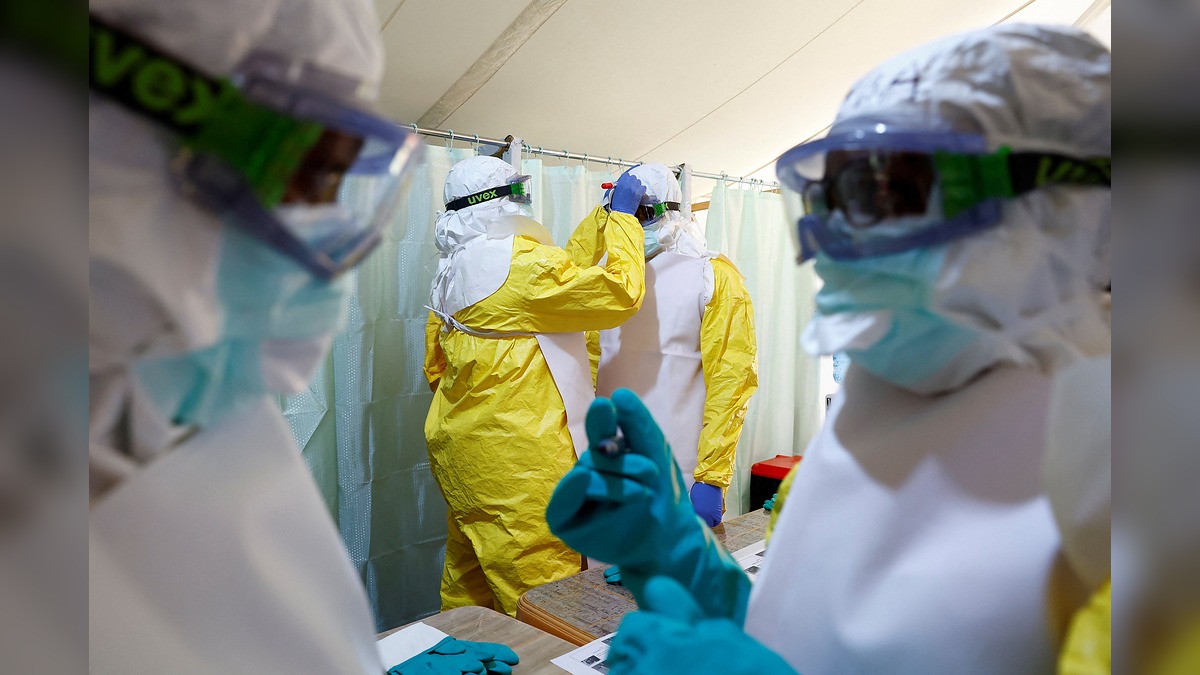
Jerkis Mahamba, a 29-year-old Ebola survivor, is now helping care for children receiving treatment at an isolation centre in Butembo, eastern Democratic Republic of Congo (DRC).
Whenever he hears a child crying in the ward, Mahamba puts on protective equipment and goes to comfort them. Having recovered from the same strain of Ebola, he understands the fear and discomfort they are experiencing.
Mahamba contracted the virus in September and spent 18 days receiving treatment at the same facility. His recovery gave him immunity to the strain currently circulating in the DRC, allowing him to provide close support to young patients whose parents are not permitted to touch them.
Some children need reassurance through a hug, while others want to be rocked to sleep or simply have someone to talk to.
Mahamba Uses His Experience to Reassure Children
“I introduce myself and tell them, I went through this too. I ask them not to lose hope,” Mahamba told Reuters at the hospital in Butembo’s Kitatumba neighbourhood.
He recalls experiencing vomiting, losing his appetite and struggling to take medication during his own illness.
Although he has immunity, Mahamba continues to wear protective clothing and disinfect his clothes to prevent carrying the virus outside the ward.
He said he sometimes picks up distressed children and gently settles them back into their beds. He then finds games and activities to keep them occupied until they become comfortable and eventually fall asleep.
Families Watch From Outside the Isolation Ward
The children’s relatives are often forced to watch through a glass window because they cannot enter the isolation area or make physical contact with them.
Kambale Syavula Volonté, the uncle of one of the patients, said the separation was difficult for families.




“Our love for our children is very strong,” he told Reuters.
MSF Recruits Mahamba After His Recovery
Before contracting Ebola from a relative, Mahamba earned a living by selling school supplies on the streets of Butembo, one of the centres of the outbreak near the Ugandan border.
Following his recovery, the medical charity Médecins Sans Frontières (MSF) employed him at the treatment centre, where he joined other survivors supporting the response to the epidemic.
Survivors have taken on different responsibilities within the facility. Some provide companionship and emotional support to patients, while others help clean and disinfect rooms and medical equipment.
Others work in surrounding communities, visiting villages and remote areas to provide information about the disease and address misinformation.
Ebola Survivors Help Counter Fear and Misinformation
Dr Toussaint Selemani, head of the MSF-run treatment centre, said survivors could play an important role in encouraging people to seek medical assistance.
He explained that their personal experiences could help reduce fear and stigma surrounding the disease and reassure people experiencing symptoms that they should visit a treatment centre.
False claims that the outbreak is part of a foreign conspiracy or that healthcare workers are deliberately spreading Ebola have contributed to hostility towards medical teams.
Late last month, youths armed with machetes attacked two community health workers who were conducting awareness activities. One was killed, while the other was injured.
Selemani said survivors could use their experiences to challenge misinformation and encourage people to seek care promptly.
Mahamba Shares His Recovery Story With Local Communities
Alongside his work in the hospital, Mahamba also visits communities to speak about Ebola prevention.
He remembers feeling frightened and distrustful as the disease spread and people around him became ill. He now shows residents photographs of himself during his illness and encourages them to take precautions.
However, most of his time is spent inside the treatment centre, where he supports families and responds to the cries of children in the isolation wards.
Selemani said patients could experience considerable fear and anxiety while receiving treatment, particularly when they worry they might die.
Meeting someone who has survived the disease, he added, can help restore their hope.
