
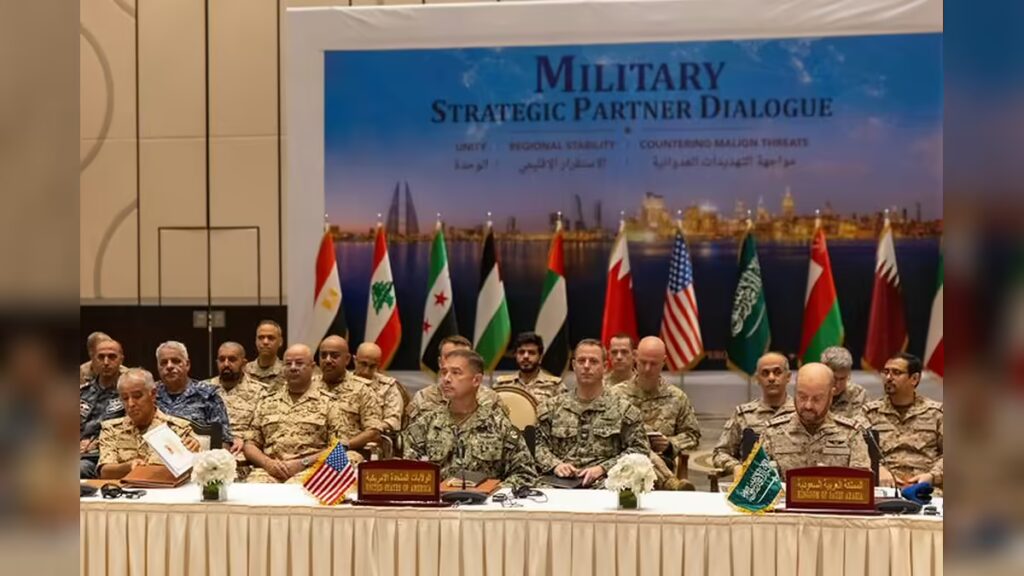
Senior military leaders from across the Middle East gathered in Bahrain on July 1 for a regional security dialogue led by the U.S. Central Command (CENTCOM), focusing on strengthening defense cooperation and addressing evolving security challenges.
The high-level meeting brought together representatives from 12 countries to discuss collective efforts aimed at promoting regional stability and safeguarding critical maritime routes.
Military Leaders Discuss Shared Security Priorities
The dialogue was hosted by the Bahrain Defense Force in Manama and chaired by CENTCOM Commander Adm. Brad Cooper.
Defense officials from Bahrain, Egypt, Jordan, Kuwait, Lebanon, Oman, Qatar, Saudi Arabia, Syria, the United Arab Emirates and Yemen participated in discussions covering the current regional security environment and opportunities to expand military collaboration.
Officials examined ways to improve coordination among partner nations in response to emerging security threats across the Middle East.
Focus Placed on Strait of Hormuz Security
One of the central topics of the meeting was maintaining security in the Strait of Hormuz, one of the world‘s most strategically important maritime corridors.
According to CENTCOM, participating nations reaffirmed their shared commitment to protecting the uninterrupted flow of international commerce through the waterway, which serves as a key route for global energy supplies and commercial shipping.




The discussions emphasized continued cooperation to preserve maritime security and regional economic stability.
CENTCOM Reaffirms Partnership With Regional Allies
Adm. Brad Cooper said the meeting highlighted the close relationship between the United States and its regional defense partners.
He noted that the dialogue reinforced a common commitment to enhancing regional security while strengthening cooperation among participating nations.
CENTCOM described the gathering as part of its broader efforts to promote collective defense and long-term stability across the Middle East.
Air and Missile Defense Cooperation Expands
The meeting also highlighted ongoing efforts to improve regional air and missile defense capabilities.
CENTCOM said the United States and partner countries currently operate one of the world’s largest and most advanced active air and missile defense networks in the Middle East.
Earlier this year, the command and regional governments established a Middle Eastern Air Defense coordination cell designed to improve intelligence sharing, provide early threat warnings and coordinate responses during security contingencies.
Syria and Lebanon Join U.S.-Led Defense Forum
The conference marked a significant diplomatic development, as military representatives from Syria and Lebanon participated for the first time in a regional defense conference led by the United States.
Their inclusion expanded the scope of the dialogue and reflected broader efforts to encourage communication among military leaders from across the region.
Regional Cooperation Remains Central Goal
CENTCOM said the security dialogue underscores the importance of continued coordination among regional partners in addressing shared challenges.
By expanding defense cooperation, improving information sharing and reinforcing collective security arrangements, participating nations aim to strengthen stability while protecting critical infrastructure and international trade routes throughout the Middle East.
