
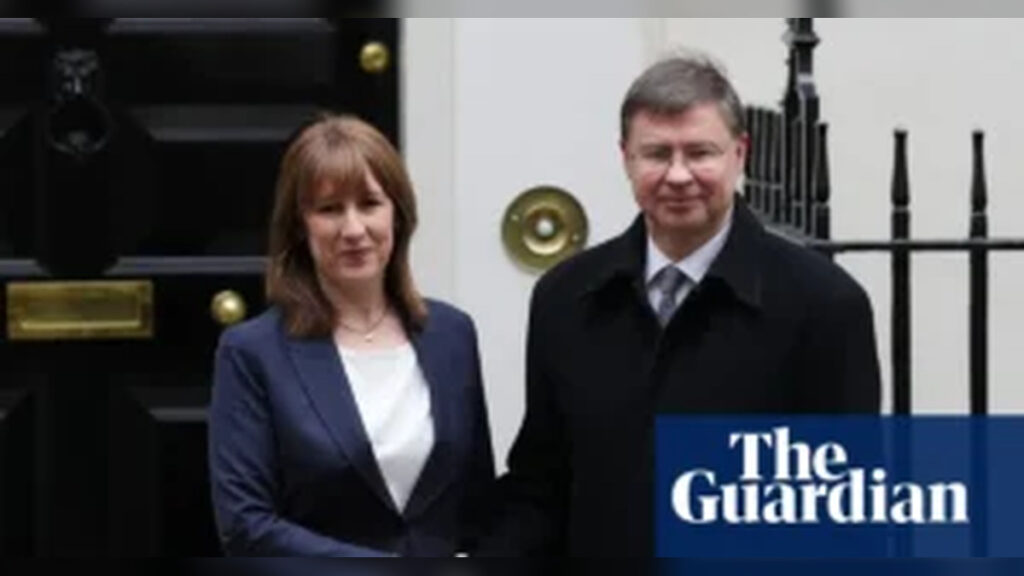
The European Union has left the door open to deeper economic cooperation with the United Kingdom, hinting it would consider proposals for closer trading arrangements if the British government chooses to pursue them.
The comments come as pressure grows on Prime Minister Keir Starmer from within Labour to strengthen post-Brexit relations with the bloc.
Brussels Adopts Flexible Tone on Future Trade Talks
European Economy Commissioner Valdis Dombrovskis has suggested the EU is prepared to consider fresh proposals from the UK, saying Brussels would approach discussions with an “open mind.”
His remarks indicate that the bloc is willing to engage in conversations about expanding trade cooperation, including the possibility of a customs union, should the UK decide to explore that path.
However, Dombrovskis stressed that participation in the EU’s single market comes with established obligations, making it clear that member countries must accept all of its core principles rather than selecting individual benefits.
Customs Union Debate Returns to the Spotlight
The renewed discussion comes as Keir Starmer faces increasing calls from Labour lawmakers to pursue closer economic integration with the European Union.
While some members of his party believe a customs union could improve trade and economic growth, the prime minister has previously argued that such an arrangement no longer fits the UK’s priorities.
Instead, Starmer has indicated he is interested in seeking cooperation in selected areas of the single market without fully rejoining it.
EU Reiterates Importance of the Four Freedoms
Despite signaling openness to dialogue, European officials emphasized that access to the single market is tied to the EU’s long-standing framework.
Dombrovskis noted that the single market is built on the “four freedoms”—the free movement of goods, services, capital, and people—suggesting that the UK would not be able to negotiate access while excluding key elements such as freedom of movement.




The message reinforces the EU’s position that the integrity of the single market remains non-negotiable.
European Leaders Call for a Fresh Partnership
Other senior EU figures have also expressed optimism about improving relations with Britain.
European Parliament President Roberta Metsola said both sides should move beyond the political divisions that followed Brexit and build a new relationship focused on practical cooperation.
She highlighted areas including trade, customs, scientific research, mobility, security, and defense as opportunities for closer collaboration, urging Europe and the UK to leave past disagreements behind and establish a stronger partnership.
Meanwhile, European Commission spokesperson Paula Pinho described the single market as one of the EU’s greatest achievements and said an upcoming EU-UK summit would provide an opportunity to better understand Britain’s future ambitions.
Negotiations Continue on Several Key Areas
Talks between London and Brussels are already progressing on a range of practical issues aimed at easing trade and cooperation.
Among the topics under discussion are a veterinary agreement to simplify food exports, a youth mobility initiative, British participation in the EU’s electricity market, and closer coordination of carbon emissions trading systems.
These negotiations are viewed as important steps toward improving economic ties without reversing Brexit.
Government Sees Economic Benefits From Pragmatic Approach
Cabinet Office minister Nick Thomas-Symonds has defended the government’s strategy of pursuing practical agreements rather than seeking full reintegration into the EU.
Writing in the Financial Times, he argued that negotiations covering food exports, beverages, and carbon trading could generate economic benefits worth an estimated £9 billion annually by 2040.
At the same time, he reaffirmed Labour’s commitment not to rejoin either the single market or the customs union and ruled out restoring freedom of movement between the UK and the EU.
EU Pushes to Strengthen Its Own Single Market
The renewed discussion over UK-EU relations comes as Brussels focuses on reinforcing its internal economy.
European leaders are preparing for a special summit dedicated to strengthening the single market after a report by former Italian Prime Minister Mario Draghi warned that Europe risks falling behind economically unless it becomes more competitive and industrially resilient.
European Council President António Costa has described reinforcing the single market as a strategic priority, underlining its importance to the bloc’s long-term economic future.
UK-EU Relationship Enters a New Phase
Although major Brexit red lines remain in place on both sides, recent statements suggest there is growing willingness to explore practical cooperation where mutual interests align.
With negotiations continuing across several sectors and political pressure mounting for closer economic engagement, the coming months could shape a new chapter in UK-EU relations—one focused less on revisiting Brexit and more on finding workable solutions for trade and growth.

