
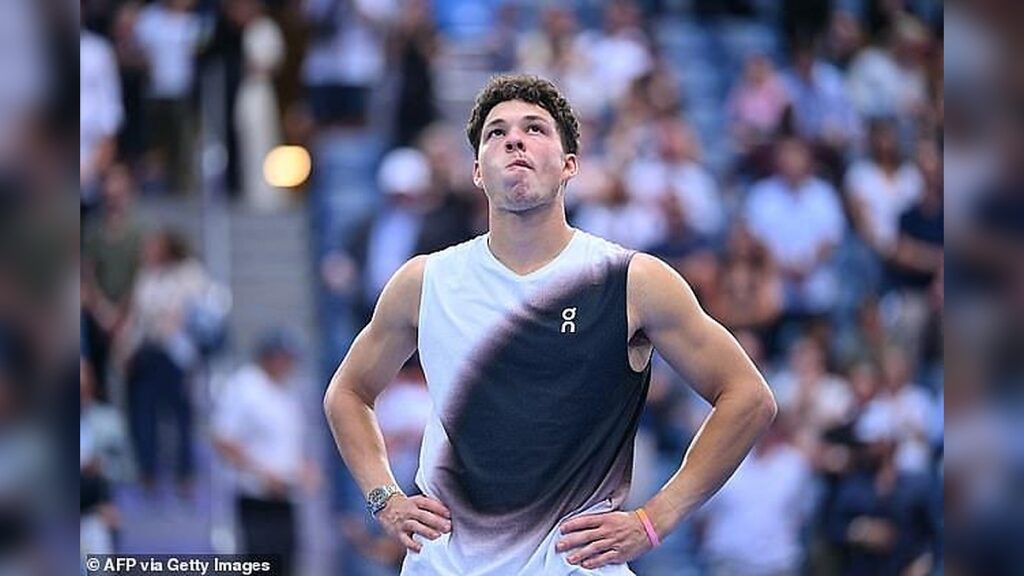
Ben Shelton has called for a change to tennis’s serving regulations after his US Open final defeat to Alexander Zverev, arguing that players should not be allowed unlimited time before taking a second serve.
Shelton lost to top seed Zverev in four sets in Sunday’s final in New York, but the American’s frustration extended beyond the result.
Much of his concern centred on his opponent’s unusually long pre-serve routine, which regularly involves bouncing the ball more than 10 times.
Second Serves Become the Focus of Debate
Under current rules, a player has 25 seconds to begin the first service motion after the previous point ends.
However, there is no specific countdown for a second serve.
Instead, the regulations require the player to serve “without delay”, leaving room for interpretation over how long a player can take and how many times they can bounce the ball.
Shelton believes that distinction should be reconsidered.
“I definitely think for a first serve, you should be able to do whatever you want – you can use the full 25 seconds every time,” Shelton said.
“I think that there should be some sort of rule… limiting time on second serve. You shouldn’t have unlimited time.
For our sport, for the fans, I think it’s tough to be sitting there that long for the next play, the next action to happen.”
Zverev’s Ball-Bouncing Habit Draws Attention
Zverev’s serving routine has become one of the most discussed aspects of his game at the US Open.
Reports claimed the German had bounced the ball more than 12,000 times across his first five matches at Flushing Meadows.




The routine has also irritated other players. Karen Khachanov voiced his frustration following his semi-final defeat to Zverev, saying the repeated bouncing annoyed him and many other players.
Tennis greats Andy Roddick and John McEnroe have also questioned whether the sport should place tighter restrictions on such lengthy routines.
Shelton Refuses to Wait in a Ready Position
The issue became particularly noticeable during the final, with Shelton deliberately waiting before settling into his return position while Zverev went through his serving routine.
The American said that approach brought him into conflict with chair umpire Marijana Veljovic, who told him he needed to get into position earlier.
Shelton disagreed, arguing that Zverev was free to begin his routine whenever he wanted.
“She was telling me I need to get to the line earlier, and I was like: ‘He can start his routine whenever he wants,’” Shelton explained.
“I promise you there will never be a time where he serves and I’m not ready… if he’s bouncing the ball 20 to 25 times, I shouldn’t have to just sit there for that… I think that is a stupid rule.”
American Questions the Demands on Returners
Shelton also rejected the idea that he should remain crouched and physically prepared throughout Zverev’s lengthy sequence of ball bounces.
“He never does less than ten bounces… I’m not going to sit there in a ready position with my knees bent, tension in my body for 30 seconds while I’m waiting,” he said.
For Shelton, the issue is not simply about his personal preference as a returner.
He believes excessive delays can interrupt the rhythm of a match and leave spectators waiting unnecessarily for the next point to begin.
Shelton Predicts Tournaments Will Examine the Rule
The American suggested that tournament organisers could eventually be forced to address the issue as complaints about prolonged serving routines continue to emerge.
“I’m sure at some point it will be something that these tournaments look at just because there is such a delay in play in some matches,” Shelton said.
His comments came immediately after a painful final defeat, but his criticism was focused on what he sees as a broader problem with the current rules rather than on Zverev alone.
Zverev Says the Routine Is Not Deliberate
Zverev has previously played down suggestions that he deliberately uses the extended ball-bouncing sequence to disrupt opponents.
Following his semi-final victory over Khachanov, the German insisted that he does not consciously count the number of bounces before serving.
“I’m not counting in my head… I’m not getting a certain number or anything like that. I don’t know why it increased so much,” Zverev said.
That explanation, however, has done little to end the debate, with Shelton now adding his voice to growing calls for tennis authorities to establish a clearer limit for second serves.
