
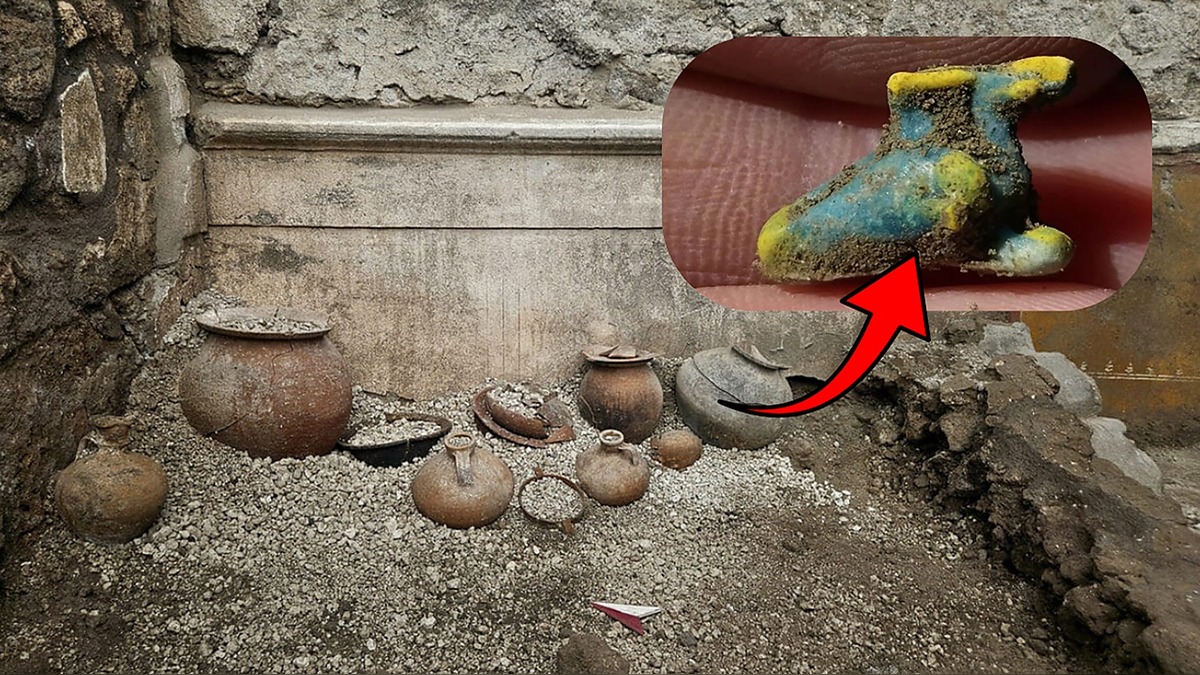
Archaeologists investigating the ruins of Pompeii have uncovered a collection of personal belongings from a wooden cupboard that remained sealed beneath volcanic debris for nearly 2,000 years.
The discovery was made inside a house along Via dell’Abbondanza, one of the ancient city’s busiest streets, which was buried when Mount Vesuvius erupted in AD 79.
The furniture and its contents were carefully excavated from beneath metres of ash, revealing objects that offer a glimpse into the everyday activities and personal lives of the home’s former occupants.
Among the items recovered were a child’s necklace, a perfume bottle, coins, tweezers, cosmetic tools and household vessels.
Child’s Necklace Contains 24 Elaborate Charms
One of the most notable discoveries was a Roman children’s necklace known as a crepundia, consisting of 24 miniature objects made from bone, glass paste, earthenware and rock crystal.
The charms feature different shapes and figures, including tiny hands, feet, pinecones and bunches of grapes.
Others represent Mercury and Bes, an Egyptian deity whose worship spread throughout the Roman world.
Crepundia necklaces were traditionally given to children as protective amulets. They also functioned as rattles, producing sounds that helped parents keep track of young children.
The objects were not typically worn by adults, although many people retained them as childhood keepsakes.
Because people in the Roman world frequently travelled for business and trade, the necklaces were sometimes stored in small containers or bags and carried as reminders of home.
Perfume, Cosmetics and Other Household Belongings Recovered
The cupboard also contained several objects associated with personal grooming and domestic routines.
Archaeologists recovered a small glass bottle believed to have held perfume or ointment, tweezers, a pestle used for mixing cosmetics and an incense burner.
Other finds included bronze, glass and ceramic pots and vases, as well as a finely decorated snuff bottle featuring a pine-scale pattern.
The excavation also revealed evidence of less refined household activity.
Researchers discovered the remains of two wild mice that appeared to have been taking food from a large storage jar when the volcanic disaster struck.
Coins and Lead Weights Provide Clues About the Occupants
Further discoveries inside the cupboard included a small wooden box containing lead weights, which researchers believe could indicate that the household’s occupants were involved in commercial activities or trade.
A woven container holding 38 bronze coins was also recovered.
The collection of valuables and personal belongings has raised questions about what happened to the people who lived in the property.
According to Gabriel Zuchtriegel, Director General of the Archaeological Park of Pompeii, the objects provide valuable evidence of the occupants’ everyday routines, although their identities cannot yet be established with certainty.




He explained that the discovery brings researchers closer to understanding the people who lived in the house, highlighting how ordinary possessions can reveal the human experiences behind the ancient city’s archaeological remains.
Archaeologists Investigate the History of the House
The property, known as a domus, was situated along Via dell’Abbondanza, a 900-metre stretch that served as one of Pompeii’s principal thoroughfares.
The street was lined with shops, workshops and residential buildings.
The house itself features elaborate paintings and furniture associated with the more affluent homes found in the city centre.
Although the property was excavated in 1912, researchers have tentatively associated it with a man named Cornelius Maximus based on inscriptions discovered at the site.
However, the interior rooms are only now undergoing excavation as part of a broader restoration project, leaving archaeologists with further areas to investigate.
Zuchtriegel suggested that the fact that valuable possessions and sentimental objects were left behind could indicate that the household’s occupants died during the eruption and had no heirs to recover their belongings.
Historical accounts by the Roman historian Tacitus indicate that survivors of the disaster, or their descendants, often returned to Pompeii to retrieve valuables buried beneath the volcanic material.
The director said the significance of the latest discovery lies in the opportunity to examine different traces of an individual’s life, including personal habits, work and memories.
Mount Vesuvius Eruption Buried Pompeii in AD 79
The discovery adds to the growing collection of archaeological evidence preserved by the eruption of Mount Vesuvius in AD 79.
The volcanic disaster buried Pompeii, Oplontis and Stabiae beneath ash and fragments of rock, while the nearby city of Herculaneum was overwhelmed by volcanic mudflows.
Mount Vesuvius, located on Italy’s western coast, remains the only active volcano in continental Europe and is considered one of the world’s most dangerous volcanic sites.
The eruption lasted approximately 24 hours, with devastating pyroclastic surges beginning around midnight after the volcanic column collapsed.
These fast-moving currents of extremely hot gas, ash and volcanic material travelled down the mountain, reaching temperatures of up to 1,000°C and speeds of approximately 700 kilometres per hour.
Pliny the Younger, a Roman administrator and poet who witnessed the disaster from a distance, later documented the eruption in letters discovered centuries afterwards.
He described a towering column of smoke resembling an umbrella pine rising above the volcano, while the surrounding towns were plunged into darkness.
His account also described residents fleeing with torches as ash and pumice fell over the area for several hours.
People attempted to escape or sought shelter inside their homes as the volcanic surges swept through the settlements.
At Herculaneum, hundreds of people sheltering in seaside vaulted structures while carrying jewellery and money were killed by the approaching currents.
The exact death toll remains uncertain, although estimates have placed the number of victims in the thousands, with some estimates reaching approximately 30,000 across the affected settlements.
Excavations Continue to Reveal Pompeii’s Preserved Buildings
The eruption destroyed the ancient settlements but also preserved buildings, possessions and human remains beneath layers of volcanic material.
Archaeological investigations of Pompeii and Herculaneum have subsequently provided extensive evidence of Roman architecture, commerce and domestic life.
Excavations continue to uncover previously buried structures and objects.
In May, archaeologists revealed an alleyway lined with large houses featuring balconies that had survived largely intact, retaining much of their original colouring.
Some of the balconies still contained amphorae, the distinctive terracotta vessels used by Romans to store and transport products such as wine and olive oil.
The discovery was described as a significant novelty because upper-storey structures are rarely preserved among the ruins of Pompeii.
Italian cultural authorities have expressed interest in restoring the balconies and making them accessible to the public.
The latest cupboard discovery adds another collection of personal objects to the archaeological record, as researchers continue excavating the ancient city and uncovering evidence of the lives that existed there before the eruption.
