
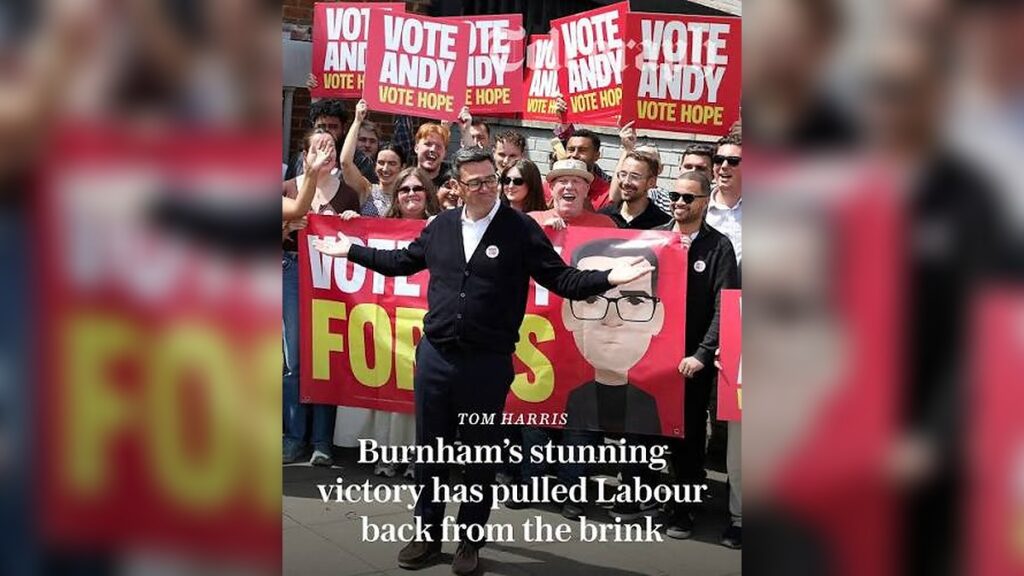
Andy Burnham’s arrival as prime minister has injected fresh optimism into Labour, with opinion polls and a decisive victory in the Greater Manchester mayoral by-election suggesting the party has regained some political momentum.
However, while Labour has climbed back to the top of national polling, analysts warn that the party remains far from securing the commanding position it would need to comfortably win the next general election.
Labour Enjoys a Noticeable Rise in Support
Since Burnham entered Downing Street nearly two weeks ago, Labour’s polling numbers have improved significantly.
The party is now averaging support in the mid-20% range, its strongest position since early last year.
The recovery follows a difficult period under Sir Keir Starmer, whose resignation came after Labour’s support slipped to just 19%—the lowest level inherited by any incoming mid-term prime minister in recent British political history.
Although the improvement is encouraging, Labour still trails well behind the 35% vote share it achieved during the 2024 general election, highlighting the scale of the work still ahead.
A Familiar Pattern After a Leadership Change
Political history suggests that a surge in support following the arrival of a new prime minister is far from unusual.
Previous leadership transitions have produced similar effects, including Gordon Brown’s boost after succeeding Tony Blair in 2007 and Boris Johnson’s jump in popularity when he replaced Theresa May in 2019.
The only notable exception in recent years came during Liz Truss’ brief premiership, when national events surrounding Queen Elizabeth II’s death overshadowed any potential political honeymoon.
Against that backdrop, Burnham’s early improvement was widely expected given the low point from which Labour was starting.
Greater Manchester Result Reinforces Positive Momentum
Labour’s confidence received another lift after Thursday’s Greater Manchester mayoral by-election delivered a convincing victory for the party.
Although Labour secured 47% of first-preference votes—below the 63% Burnham achieved in the previous mayoral election—the result represented a dramatic improvement compared with the party’s disappointing local election performance in May.
The vote share almost doubled Labour’s regional local election result earlier this year and even exceeded its performance in the 2024 general election, suggesting Burnham’s leadership may already be strengthening the party’s appeal beyond what national polls alone indicate.
Reform UK’s Problems Have Also Helped Labour
Labour’s return to first place in national surveys has not been driven solely by renewed enthusiasm for Burnham.




Reform UK has experienced its own political setbacks after facing scrutiny over party funding and questions surrounding Nigel Farage’s financial declarations before entering Parliament.
Farage’s decision to resign as party leader temporarily and contest a by-election in his Clacton constituency appears to have had unintended consequences.
Reform’s polling slipped from around 27% before the announcement to approximately 24%, where it has remained in subsequent surveys.
The party’s leader has also seen his personal approval ratings weaken considerably during the same period.
Vote Splitting Adds to Reform’s Difficulties
Reform also underperformed in the Greater Manchester mayoral contest, recording a noticeable decline compared with its recent local election results.
One factor was the emergence of Rupert Lowe’s new political movement, Restore Britain, which attracted nearly 9% of the vote and even finished ahead of the Conservatives in the contest.
The split among right-leaning voters appears to have reduced Reform’s momentum at a crucial moment, making Labour’s return to the top of the polls easier than it might otherwise have been.
Greens and Liberal Democrats Lose Ground
Another important feature of Labour’s recovery has been its ability to reclaim support from parties that had benefited from dissatisfaction with Starmer’s leadership.
Both the Green Party and the Liberal Democrats have slipped by around two percentage points since Burnham secured the Labour leadership.
The Greens have been particularly affected.
Much of their recent growth had come from former Labour supporters, but that trend has begun to reverse following the leadership change.
The proportion of Labour’s 2024 voters who now say they would back the Greens has fallen sharply, while Labour has simultaneously increased the share of its previous supporters who say they would remain loyal to the party.
Conservatives Also Benefit From Reform’s Decline
Labour is not the only party gaining from Reform UK’s recent struggles.
The Conservatives have edged upward in the polls, reaching around 20% support—their strongest position for well over a year.
As Reform loses momentum, both Labour and the Conservatives appear to be recovering voters who had previously drifted toward Farage’s party.
This means Labour’s advantage over Reform remains relatively narrow despite the positive headlines surrounding Burnham’s first weeks in office.
Winning Back Core Voters Remains Labour’s Biggest Test
Despite the encouraging start, Labour’s biggest electoral challenge remains unresolved.
Many traditional working-class and pro-Brexit voters who once formed the backbone of Labour’s support now identify with Reform UK.
Rebuilding trust among those communities will be essential if Burnham hopes to transform his early popularity into long-term electoral success.
Ultimately, polling gains and by-election victories offer only an early indication of public sentiment.
Labour’s fortunes ahead of the 2029 general election will depend less on the initial “Burnham bounce” and more on whether voters believe the government is delivering meaningful progress on the issues that matter most.

