
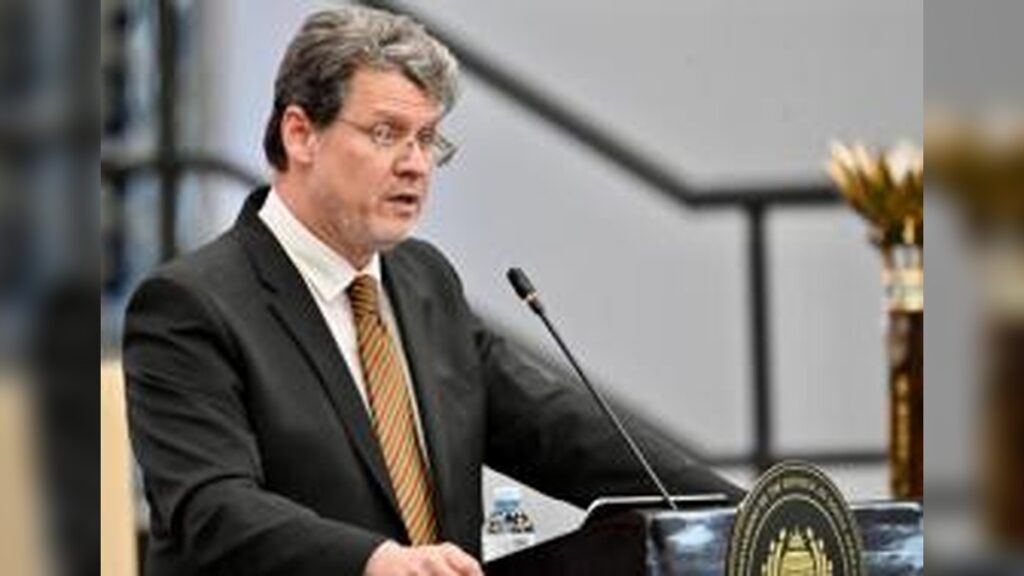
South Africans were urged to deepen their commitment to constitutional values and take an active role in strengthening democracy as the country marked three decades since the adoption of its founding legal framework.
The appeal came during a joint sitting of Parliament on Thursday, where officials reflected on the legacy, progress, and ongoing challenges of constitutional democracy under the theme “One Constitution.
One Nation. Reflect. Renew. Recommit.”
Constitution Celebrated as Product of Struggle and Sacrifice
Deputy Minister of Justice and Constitutional Development Andries Nel told lawmakers that the Constitution represents far more than a governing document, describing it as a living outcome of decades of political struggle against colonialism and apartheid.
He said it embodies the hopes of generations who fought for freedom, equality, and human dignity, arguing that its foundations were built on both historical resistance and collective aspiration.
Nel emphasised that the Constitution emerged from a long tradition of liberation-era policy frameworks, including early rights-based declarations and charters that shaped South Africa’s democratic vision.
Drafting Process Recalled by Constitutional Assembly Veteran
Reflecting on his role in the Constitutional Assembly between 1994 and 1996, Nel recalled the intense negotiations that led to the final adoption of the Constitution.
He pointed to the influence of key historical documents such as the ANC’s early Bill of Rights, the Africans’ Claims of 1943, the Women’s Charter of 1954, and the Freedom Charter of 1955, saying these texts helped anchor the values later embedded in the constitutional framework.
According to Nel, the final document represented a carefully constructed consensus aimed at building a unified and democratic society.
Constitution Defended as Tool for Transformation
Responding to critics who argue that the Constitution limits structural reform, Nel strongly rejected the claim, insisting instead that it is designed to enable transformation rather than block it.




He described it as a “revolutionary and transformative” instrument intended to dismantle inequality and promote a society grounded in human dignity, equality, and human rights.
Nel argued that constitutional principles provide the legal and moral foundation for ongoing social and economic change.
Progress Highlighted in Service Delivery and Governance
Looking back over 30 years of democracy, Nel acknowledged significant progress in expanding access to essential services across the country.
He cited improvements in housing provision, healthcare access, education systems, water and electricity supply, and social protection programmes.
He also pointed to strengthened democratic institutions and a more entrenched rule of law as key achievements since 1994.
Despite these gains, he stressed that development remains uneven and incomplete.
Persistent Challenges Undermine Constitutional Vision
Nel cautioned that South Africa continues to face deep structural problems that hinder the full realisation of the Constitution’s promise.
He listed poverty, unemployment, inequality, crime, corruption, and gender-based violence as major obstacles still affecting millions of citizens.
He also raised concerns about the exclusion of many young people from education, skills development, and job opportunities, warning that this trend threatens long-term national stability and growth.
Global Democratic Pressures Raise Concern
Beyond domestic issues, Nel warned that democratic values are increasingly under strain worldwide, with growing challenges to inclusion, institutional independence, and the rule of law.
He said South Africa must remain vigilant in protecting its democratic gains, noting that constitutional systems can weaken if citizens become disengaged or complacent.
Call for Civic Engagement and Constitutional Renewal
Closing his address, Nel urged South Africans to actively participate in safeguarding democracy and ensuring the Constitution remains a living framework for national development.
He stressed that constitutional democracy should not be taken for granted, but continuously protected and strengthened through civic participation and accountability.
As the country reflects on 30 years of constitutional rule, the message from Parliament was clear: the next chapter of democracy depends not only on institutions, but on the sustained engagement of its people.

