
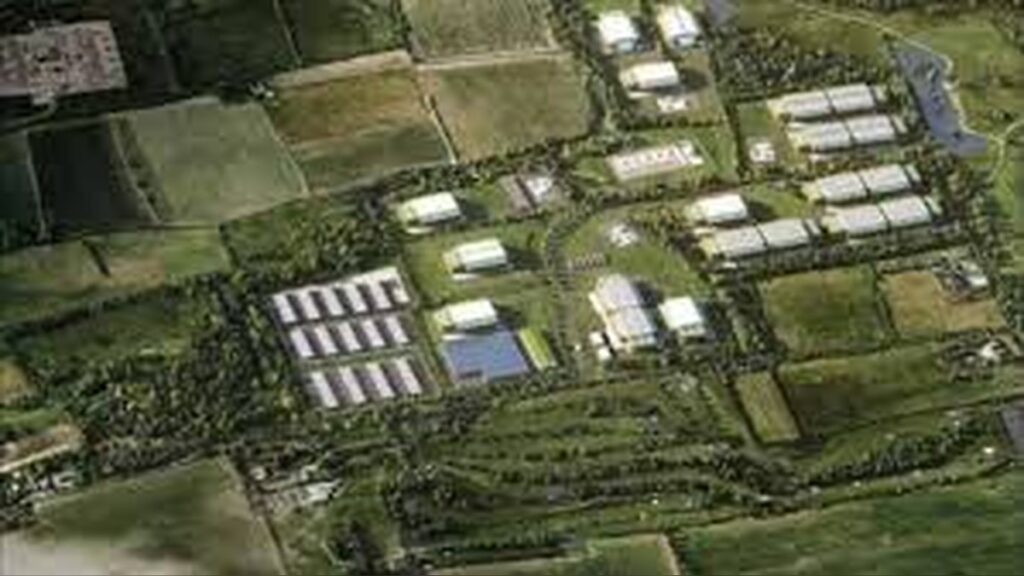
North Ockendon, a settlement with roots stretching back to the Bronze Age, is at the centre of a growing planning controversy as proposals emerge for what could become Europe’s largest data centre.
Despite its location on the edge of London, the area has long retained a quiet, rural character that residents say is increasingly under threat from large-scale infrastructure development linked to the UK’s expanding artificial intelligence sector.
The proposed “East Havering Data Centre” is part of a wider wave of around 175 new facilities planned across Britain, as government policy accelerates investment in AI and cloud computing infrastructure.
The UK already hosts roughly 500 operational data centres, with London forming the densest cluster.
However, the scale of the North Ockendon scheme — estimated at around 600MW and covering approximately 500 acres of green belt farmland — has triggered strong opposition from locals who fear irreversible change.
Noise Fears and Industrial-Scale Development Concerns
One of the most significant concerns raised by residents relates to noise pollution, particularly from construction activity and potential long-term operational hum.
Campaigners point to examples from similar developments in the United States, where communities living near data centre clusters have reported a continuous low-frequency noise linked to cooling systems and gas-powered backup generators.
Although the East Havering project is expected to connect to a substation in nearby Warley, opponents fear that temporary or auxiliary gas turbine systems could still generate a persistent mechanical sound capable of disrupting the surrounding countryside.
Local residents argue that the area’s current tranquillity — marked by birdsong and open farmland — could be replaced by industrial-level noise and infrastructure.
Lifelong Residents Say Rural Identity Is at Risk
Among those most vocal is Daniel Stock, 52, who operates Top Meadow Golf Course, a business built on land that was previously a poultry farm.
Having lived in North Ockendon his entire life, Stock says the landscape that supports local leisure and hospitality is under increasing pressure from multiple developments, including solar farms and major transport projects.
He warned that the proposed data centre would further erode the rural environment that attracts visitors to the area, particularly golfers, wedding guests, and diners seeking open countryside views.
Stock also questioned whether green belt land — traditionally protected from major construction — should be repurposed for industrial-scale digital infrastructure.
Conservation Alarm Over Wildlife and Habitat Loss
Nearby landowner Danny Leach, 58, who has lived adjacent to the proposed site for more than two decades, has also raised concerns about environmental impact.




He claims the area supports dozens of bird species, including peregrine falcons, barn owls, red kites, and kingfishers, alongside other wildlife such as foxes and amphibians.
Leach argues that ecological surveys carried out for the development have underestimated the existing natural quietness of the area, saying recorded background noise levels do not reflect true conditions.
He also fears that large-scale clearance of hedgerows and mature trees — some over a century old — would permanently alter the landscape, replacing farmland and habitat with high-security infrastructure.
Plans reportedly include perimeter fencing reaching up to 21 metres in height, which critics say would create an industrial appearance inconsistent with the surrounding countryside.
Long-Term Residents Say Quality of Life Would Be Transformed
Emma Edmonds, 68, who has lived in the village for 50 years and is a grandmother and great-grandmother, has become one of the most prominent opponents of the scheme.
After learning of the proposal, she placed a handwritten “No to data centre” sign outside her home and says she has researched the issue extensively since.
She described concerns about constant mechanical noise based on videos of similar facilities abroad, arguing that residents could face sleepless nights if similar conditions occur locally.
Edmonds also expressed unease about the broader role of artificial intelligence in society, saying she believes increased reliance on the technology could have negative social consequences, particularly for younger generations.
Scale of the Development and Official Support
Developer Digital Reef is behind the proposal, which would convert around 540 acres of farmland into a mixed-use digital infrastructure zone.
The scheme includes plans for approximately 84 acres of data centre buildings, alongside a large ecological park covering roughly 280 acres, with public access routes and cycling paths.
In total, the facility could span more than 400,000 square metres of operational space, alongside battery storage, renewable energy systems, horticulture facilities, and educational zones.
Construction is expected to take around four years — significantly longer than typical data centre builds, which often range between 19 and 30 months.
Despite opposition, Havering Council has backed the proposal through a Local Development Order, which streamlines planning approval.
The authority has highlighted potential benefits including thousands of jobs and an estimated £13.5 million in annual revenue.
Officials also argue that the ecological park component could provide public green space and environmental mitigation.
National AI Push Meets Local Resistance
The controversy in North Ockendon comes as the UK government continues to position artificial intelligence as a key driver of economic growth, with plans for designated AI “growth zones” intended to accelerate infrastructure development.
Data centres have been classified as critical national infrastructure, reflecting their importance in supporting digital services and cloud computing demand.
However, growing concerns have emerged nationally over the environmental footprint of such facilities, particularly their energy and water consumption.
Some designs propose using waste heat for local heating systems or agricultural projects, such as indoor farming.
Despite these proposals, residents in North Ockendon say they fear the loss of countryside character is irreversible, warning that the area risks being transformed into an industrial hub rather than a rural community on London’s fringe.

