
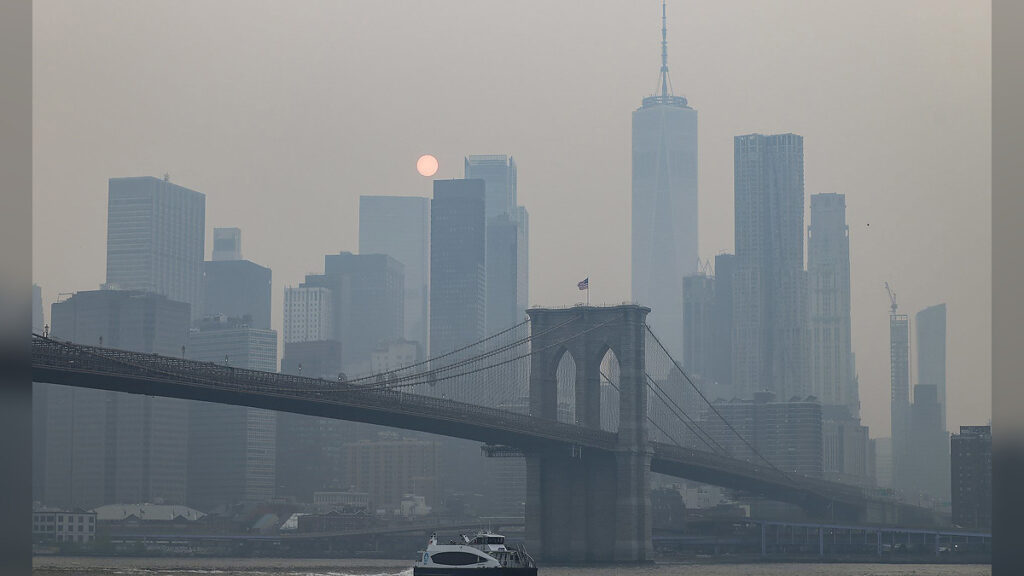
Massive wildfires burning across Canada have triggered a cross-border air quality emergency, sending dense smoke into several major US cities and leaving millions of residents under health advisories.
Fueled by extreme heat and powerful winds, the smoke has created hazy skies, dramatically reduced visibility, and raised concerns over prolonged exposure to hazardous air pollution.
More than 850 active wildfires were reported across Canada on Thursday, forcing evacuations in several communities, including areas near Lake Superior in Ontario.
As firefighters battled the blazes, smoke traveled hundreds of miles southward, affecting large portions of the eastern and Midwestern United States.
Satellite Imagery Tracks the Smoke’s Journey
New satellite graphics released by the National Oceanic and Atmospheric Administration (NOAA) illustrated the scale of the event, showing thick plumes of smoke drifting across eastern Canada and into the northeastern United States.
The imagery highlighted the role of the jet stream, a fast-moving air current in the upper atmosphere, which carried smoke across international borders.
Combined with high temperatures and strong winds, the atmospheric conditions allowed the smoke to spread rapidly across multiple states, creating widespread unhealthy air conditions.
New York Among Hardest-Hit Cities
New York City awoke to an eerie orange haze as smoke blanketed the skyline while a heatwave intensified discomfort for residents.
Air quality deteriorated to “very unhealthy” levels, prompting officials to urge people to limit outdoor activities and avoid breathing the smoky air whenever possible.
Photographs captured commuters moving through smoke-filled streets, while basketball players continued outdoor games beneath orange-tinted skies.
Many residents opted to wear N95 masks after public health officials warned that even healthy individuals could experience breathing difficulties or other adverse health effects.
Midwest Cities Experience Dangerous Pollution Levels
The smoke also severely affected cities throughout the Midwest.



Detroit briefly recorded a US Air Quality Index (AQI) of 566, making it the most polluted major city in the world at the time of the measurement.
Residents described conditions as resembling an inescapable bonfire, with smoke reportedly infiltrating homes and buildings.
Minneapolis followed with an AQI of 289, while Chicago registered 259, both falling into the “very unhealthy” category where prolonged exposure poses health risks for everyone, not only vulnerable groups.
Satellite imagery showed large smoke plumes lingering over Minnesota, Michigan, and the Great Lakes region as winds continued pushing pollution farther south.
States Issue Air Quality Alerts
Authorities across several states responded by issuing widespread air quality warnings.
Michigan declared a statewide air quality alert as smoke spread from the Upper Peninsula toward southern parts of the state.
In Minnesota, pollution officials reported that smoke concentrations in the Twin Cities exceeded previous hourly records, with traces of ash also detected.
Illinois issued a Red Air Pollution Action Day for Rockford and the Chicago metropolitan region, while Pennsylvania activated a statewide Code Red alert after smoke from Ontario and Minnesota drifted south across the state.
Atmospheric chemist Emily Fischer of Colorado State University described the event as “basically a river of smoke pouring into the Midwest,” underscoring the scale of the atmospheric transport.
Why Wildfire Smoke Is Especially Hazardous
Experts warn that wildfire smoke poses greater health risks than typical urban pollution because it often contains microscopic particles released when homes, vehicles, plastics, metals, and other manufactured materials burn.
These particles can penetrate deep into the lungs and remain suspended in the atmosphere for extended periods, increasing the likelihood of respiratory problems and other health complications.
Depending on weather conditions, smoke from major wildfires can linger over affected regions for days or even weeks.
Canadian Fire Crews Continue Relentless Battle
Emergency crews across Canada remain engaged in an ongoing effort to contain the hundreds of active fires, with extreme temperatures making firefighting operations increasingly difficult.
Randy Schroeder, a fire chief in Alberta, said the combination of persistent heat and wildfire activity has created unusually challenging conditions.
He noted that today’s fires grow larger and burn for much longer than they typically did under similar conditions in previous years, highlighting the growing intensity of Canada’s wildfire seasons.
Outlook
Meteorologists continue to monitor shifting wind patterns that will determine where smoke travels next.
Until weather conditions improve or more fires are contained, millions of people across Canada and the United States could continue experiencing poor air quality, with health officials advising residents to stay informed, reduce outdoor exposure, and follow local air quality alerts.
