
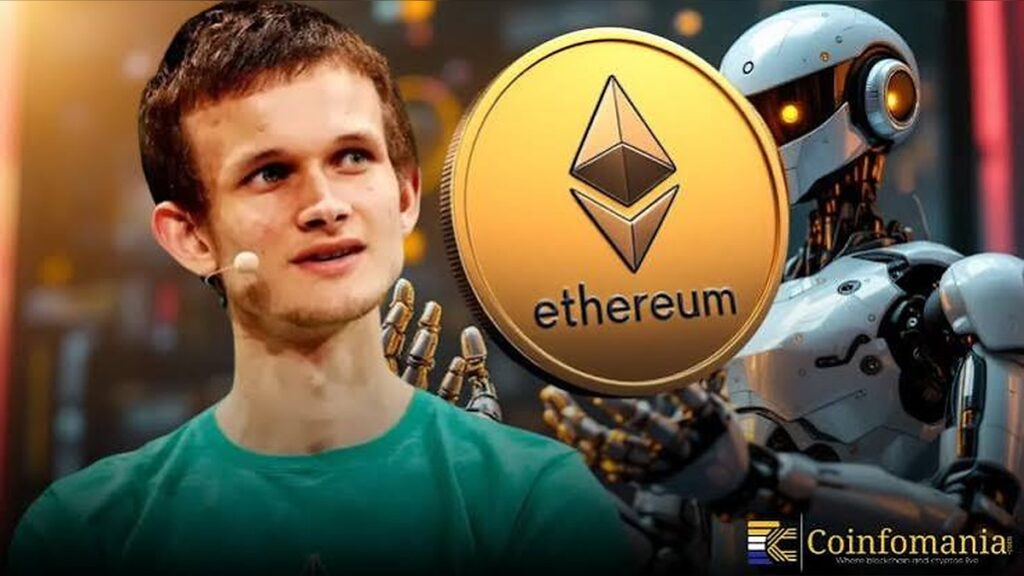
Ethereum co-founder Vitalik Buterin has acknowledged that an AI-powered investigation successfully uncovered his authorship of an anonymously published Ethereum proposal, highlighting the growing ability of artificial intelligence to identify writers despite efforts to conceal their identity.
The successful analysis was carried out by Franklyn Wang, CEO of Co-Invest, whose submission correctly linked Buterin to an anonymous rewrite of Ethereum Improvement Proposal (EIP) 7503.
The result comes just weeks after Buterin challenged the crypto community to determine whether modern AI systems were capable of breaking online anonymity.
A Challenge Designed to Test AI’s Limits
On June 22, Buterin publicly launched an experiment inspired by recent research suggesting that large language models could make anonymous online writing increasingly difficult.
He revealed that, sometime during the past decade, he had anonymously published a document related to Ethereum under a different identity and invited researchers and developers to discover which one it was.
The exercise was intended to test whether AI could identify an author even when traditional writing patterns had been deliberately disguised.
Reasoning, Not Vocabulary, Gave Away the Author
Franklyn Wang later revealed that his AI-assisted analysis identified Buterin as the most likely author of an anonymous December 2024 rewrite of EIP-7503.
According to Wang, the breakthrough did not come from recognizing specific words or writing style.
Instead, the system focused on the author’s distinctive way of explaining technical concepts, mathematical reasoning and algorithms.
He noted that while the wording had been altered, the underlying thought process remained consistent enough for AI to recognize.




Buterin Reveals His Effort to Hide His Identity
After confirming Wang’s findings, Buterin explained the lengths he had taken to disguise his work.
He said the proposal had first been written in Chinese before being translated into English using Qwen 2.5. He then manually edited the translated text in an effort to eliminate obvious stylistic clues that could reveal his identity.
Despite those precautions, the AI system still detected recurring intellectual patterns rather than relying on linguistic similarities alone.
Buterin acknowledged that his attempt had focused primarily on masking prose, while the successful analysis centered on how he structured explanations and solved technical problems.
Research Has Warned That AI Could Threaten Online Anonymity
The experiment echoes conclusions from a February study conducted by researchers from ETH Zurich and Anthropic.
Their research argued that modern large language models can identify pseudonymous internet users at a scale previously considered impractical.
By extracting identity-related signals from unstructured text, comparing them with known writing samples and reasoning through possible matches, AI systems were found to outperform many traditional deanonymization techniques.
Buterin’s challenge provided an opportunity to see whether those academic findings could be replicated in a real-world blockchain setting.
Anonymous Contributions Have Long Shaped Cryptocurrency
Privacy and pseudonymity have played an important role throughout cryptocurrency’s history.
The most famous example remains Bitcoin creator Satoshi Nakamoto, whose true identity has never been confirmed despite years of speculation and investigation.
If AI continues improving its ability to identify authors through reasoning patterns rather than simple writing style, anonymous contributions to open-source blockchain projects could become significantly more difficult to maintain.
Earlier Attempt to Identify Satoshi Fell Short
Vladimir Novakovski, CEO of Lighter, revealed that he had previously collaborated with Wang on a separate project in 2023 that attempted to identify Satoshi Nakamoto using GPT-4.
That effort compared cryptography research papers and writing samples in search of stylistic similarities but failed to produce any high-confidence conclusions about Bitcoin’s creator.
Novakovski said Wang later adapted a similar analytical approach for Buterin’s public anonymity challenge, ultimately achieving a successful result.
AI Raises New Questions About Digital Privacy
The outcome of Buterin’s experiment illustrates how advances in artificial intelligence are expanding beyond language generation into sophisticated authorship analysis.
While developers continue exploring AI’s potential across software development and blockchain technology, the experiment also raises broader concerns about whether technical contributors, researchers and open-source developers will be able to remain anonymous in an era where reasoning patterns may become as identifiable as fingerprints.

