
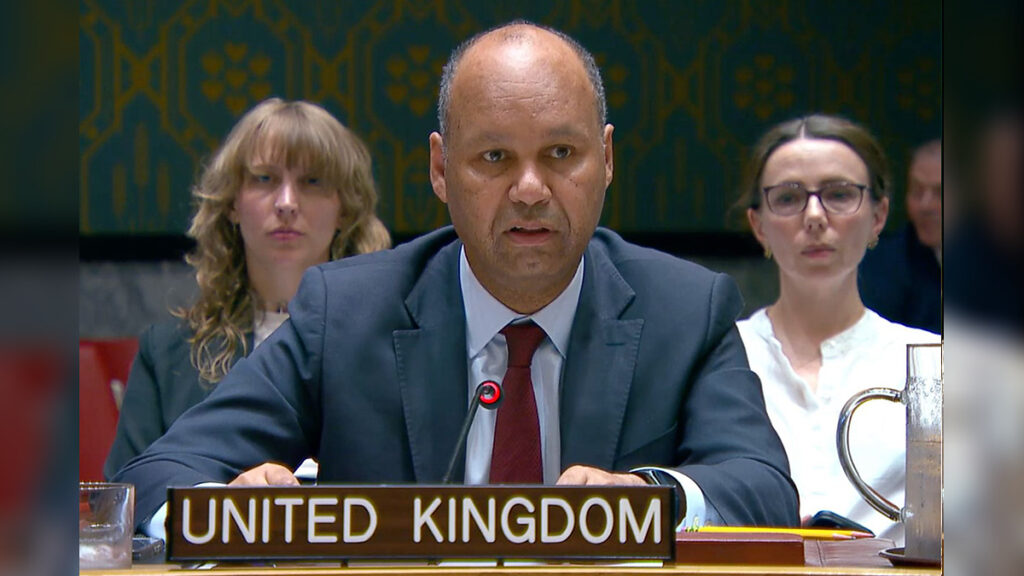
At a recent United Nations Security Council session on Ukraine, the United Kingdom delivered a blunt assessment of Russia’s conduct in the ongoing war.
Speaking through Ambassador James Kariuki, the UK Chargé d’Affaires, London argued that Moscow is leaning more heavily on escalation, intimidation, and civilian harm as its battlefield position weakens.
The meeting itself was convened after Russia requested discussion over an alleged incident in occupied Luhansk.
However, UN briefers noted they were unable to independently verify what happened because Russia continues to block access to territories it occupies in Ukraine.
A Sharp Contrast Between Claims and Actions
Just one day after pushing for the Council meeting, Russia carried out one of its most intense aerial assaults on Kyiv since the full-scale invasion began.
According to the UK statement, the strikes damaged a wide range of civilian infrastructure, including homes, schools, emergency services, government buildings, and cultural sites.
The UK emphasized that these are not just symbolic losses.
They are essential parts of daily life, sustaining communities and providing basic services.
When they are hit, ordinary people are the ones who suffer most.
Rising Civilian Toll and Intensifying Attacks
The UK delegation also highlighted a troubling escalation in casualties.
Reports presented at the Council suggested that nearly 200 civilians were killed and more than 1,500 injured in Ukraine within a single month.
May, they warned, is shaping up to be the deadliest month for civilians since the early phase of the war.
The statement painted a picture of a conflict where violence against civilians is not declining but accelerating, despite repeated international calls for restraint and negotiation.
Oreshnik Missile Use Raises Alarm
Another major concern raised was Russia’s reported deployment of the Oreshnik missile system for the third time, and for the first time in the Kyiv region.
The UK described this as especially alarming because the system is nuclear-capable and its use in densely populated areas is seen as reckless and dangerous.




Diplomatic sites were also reportedly affected, including UN-related facilities and a residential building housing the Albanian Ambassador.
Following these strikes, Russia allegedly issued warnings urging diplomats to leave Kyiv, suggesting more attacks could follow.
Accusations of Victimhood and Battlefield Weakness
The UK sharply criticized what it described as Russia’s dual messaging.
On one hand, Moscow portrays itself as responding to threats; on the other, it conducts large-scale attacks on civilian areas and then raises concerns in international forums.
Ambassador Kariuki argued that this behavior reflects weakness rather than strength, suggesting that Russia is increasingly reliant on escalation because it is struggling on the battlefield.
The UK also cited intelligence estimates claiming that nearly half a million Russian soldiers have been killed since the start of the war, while Ukraine continues to resist.
Ceasefire Calls and Diplomatic Stalemate
Members of the Security Council reiterated support for peace efforts, but the UK stressed that meaningful progress is impossible while attacks on civilians continue.
The statement echoed the UN Secretary-General’s call for an immediate and comprehensive ceasefire as the only viable path forward.
However, there was little indication that positions are shifting.
The underlying diplomatic divide remains wide, with continued disagreement over responsibility, security guarantees, and the conditions for any peace process.
Impact and Consequences
The immediate impact of the latest escalation is a worsening humanitarian situation inside Ukraine.
Civilian casualties continue to rise, and repeated strikes on infrastructure are placing additional pressure on already strained emergency services and public utilities.
Diplomatically, the accusations at the UN further deepen tensions between Russia and Western states, making consensus at the Security Council even harder to achieve.
The reported strikes near diplomatic sites also raise concerns about the safety of foreign missions operating in Kyiv.
Militarily, the UK framing suggests a shift toward intensified long-range strikes, which could signal a new phase of the conflict focused less on territorial gains and more on pressure through destruction.
What’s Next?
Attention now turns to whether international partners can agree on stronger diplomatic or economic measures in response to the escalation.
Calls for a ceasefire are expected to continue, but enforcement remains the key challenge.
On the ground, Ukraine is likely to reinforce air defenses around major cities and diplomatic zones, especially after repeated strikes on Kyiv.
Meanwhile, UN discussions are expected to continue, though progress toward a binding resolution remains uncertain.
The broader question is whether escalation will force negotiations—or further entrench both sides in a prolonged conflict with rising civilian costs.
Summary
The UK’s statement at the UN Security Council paints a picture of a war entering an increasingly dangerous phase.
It argues that Russia is responding to setbacks by intensifying attacks on civilian areas, while diplomatic channels remain largely stuck.
Despite repeated international calls for peace, the situation on the ground continues to deteriorate, with rising casualties, expanded missile use, and growing risks to civilians and diplomatic infrastructure.
Bulleted Takeaways
- The UK says Russia escalated attacks immediately after requesting a UN meeting on Ukraine
- One of the largest recent strikes on Kyiv caused widespread civilian infrastructure damage
- Nearly 200 civilians reportedly killed and over 1,500 injured in a single month
- UK raised alarm over reported use of the Oreshnik nuclear-capable missile in Kyiv region
- Diplomatic sites, including UN-linked facilities, were reportedly affected
- UK claims Russia is masking battlefield weakness with intensified attacks
- Estimated Russian military losses cited at nearly 500,000 soldiers (according to intelligence reports)
- UN members continue to call for an immediate and comprehensive ceasefire
- Diplomatic deadlock persists with no clear path to peace agreement yet

