
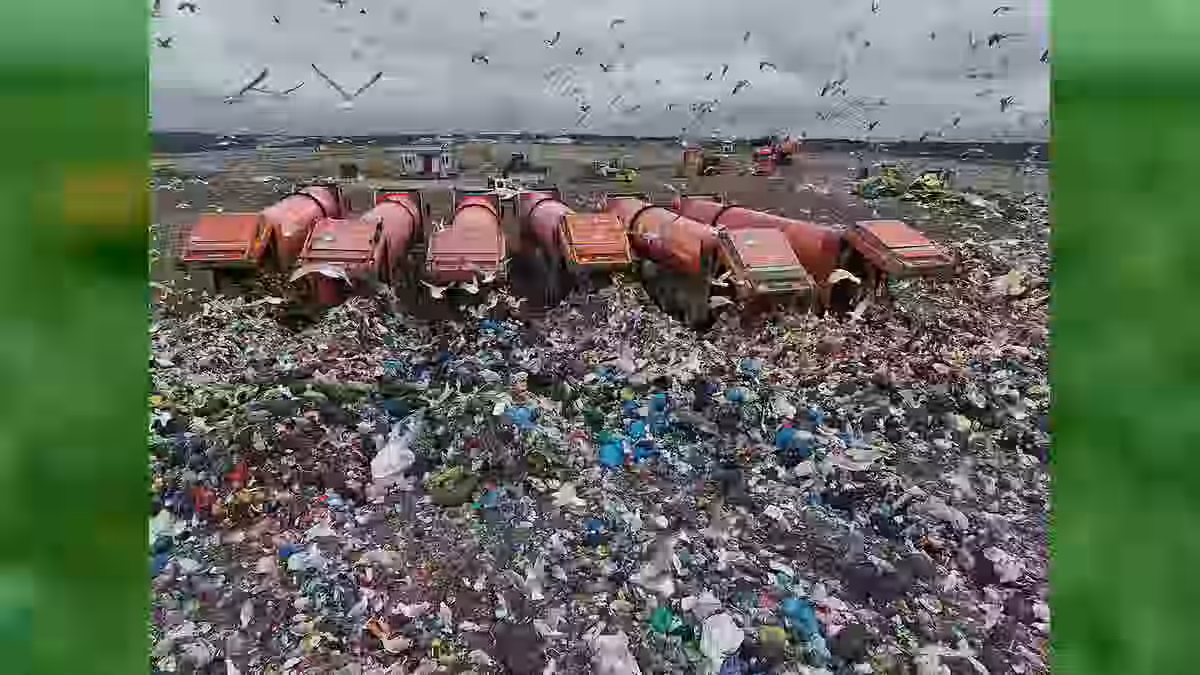
Turkey is facing growing scrutiny over methane emissions from its waste disposal sites, with satellite observations identifying several major sources of the greenhouse gas ahead of the COP31 climate summit in Antalya.
In the countryside west of Istanbul, household waste from the city of approximately 16 million people is transported by trucks to a large landfill, where decomposing rubbish produces gas that is collected and used to generate electricity.
However, satellite monitoring has detected significant quantities of methane escaping from the site despite the existing collection infrastructure.
Turkey will host COP31 from November 9 to 20, with methane reduction among the priorities for the international climate discussions.
Methane is the second-largest contributor to climate change after carbon dioxide. It is more than 80 times as potent as carbon dioxide over its first 20 years in the atmosphere, making reductions in its emissions important for slowing near-term global warming.
Turkey Ranks Among the World’s Largest Waste Methane Emitters
According to emissions data from non-profit tracker Climate TRACE, Turkey is the world’s fifth-largest emitter of methane from solid waste, behind China, the United States, Russia and Brazil.
Researchers at the University of California, Los Angeles (UCLA), analysed satellite observations and identified 70 methane plumes across Turkey’s 10 highest-emitting waste disposal sites.
The detected emission rates ranged from an average of 841 kilogrammes to 7.4 tonnes per hour.
Three of the major emitting locations were around Istanbul, while others were identified near Ankara, Izmir and Antalya, the city hosting COP31.
The findings indicate that the presence of gas collection systems at major municipal landfills has not prevented substantial methane releases.
Istanbul Landfill Records Persistent High Emissions
The UCLA analysis identified the Seymen landfill, west of Istanbul, as one of the country’s largest methane sources.
Using publicly available Carbon Mapper data collected by the Tanager-1 satellite between January 2025 and the end of May 2026, researchers calculated an average detected emission rate of approximately 7.4 tonnes per hour at the site.
That figure placed the landfill just below the highest-emitting landfill on a global list compiled for 2025.
Tia Scarpelli, waste sector lead at emissions-monitoring organisation Carbon Mapper, said the size and consistency of the emissions stood out.
“What stands out is how big its emissions are and how persistently large they are,” she said.
Scarpelli said Turkey could achieve substantial reductions by concentrating on its biggest emitting landfills, improving gas collection systems and repairing damaged landfill covers and faulty gas wells.
She also identified the diversion of organic waste away from landfills as an important measure for reducing methane production.



Turkish Authorities Dispute Satellite Findings
Turkey’s environment ministry questioned the use of the satellite observations to assess annual methane emissions at the Seymen landfill.
In response to questions, the ministry said the measurements were not continuous and therefore could not establish the site’s annual emissions.
It highlighted the government’s Zero Waste Initiative, which aims to increase recycling and reduce the amount of waste sent to landfills.
According to the ministry, Turkey’s national waste recovery rate increased from 13% in 2017 to 37.53% in 2025.
The ministry also said the landfill operator, Istac, had an economic incentive to capture methane efficiently because the collected gas is used to generate electricity.
Landfill Generates Electricity From Decomposing Waste
At Seymen, Istac collects gas produced as organic materials break down beneath the landfill surface. An energy company then burns the captured gas to generate electricity at a facility that began operating in 2020.
A 2025 report by energy news website Enerji Gunlugu put the plant’s monthly electricity production at approximately 22,000 megawatt-hours.
Istac official Aysen Erdincler disputed whether the satellite readings accurately represented the landfill’s usual emissions, saying methane releases generally ranged between four and six tonnes per hour.
She said a satellite measurement of 12 tonnes per hour recorded on one day had increased the calculated average.
Istac head Fatih Ugur explained that approximately 30 hectares of the landfill had been left uncovered on the day of that measurement while workers carried out repairs to methane collection pipes.
He also attributed the higher methane concentration to low atmospheric pressure.
The landfill receives approximately 8,500 tonnes of household waste daily. Istanbul generates an average of around 20,000 tonnes of household waste each day, according to Istac.
Researchers have not established how much of the methane produced at Seymen is captured by the collection system. Erdincler said leaks at the facility were generally around 25%.
Turkey Has Not Joined Global Methane Pledge
Methane emissions from Turkey’s waste sector increased by nearly 25% in the decade leading up to 2024, according to World Bank data based on the European Commission’s EDGAR emissions database.
The global increase over the same period was approximately 6.5%.
Turkey’s annual waste-sector emissions have remained at around 21 million tonnes of carbon dioxide equivalent since 2020.
The Global Methane Pledge (GMP) was launched at COP26 in 2021, with participating countries committing to work towards a collective reduction of at least 30% in methane emissions from 2020 levels by 2030.
More than 30 countries subsequently supported national methane reduction targets, but Turkey is not listed among the pledge’s participants.
COP31 Could Provide Opportunity for Methane Commitments
Selim Yildirim, chief climate policy researcher at Ankara-based non-profit policy and media platform D84, said Turkey had more developed waste disposal infrastructure than poorer countries but lagged behind much of Europe in waste management, recycling and recovering value from discarded materials.
He said Turkey could still join the Global Methane Pledge during COP31, although membership alone would not guarantee emissions reductions.
“The issue is whether you can effectively turn it into action and implement it,” Yildirim said.
He added that regulations would be needed to require landfill operators to capture and reuse methane.
Residents Complain About Landfill Odours
People living near the Seymen landfill have also raised concerns about unpleasant smells coming from the waste disposal site.
Although methane itself has no smell, decomposing organic waste releases other compounds that can produce strong odours.
Soner Duz, a 46-year-old barber who lives approximately five kilometres from the landfill, said the smell becomes particularly noticeable during the summer when residents leave their windows open to cope with the heat.
“Around four or five in the morning, the smell suddenly comes,” he said. “It wakes you up.”
