
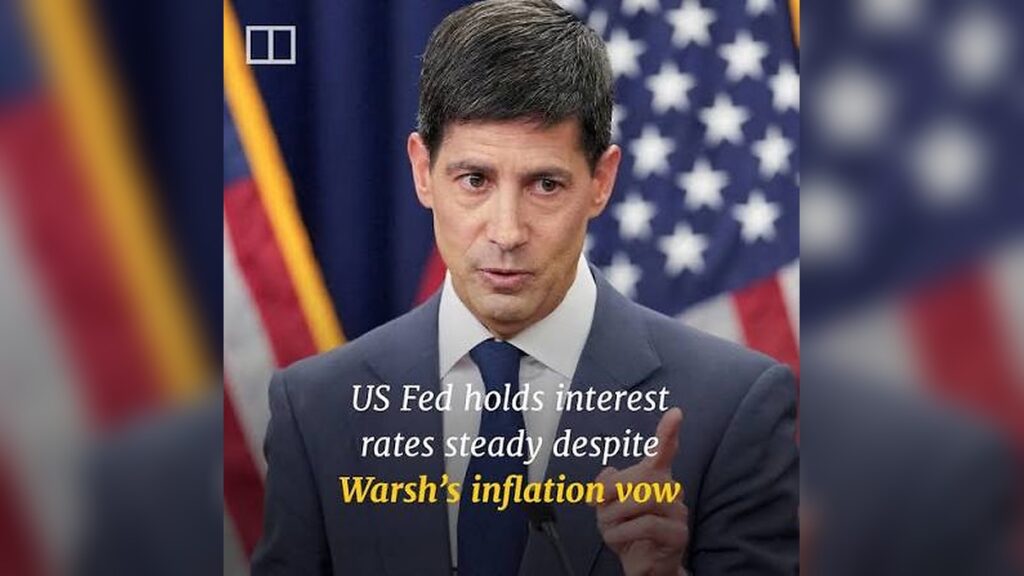
The Federal Reserve’s latest decision to leave interest rates unchanged has done little to settle the growing debate over inflation in the United States.
While policymakers agreed to keep borrowing costs where they are, a rare split among committee members highlighted deep disagreements over whether inflation is easing quickly enough.
Fed Chair Kevin Warsh reaffirmed the central bank’s commitment to bringing inflation back toward its long-term goal, insisting there would be “no soft inflation target” despite mounting uncertainty over the economic outlook.
Conflicting Inflation Numbers Fuel Uncertainty
One of the biggest challenges facing policymakers is that multiple inflation measures are painting different pictures of the economy.
The Fed’s preferred inflation gauge showed prices rising 3.7% annually in June, down from 4.1% the previous month but still well above the central bank’s 2% objective.
Other widely used indicators, however, produced lower or higher readings depending on which categories of spending were included or excluded.
The differing figures have sparked renewed debate over which measurement most accurately reflects the true state of inflation in the U.S. economy.
Measuring Inflation Is More Complex Than It Appears
Although inflation is commonly described as the rate at which prices increase, economists use different methods to calculate it.
Government statisticians evaluate thousands of products and services while adjusting for changes in quality, consumer buying habits and housing costs.




These calculations can produce noticeably different outcomes even when analyzing the same economy over the same period.
For example, some indexes remove volatile food and energy prices, while others eliminate unusually large price swings altogether to better identify long-term inflation trends.
Why Everyday Experience Doesn’t Match Official Data
Many Americans continue to feel squeezed by rising living costs even when official inflation figures show improvement.
Economists note that inflation measures how quickly prices are changing—not whether prices themselves are falling.
As a result, groceries, gasoline and housing remain significantly more expensive than they were just a few years ago, even if inflation has slowed.
The gap between official statistics and household experiences has contributed to public skepticism about claims that inflation is coming under control.
Fed Reviews How Inflation Should Be Measured
While the Federal Reserve has no plans to abandon its long-standing 2% inflation target, officials are reviewing whether current measurement methods remain the best guide for monetary policy.
Warsh has established groups to examine alternative ways of tracking inflation, with some economists suggesting policymakers should accept a broader range around the 2% target rather than treating it as a fixed number.
Supporters argue such flexibility would better reflect the limitations of inflation data, while critics warn it could weaken confidence in the Fed’s commitment to price stability.
Interest Rate Decisions Carry Wide-Ranging Consequences
The ongoing disagreement extends well beyond academic economics.
The inflation measure the Federal Reserve chooses to emphasize can directly influence interest rates, mortgage costs, business investment and consumer borrowing.
It also affects annual adjustments to Social Security benefits, tax brackets, wage negotiations and countless financial decisions made by businesses and households.
With borrowing costs already at their highest levels in nearly two decades, the outcome of the Fed’s review could shape economic policy and household finances for years to come.

